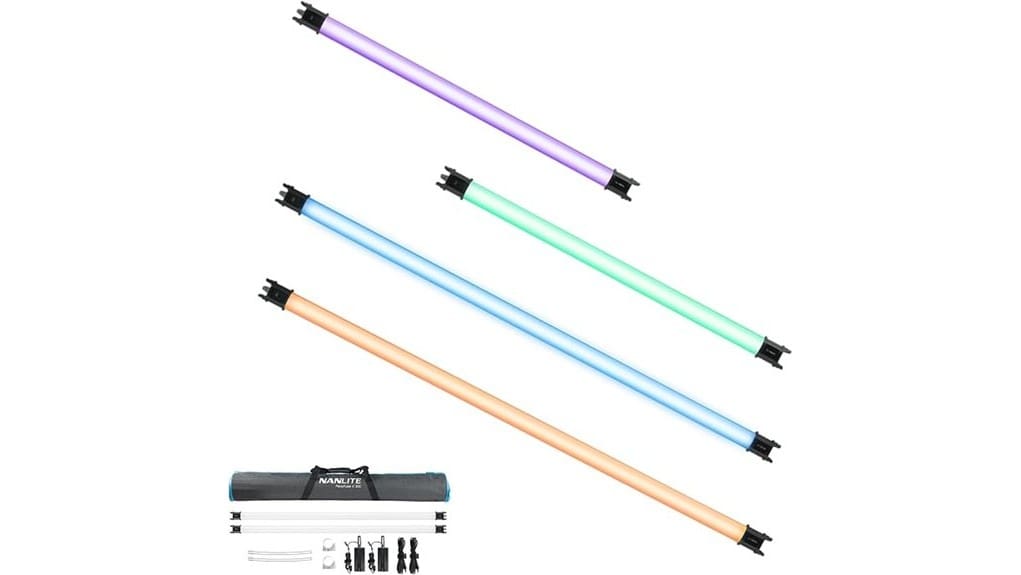
The NANLITE PavoTube II is a compact, battery-powered RGBWW tube that gives you predictable, color-accurate light and fast multi-tube syncing for run-and-gun shoots. It delivers about 2,850 lumens from the 30 cm model, CCT 2,700–6,500 K, strong CRI, and usable short-throw lux with smooth dimming. On-tube dials and effects make set changes swift. Expect ~2 hours at full power or continuous AC operation. Keep going to see detailed pros, cons, and runtime tips.
Some Key Takeaways
- Compact, battery-powered RGBWW wand delivering up to ~2,850 lumens from the 30 cm tube for short-throw key and fill lighting.
- Accurate CCT 2700–6500 K and strong color rendering, with RGB mode reproducing saturated hues faithfully.
- Intuitive on-tube controls, labeled dials, tactile buttons, scene recall, and wired/wireless sync for multi-tube rigs.
- Internal Li‑ion battery gives about two hours at full power, or continuous use via included AC adapter.
- Best for portable, repeatable run-and-gun setups; tradeoffs include limited full-power runtime and a premium price.
What the PavoTube II Is and Who It’s For
Think of the PavoTube II as a compact, handheld LED wand designed for photographers, videographers, and studio technicians who need portable, controllable light. You’ll find a rugged, battery-powered tube that delivers adjustable RGBWW output, on-tube controls, and sync capability for multi-tube rigs. You’ll use it for run-and-gun shoots, location interviews, and practical fills where space and setup time are limited. You’ll use it for run-and-gun shoots, location interviews, and practical fills where space and setup time are limited. It supports portable creativity and gives beginner filmmakers a predictable, repeatable toolset without complex ballast or stands. Functionally, it’s an integrated light source optimized for mobility, color control, and straightforward channeling into existing workflows. The PavoTube II is an ideal choice for photographers who want to brighten their photography with on-camera LED lights.
Real-World Light Output: Brightness, Color Temp, and RGB Performance
Although compact, the PavoTube II delivers surprisingly strong usable light: at its peak you’ll get roughly 2,850 lumens from the 30-cm tube, with smooth dimming down to 0% for fine exposure control. You’ll measure usable output in measured lux that’s sufficient for short-throw key and fill roles; expect falloff typical of a bare tube. Color temperature spans 2,700–6,500 K with stable output across the range, and color rendering stays high for practical work. RGB mode reproduces saturated hues accurately with controllable hue/saturation, though saturated colors trade intensity for fidelity compared to white-tuned outputs. These continuous LED tubes are ideal for photographers who want consistent, flicker-free illumination for both photo and video work with continuous LED lighting.
Controls, Effects, and How Easy It Is to Use on Set
When you pick up a PavoTube II, its control layout gets you operating quickly: on-tube dials and tactile buttons let you adjust brightness, color temperature, hue, and saturation without menu diving, and the labeled rotary knobs provide immediate, fine-grained control for dimming and color shifts. You’ll find intuitive controls across modes: preset CCT, full RGB, and a suite of creative effects like lightning, paparazzi, and pulse. Buttons let you store and recall scenes. On set ergonomics are solid—grippy tube, accessible switches, and sync ports for chaining. Workflow integration with wireless and wired sync keeps changes consistent across multiple tubes. These features make the PavoTube II a strong choice for photographers seeking LED light panels that balance portability and professional control.
Battery Life, Power Options, and Runtime Tips
Because the PavoTube II uses an internal Li‑ion pack, you can run it untethered for up to about two hours at full output, with runtime increasing as you dial down brightness or limit RGB effects. You’ll also run indefinitely via the included AC adapter for continuous studio use. For field reliability, follow battery maintenance: store at ~40–60% charge, avoid deep discharge, and keep firmware updated. Carry charged spares or a USB‑C power bank and use the sync cord to manage multiple tubes. Plan swaps and monitor output to achieve effective power redundancy on shoots without unexpected downtime. Consider pairing your tubes with an umbrella lighting kit to soften and shape light for more versatile results.
When to Buy the PavoTube II : Pros, Cons, and Comparable Alternatives
Think of the PavoTube II as a versatile tool that fits shooters who need a portable, color‑accurate light with full RGBWW control and easy synchronization across multiple units. You should buy it when you require accurate CCT tuning, solid max output (2,850 lm), integrated effects, and fast multi‑tube syncing for narrative or broadcast work. Pros: compact, intuitive onboard controls, battery or AC operation, expandable sync. Cons: limited runtime at full power, premium price versus budget alternatives, and potential questions about long term durability compared with heavier‑duty fixtures. Consider Quasar, Astera, or Kino Flo for alternatives depending on budget and robustness. Perfect for creators focused on improving their scenes with video light kits and portable lighting solutions.
Some Questions Answered
Can These Tubes Be Daisy-Chained for Power as Well as Sync?
No — you can’t power daisy chaining; the sync cord only carries control signals. You’ll sync multiple tubes for unified effects and settings using the included sync cable, but each tube requires its own power source or AC adapter because the cord has power daisy chaining limitations. For portable use you’ll rely on each unit’s internal battery (or individual adapters) while synchronization remains supported across linked units for hue, saturation, effects and dimming.
Are Replacement Batteries or Cells User-Replaceable?
No — the batteries aren’t user-replaceable; battery replacement requires opening sealed housings and voids the warranty. You’ll need authorized service for safe cell swap or full battery replacement, so plan for professional support. For longer field use, carry spare charged units or run from mains. This reflects limited user serviceability: you can perform external maintenance (mounts, adapters) but not internal battery servicing without manufacturer intervention.
Do They Support Wireless DMX Control Natively?
No — they don’t natively support wireless DMX. You’ll need a wireless integration bridge or DMX transmitter/receiver to control them remotely; the tubes accept wired sync and on-tube controls. You can use third-party wireless DMX gear or NanLite’s ecosystem if available, and you’ll want to check for remote firmware updates that add compatibility. Plan for a gateway device to translate wireless DMX into the tube’s supported control protocols.
What Mounting Accessories Are Compatible With Third-Party Rigs?
You can mount it to third-party rigs using cold shoe adapters, magic arm clamps, spigots and standard 1/4″-20 or 3/8″-16 threaded brackets. Use ball-head mounts, articulating magic arm clamps with 1/4″ or 3/8″ fittings, or quick-release spigot adapters for stands and cages. Clamp mounts for light bars and V-mount plates work too. Verify adapter thread size and weight rating match the tube to maintain secure, vibration-free mounting.
Is There an IP or Weather-Resistance Rating?
No, it doesn’t have an official waterproof rating or ingress protection certification. You shouldn’t assume water or dust resistance; the unit is designed for indoor/studio use and battery operation. If you’ll work in damp or outdoor environments, you’ll need additional protection like weatherproof housing, sealed bags, or custom enclosures. For reliable field use, consider lights with specified IP ratings or factory-rated weatherproof models to meet safety and durability requirements.