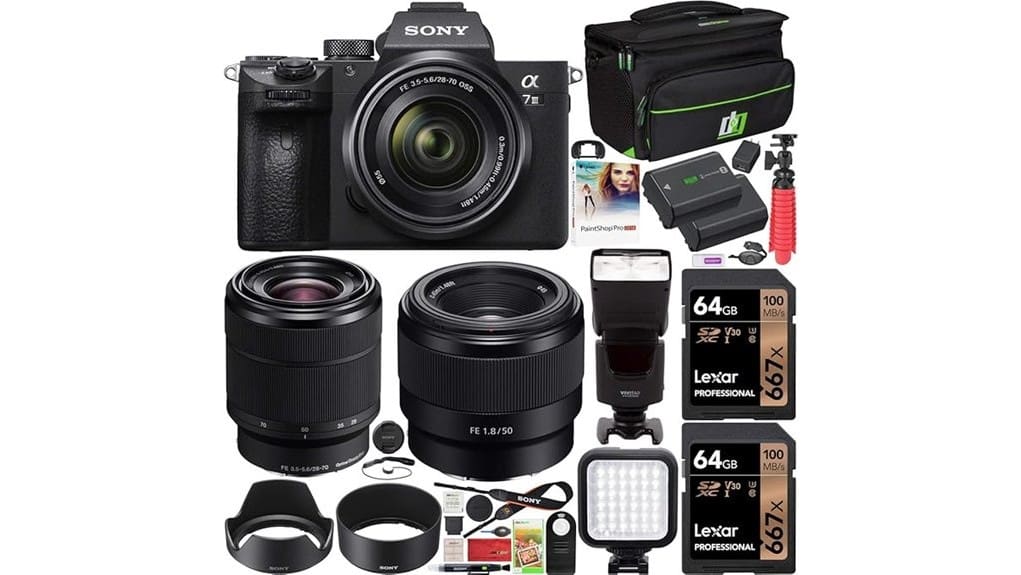
If you need a compact, pro-capable full‑frame kit, the Sony ILCE‑7M3K/A7 III 2‑lens bundle gives you 24.2MP stills, 4K full‑frame oversampled video, and class‑leading 5‑axis stabilization in a weather‑sealed body. Fast hybrid AF (693 phase points), 10 fps burst, dual card slots, and long NP‑FZ100 battery suit hybrid and travel shooters. The 28–70mm zoom favors coverage; the 50mm f/1.8 favors low‑light and bokeh. Keep going and you’ll find detailed comparisons and usage notes.
Some Key Takeaways
- Sony a7 III delivers 24.2MP full-frame image quality with ~15 stops dynamic range and 14-bit RAW fidelity.
- 4K full-frame video uses full-pixel readout with oversampling for detailed, low-moiré footage.
- Fast Hybrid AF covers ~93% of frame with 693 phase-detect points, Eye AF, and reliable 10 fps continuous shooting.
- Included FE 28–70mm zoom gives everyday versatility; FE 50mm f/1.8 prime offers superior low-light, bokeh, and sharpness.
- Robust handling, 5-axis stabilization (~5 stops), dual card slots, and long NP-FZ100 battery life suit hybrid and travel shooters.
Sony a7III 2‑Lens Kit at a Glance: Who This Bundle Is For
While the a7III 2‑Lens Kit serves a broad range of shooters, it’s particularly well suited for hybrid photographers who need high‑quality stills and 4K video in a single, portable system. You’ll appreciate the kit’s balance: a 50mm f/1.8 prime for controlled portrait lighting and a 28–70mm for general coverage. Compared to APS‑C kits, the full‑frame sensor and BIONZ X processor deliver wider dynamic range and cleaner high‑ISO performance. Travel portability is strong: mirrorless form, dual‑card slots, and included accessories reduce gear swaps. This bundle targets prosumers wanting versatile image quality without carrying multiple bodies. The kit is ideal for mirrorless enthusiasts looking for essential gear like dual‑card slots and compact form factors to minimize what they carry.
Key Specs That Matter: Body, Sensor, Video, and Stabilization
Having established who benefits most from this kit, let’s look at the hardware that delivers on that promise: the a7 III body, its full‑frame sensor and processing, 4K video capabilities, and built‑in stabilization. You get Full frame dynamics from the 24.2MP back‑illuminated CMOS and BIONZ X front‑end LSI, yielding 15 stops and 14‑bit RAW fidelity. Video oversampling produces detailed 4K (full‑pixel readout, no crop), improving detail and reducing moiré. The 5‑axis SteadyShot INSIDE provides Stabilization benefits roughly equivalent to a 5‑stop advantage. Body durability, weather‑sealing, and ergonomics compare favorably with pro‑grade rivals. This kit pairs well with monitor calibration tools for photographers seeking true-to-life color and accurate image review.
Real‑World Autofocus, Burst Speed, and Low‑Light Performance
When you put the a7 III into real shooting scenarios its Fast Hybrid AF system shows why Sony pushed the phase/contrast point count—693 phase-detection and 425 contrast points cover roughly 93% of the frame, delivering rapid, reliable subject acquisition across wide compositions and challenging backgrounds. You’ll find AF tracking steady at 10 fps with AF/AE, maintaining lock on erratic subjects better than many rivals. Eye AF performance is consistently accurate for portraits, even at narrower apertures. Low light sensitivity extends usable range; High ISO cleanup keeps noise manageable up to ISO 51200 for pragmatic, publishable results. This makes the a7 III an excellent match for photographers using telephoto lenses in wildlife and sports situations.
Lenses in the Kit Compared: FE 28–70mm Vs FE 50MM F1.8
Because the kit pairs a flexible FE 28–70mm f/3.5–5.6 zoom with a fast FE 50mm f/1.8 prime, you get two distinct toolsets: the 28–70 covers everyday focal lengths with optical stabilization and variable aperture for run-and-gun versatility, while the 50mm delivers a fixed focal length, one-stop-plus brighter aperture and shallower depth of field for low‑light and subject isolation. You’ll favor the zoom for focal versatility and pragmatic shooting, noting moderate build quality and adequate bokeh at longer ends. The 50mm offers superior bokeh comparison results, crisper autofocus performance and better low-light control despite lighter construction. For those learning lens selection fundamentals, understanding zoom vs prime can help you choose the right tool for different photographic situations.
Handling, Ergonomics, Battery Life, and Dual Card Workflow
Shifting from lens performance to how the body feels and performs in real use, the a7 III balances a compact mirrorless footprint with a substantial grip that helps you maintain control during extended shoots or with heavier glass; the textured front and well-placed thumb rest yield secure handling comparable to higher-tier Sony bodies, while the button layout and dual dials let you change exposure parameters quickly without hunting through menus. You get excellent grip comfort for long sessions. Battery life (NP-FZ100) is class-leading, reducing swap frequency. Dual card slots support flexible file management: overflow, backup, or RAW/JPEG separation for efficient workflow. If you’re shooting for long periods, consider carrying a spare NP-FZ100 battery to ensure uninterrupted sessions.
Photo and Video Quality Samples: What to Expect in 4K and RAW
Although the a7 III’s 24.2MP full‑frame sensor and BIONZ X processor are a familiar pairing, you’ll see a distinct balance of resolution, dynamic range, and low‑light performance that makes both 4K video and RAW stills versatile for professional work. You can extract detailed 14‑bit RAW files with ~15 stops latitude for heavy color grading, retaining highlight and shadow data. 4K uses full‑pixel readout, minimizing moiré and temporal noise; expect clean footage with limited motion artifacts at 100–400 ISO. Compare lenses: the 50mm prime yields crisper edges and better bokeh than the 28–70 kit zoom. Consider using a light meter to ensure consistent exposure and optimal dynamic range when shooting both stills and video.
Should You Buy This Sony a7III Kit or Look Elsewhere?
Should you buy the Sony a7 III 2‑Lens Kit or look elsewhere? You’ll get a capable 24.2MP full‑frame body, versatile 28–70mm and 50mm lenses, dual UHS slots and strong resale value versus entry DSLRs. Compare competitive alternatives like the Nikon Z6 II or Canon R6 for faster burst rates or newer autofocus refinements. Factor software ecosystem and firmware support—Sony’s remains robust for long‑term use. If you plan future proof upgrades (higher‑end glass, CFexpress, vertical grip), the a7 III platform scales well. Choose this kit if balance, value and lens compatibility match your priorities. Many serious photographers favor high‑capacity memory and continued firmware updates to support large capacity memory cards and future performance.
Some Questions Answered
Does This Kit Include a Sony USA Warranty and Authorized Model Confirmation?
Yes — you’ll get Sony USA warranty confirmation and an authorized model designation. For warranty verification, the kit is listed as an official Sony USA partner model with Sony USA warranty; buy from authorized resellers to guarantee coverage. Comparatively, gray-market units lack this verification. You’ll want to retain receipts and serial numbers for claims, and confirm seller status against Sony’s authorized resellers list before purchase to avoid warranty disputes.
Are Extra Batteries and a Charger Included in the Box?
Yes — the box lists NP-FZ100 rechargeable battery plus a replacement NP-FZ100 battery, so battery inclusion is confirmed. A dedicated AC adapter is included for charging in-camera or via the adapter, so charger compatibility with Sony NP-FZ100 is standard. Comparatively, you’re getting two OEM batteries and an AC adapter rather than a separate standalone external charger; that suits typical workflow but limits rapid external charging.
What Accessories Are Bundled Beyond the Two Lenses and Camera Body?
You get a thorough accessory bundle beyond the two lenses and body: two NP-FZ100 batteries, AC adapter, Micro USB cable, shoulder strap, body/eyepiece caps, plus extras like a Deco Gear bag, two Lexar 64GB cards, flash, wireless remote, LED light, tripod, card reader, cleaning tools and software. Compared to optional purchases, you won’t get a battery grip or lens hood included, so you’ll need to add those separately for extended handling or flare control.
Is the Included Tripod Suitable for Video Stabilization and Timelapse?
Yes — the included 1/2 tripod offers basic tripod performance but isn’t optimized for professional video stabilization or advanced timelapse workflow. You’ll get steady static shots and simple interval timelapses, yet limited head fluidity, load capacity, and smooth panning. For stabilized motion, long-duration timelapse with motion control, or heavier lenses, you’ll want a tripod/head with higher payload, fluid drag, and intervalometer compatibility to achieve noticeably better results.
Are the Lexar SD Cards UHS-II or UHS-I and Fully Compatible?
They’re UHS-I class cards labeled “667x” (not true UHS II); you’ll have full UHS II compatibility only at UHS-I speeds when used in the camera. You can use them without issue—camera supports UHS-II but will fall back to UHS-I protocol. Compare throughput: UHS-II offers higher sustained write potential; these cards provide adequate Card endurance for typical stills and moderate video, but heavy 4K/continuous burst use benefits from genuine UHS-II media.