You’ll get a dependable, budget‑friendly starter DSLR with the Canon EOS Rebel T7 bundle: a 24.1MP APS‑C sensor, DIGIC 4+ processing, 18–55mm and 75–300mm lenses, and basic 1080/30p video plus Wi‑Fi/NFC for sharing. Image quality is strong in good light, but expect noise above ISO 1600 and modest 9‑point AF and 3 fps burst speed. It’s ideal for beginners who want reach without overspending, and the full review covers practical tips, uses, and alternatives.
Some Key Takeaways
- Reliable 24.1MP APS‑C sensor delivers clean, detailed JPEGs in good light, making it great for beginners.
- Included 18–55mm and 75–300mm lenses cover wide-to-telephoto needs but autofocus and low-light performance are limited.
- Video capped at 1080/30p with restricted AF and mic options, suitable for basic vlogging only.
- 9‑point AF and 3 fps burst are adequate for static scenes but weak for fast action or tracking.
- Good value for new shooters—watch for discounts or consider used/mirrorless alternatives if you need advanced features.
Is the Canon EOS Rebel T7 Bundle Worth It? Quick Verdict and Value Summary
Cut through the marketing: the Canon EOS Rebel T7 bundle gives you a solid, entry-level DSLR package for beginners who want reliable image quality and a broad focal-range lens set without overspending. You’ll get a 24.1MP APS-C sensor and versatile 18–55mm plus 75–300mm coverage, so you can shoot street photography or stretch into distant subjects without swapping bodies. Full HD video and Wi‑Fi with NFC make basic travel vlogging straightforward. Autofocus and 3 fps burst aren’t pro-grade, but performance matches price. Overall, it’s a practical, cost-conscious choice for new shooters seeking dependable results. Check our shop for mirrorless camera gear that complements this kit and helps you upgrade lenses and accessories over time.
What’s Included: Detailed Specs for the T7, 18–55mm, 75–300mm, and Accessories
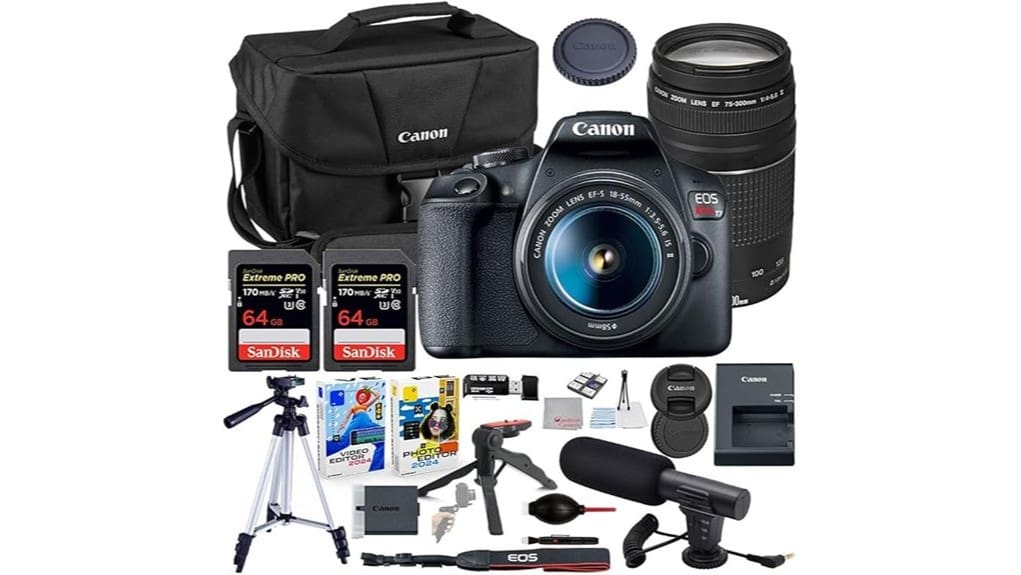
While the bundle centers on the Canon EOS Rebel T7 body, it also includes two practical kit lenses and a selection of accessories that together cover most beginner shooting needs: the T7 brings a 24.1MP APS‑C sensor, DIGIC 4+ processor, 3.0″ 920k‑dot LCD, 1080/30p video, a 9‑point AF system, ISO 100–6400 and 3 fps burst, the EF‑S 18–55mm f/3.5‑5.6 IS II supplies 28.8–88mm equivalent coverage with one aspherical element and optical stabilization for sharper walkaround shots, the EF 75–300mm f/4‑5.6 III adds a lightweight 4x telephoto range driven by a DC micro motor for distant subjects, and the package completes with a Canon 200ES shoulder bag, a microphone, an accessory kit, and two 64GB Extreme memory cards—plus built‑in Wi‑Fi/NFC for remote control and sharing and a one‑year Canon warranty.
You’ll find the kit practical: the lenses cover wide to telephoto, the body supports wireless control and remote shooting, and the bag and cards get you out shooting immediately. If you plan heavy handheld telephoto work or extended shoots, consider adding a battery grip for extra runtime and improved handling; for critical sharpness, budget for lens calibration to guarantee peak AF performance between body and included optics. The site also carries a range of recommended essential gear aimed at DSLR enthusiasts and photographers to complement this bundle.
How the T7 Performs in Real Use: Image Quality, Autofocus, Low Light, and Video
Performance is what matters day-to-day, and the T7 delivers reliable, entry-level results: its 24.1MP APS‑C sensor and DIGIC 4+ processor produce clean, detailed JPEGs in good light with natural color rendering and usable dynamic range for most consumer needs, but you’ll see noise and detail loss climb noticeably above ISO 1600, limiting low‑light flexibility. You’ll get accurate color and decent sharpness from the 18–55; the 75–300 reaches subjects but AF isn’t fast. The 9-point AF with a single cross-type center works for static scenes, though subject tracking is weak. Video is serviceable 1080/30p, limited autofocus and mic options. Consider investing in reliable power solutions like camera batteries to keep shooting longer and avoid missing key moments.
Who Should Buy This Bundle and Which Lens to Use for Your Needs
If you’re stepping up from a smartphone or an older entry‑level camera and want an affordable, all‑around kit that covers wide‑angle to telephoto, the Rebel T7 bundle is a sensible pick—it’s aimed at beginners, hobbyists, and casual shooters who prioritize stills and simple Full HD video over speedy autofocus or advanced low‑light performance. You should buy this bundle if you want versatile coverage straight away: the 18–55 handles travel ultrawide needs and everyday scenes, while the 75–300 serves portraits and distant subjects. Use controlled portrait lighting for flattering results; upgrade glass later as your skills demand. This bundle pairs well with camera backpacks designed for photographers on the go who need organized, protective storage.
Buying Guide: Price Benchmarks, Alternatives, and When to Wait or Pull the Trigger
Now that you know who this bundle suits and how the two lenses cover common shooting situations, let’s look at price expectations, competitors, and timing so you can decide whether to buy now or wait. Monitor pricing trends: expect frequent discounts on the T7 bundle around holidays and back-to-school; street price often undercuts MSRP by 15–30%. Compare competing models like Nikon D3500 or used Canon EOS bodies for similar image quality; consider newer mirrorless entry options if budget allows. Buy if you need a reliable starter kit now; wait for sales or refurbished units if you want lower risk and better value. This site focuses on products for enthusiast photographers and camera fans, so check related gear and bundles when comparing options.
Some Questions Answered
Does the Bundle Include a Camera Battery Charger and Spare Battery?
No, the bundle doesn’t explicitly list a battery charger or spare battery. You should assume only the camera, lenses, accessories noted (bag, microphone, accessory kit, two 64GB cards) are included, so buy a battery charger and spare battery separately to avoid downtime. For reliable operation, get an OEM Canon LP‑E10 charger and spare LP‑E10 battery; third‑party alternatives exist but check reviews and compatibility before purchasing.
Are the Memory Cards Formatted and Pre-Installed for Immediate Use?
No — the included memory cards typically aren’t guaranteed as preformatted cards, so they may arrive unformatted and not pre-installed in the camera; you’ll need to format them in-camera before first use for instant readiness. You should inspect the cards on arrival, back up any preloaded content, then format them using the camera’s menu to guarantee correct file system and peak performance. This avoids compatibility and recording issues.
Is There Any International Warranty Coverage Beyond the 1-Year U.S. Warranty?
No, there isn’t international coverage beyond the 1-year U.S. warranty; Canon’s standard warranty is region-specific. You’ll want to check if service transferability applies in your country, but typically Canon requires proof of purchase and limits repairs to the region of sale. If you travel or import, you’ll likely pay for out-of-warranty service or local fees. Contact Canon support for exact terms and any authorized service exceptions or transfer options.
Are Lens Caps, Hoods, and Rear Caps Included for Both Lenses?
Yes — the standard practice is that lens caps and rear caps are included for both lenses, but a dedicated hood isn’t usually bundled. You’ll get front and rear lens caps and can expect hood compatibility for the EF‑S 18‑55mm and EF 75‑300mm (both accept screw‑on or bayonet hoods specific to their mounting/diameter). If you need a hood, confirm the exact model and thread/fit to purchase the proper compatible hood.
Can the Microphone Record Audio Directly to the Camera Without Adapters?
No — the microphone in the bundle won’t record directly to the camera without adapters if it’s a wireless or external-power dependent unit. You’ll need a mic with a 3.5mm plug or an adapter to feed audio into the T7’s mic jack; otherwise audio goes via wireless transmission to a receiver that then requires connection. If the mic needs external power, you’ll also need appropriate powering or an interface to route sound into the camera.