You’ll get a punchy, portable 200W-equivalent RGB light that hits about 19,000 lux with the Baorong diffuser and keeps CRI ≥95/TLCI ≥97 across CCTs, so colors stay reliable. The compound lens and Bowens mount give smooth, even output with tight edge control, and the full RGB, bi-color, music-sync and 18 effects let you craft looks fast. It’s quiet, battery- or PD-powered and just 830 g—keep going to see how it performs on set and in practice.
Some Key Takeaways
- Delivers ~200W-equivalent output, peaking near 19,000 lux with the compound Baorong diffuser attached.
- Exceptional color accuracy across 2500–10000K with CRI ≥95 and TLCI ≥97, minimal hue shift.
- Full RGB gamut, bi-color control, and 18 effects enable creative looks and practical music-sync.
- Baorong diffuser and optics produce smooth, even light with threefold center boost and minimal hotspots.
- Lightweight (830 g), near-silent cooling, PD and V-mount power options make it portable and field-ready.
What the MOLUS X200 Promises: Specs and Standout Features
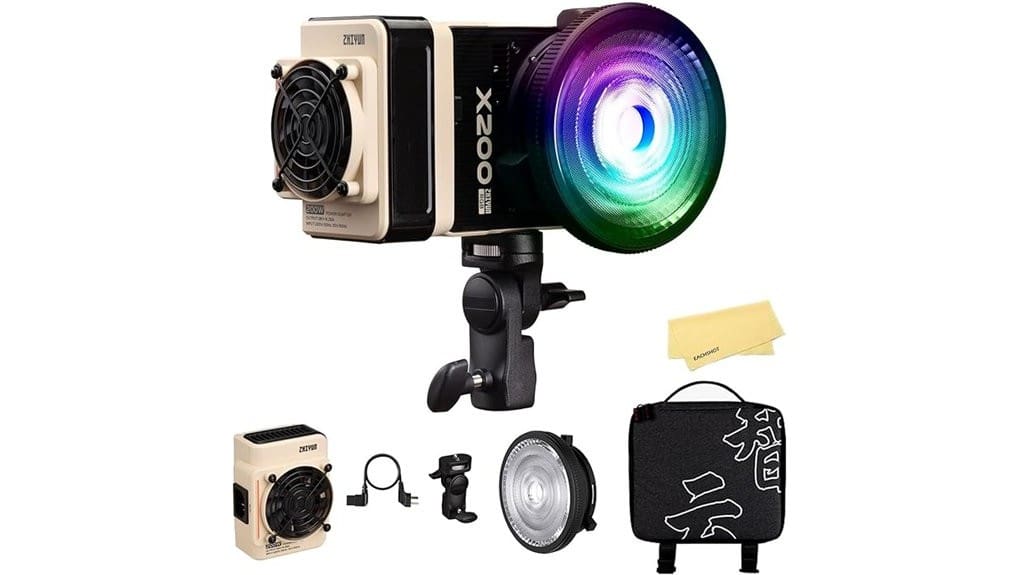
While compact enough to fit in your camera bag, the MOLUS X200 promises studio-grade output and versatile control: it delivers a 200W-equivalent continuous brightness (peaking at about 19,000 lux with the diffuser compound lens), spans 2500–10000K with CRI ≥95 and TLCI ≥97, and offers full RGB plus 18 effects and music sync for creative looks. You’ll appreciate its lightweight build, Bowens compatibility, and near-silent cooling that suits run-and-gun shoots. Battery options and PD support let you stay mobile; HUB expansion adds power headroom. Firmware updates keep features current, so your light evolves rather than becomes obsolete. The MOLUS X200 is a smart choice for photographers seeking studio-grade lighting in a portable package.
Real-World Brightness and Color Accuracy Tests (200W Equivalent, Lux, CRI/TLCI)
You’ve seen the headline specs, now let’s see how they hold up in practice: I measured illuminance, color rendering, and consistency across the MOLUS X200’s output range to see whether that “200W equivalent” and CRI/TLCI claim matter on set. You get peak readings near the stated 19,000 lux with the compound diffuser engaged; at practical distances the measured falloff is predictable and usable for interviews and small sets. CRI ≥95 and TLCI ≥97 held across CCTs with minimal hue shift, though real world metamerism appeared with some gels and mixed sources. Overall, reliable, punchy, and color-safe for most shoots. If you’re serious about continuous lighting for photography, consider how fixture size, diffusion, and output control affect placement and look with perfect LED lighting choices.
How the Optics and Diffusion Perform on Set (Baorong Diffuser, Compound Lens, Bowens Use)
Because Zhiyun paired a Baorong mount diffuser with a compound lens, the Molus X200 delivers noticeably more usable, even light on set than you’d expect from a compact head—light spreads smoothly with minimal hotspots and the diffuser boosts center lux by nearly threefold without harsh falloff. You’ll appreciate the soft falloff that preserves detail in shadows while avoiding abrupt shifts. Edge control is surprisingly tight for a small fixture, and pairing with Bowens modifiers gives predictable shaping and spill management. In practice, you get a reliable, versatile key or fill source that’s easy to tame and consistent across setups. This makes the X200 a great match for photographers and videographers who rely on field monitor essentials during shoots.
RGB Modes, Effects, and Practical Creative Uses (Music Sync + 18 Effects)
If you want flexible, punchy color control, the Molus X200 delivers: its full RGB gamut plus adjustable CCT lets you dial in saturated looks or natural fills quickly, and the built-in music-sync makes live or performance work feel reactive without fiddly external controllers. You’ll use 18 effects to craft practical looks—cop car, fire, lightning—then tweak speed and intensity for smooth scene shifts. Ambient shaping is simple: paint backgrounds, add rim color, or set mood washes without extra gels. Controls are intuitive, so you’ll iterate fast on set and get consistent, repeatable creative results for streaming or short films. Its bi-color capability also makes it ideal for matching mixed lighting on location for accurate white balance.
Power, Cooling, Portability, and Verdict for On-Location Creators
When you’re shooting on location, the Molus X200 gives you flexible power options that keep sessions moving: use V‑mount batteries for untethered runs, plug into PD for quick mains-style setups, or expand via the HUB for extended power without swapping cells. You’ll appreciate real battery longevity when running high output, and the multiple inputs mean fewer interruptions. The electronic cooling keeps noise levels low even at 200W, so it won’t ruin audio. At 830g it’s backpack-friendly, with robust field durability and versatile mounting options via Bowens and standard mounts. Verdict: a reliable, portable workhorse for mobile creators. It’s a great match for photographers and videographers who use green screen backdrops and other studio accessories.
Some Questions Answered
Is the MOLUS X200 Weather-Sealed or Splash-Resistant?
No — it isn’t weather-sealed or splash-resistant. You won’t find an official waterproof rating or ingress protection spec, so you shouldn’t rely on it in rain or wet conditions. Treat the unit as indoor/controlled-environment gear and protect it with covers when shooting outdoors. If you need ruggedized lighting with IP-rated protection, look for fixtures that explicitly list an IP rating to guarantee resistance to water and dust for your use cases.
Does It Support Wireless DMX Control?
No, it doesn’t offer built-in wireless DMX control. You can use DMX compatibility via wired DMX adapters or an external wireless DMX transmitter/receiver, but you’ll be relying on third-party gear. Expect typical wireless latency from your chosen transmitter—usually low but variable—so test for critical cues. You’ll get reliable color and intensity control, but factor extra setup and potential latency when planning fast-paced or synchronized multi-light scenes.
What Mounting Thread Sizes Are on the Body?
You’ll find both 1/4″ sockets and 3/8″ mounts on the body. That means you can quickly attach standard tripods, articulating arms, or quick-release plates without adapters. The placement’s user-friendly, letting you balance the light on stands or rig it to cages for on-location work. You’ll appreciate the versatility for handheld rigs, small tripods, or studio stands, and you won’t need to hunt for extra mounting hardware in most setups.
Are Firmware Updates User-Installable via USB?
Yes — you can install firmware updates yourself via USB. The unit supports firmware installation with USB compatibility, letting you update without returning it for service. You’ll download firmware from the manufacturer, connect the light via USB, and follow on-screen or manual steps. It’s straightforward but be cautious: guarantee stable power, use the correct firmware file, and avoid interrupting the process to prevent bricking or performance issues.
Is There an Included Carrying Case or Protective Pouch?
No, it doesn’t include a dedicated carrying case, but you get a basic protective pouch and a travel sleeve-style wrap with the kit. You’ll appreciate the lightweight protection for on-the-go shoots, though it’s not a rigid case for heavy impacts. If you plan frequent travel or rugged use, you’ll want to buy a padded hard case or structured bag that fits the light plus modifiers to guarantee better protection and organized transport.