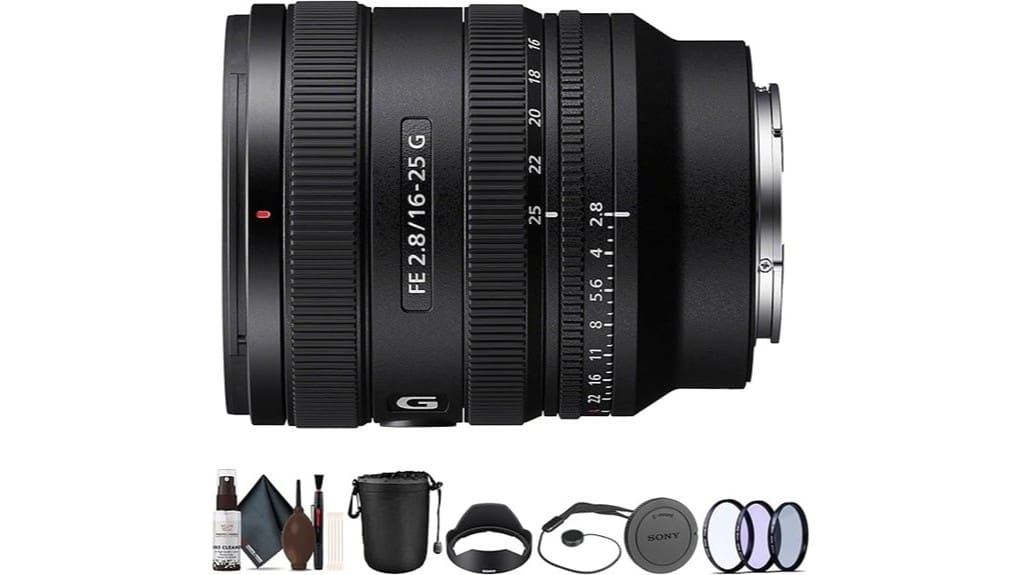
You’ll get a compact, pro-grade ultra‑wide zoom that gives you constant f/2.8 exposure, class‑leading edge‑to‑edge sharpness, and excellent microcontrast for landscapes, interiors, and run‑and‑gun full‑frame work. Distortion and chromatic aberration are restrained and easy to correct, while autofocus is fast and quiet for video. At 409 g it balances handling and build quality with weather sealing and a fluorine front element. Keep going and you’ll find detailed comparisons, optical tests, and real‑world use notes.
Some Key Takeaways
- Outstanding edge-to-edge sharpness and high microcontrast from f/2.8 through mid apertures for professional image quality.
- Constant f/2.8 across 16–25mm enables reliable low-light performance and consistent exposure for photo and video.
- Compact 409 g, weather-sealed build with fluorine front element suits travel, vlogging, and run-and-gun shoots.
- Controlled distortion and minimal chromatic aberration make RAW corrections easy and preserve fine detail.
- Offers pro-level optics and handling at a mid-range price, ideal for shooters wanting lightweight yet capable ultra-wide zoom.
Quick Verdict: Who the SEL1625G Is Best For
While it’s compact and light enough for travel, the SEL1625G targets shooters who need ultra-wide reach with professional image quality—landscape and interior photographers, vloggers and run-and-gun full-frame shooters will benefit most. You’ll appreciate constant f/2.8 for exposure consistency and low-light flexibility compared with kit zooms. Travel vloggers gain a usable wide field without a bulky rig; landscape photographers get framing versatility and close-focus utility. Weather sealing and a fluorine front element suit extended shoots. If you prioritize optical control, compactness, and robust handling over extreme tele reach, this lens fits your professional and travel workflows. For those pairing gear with mobility in mind, consider compact supports like travel tripods to complete a lightweight shoot setup.
Optical Performance: Sharpness, Distortion, and Chromatic Aberration
Frequently, the SEL1625G delivers class-leading edge-to-edge sharpness that holds up from f/2.8 through mid apertures, outperforming many 16–35mm alternatives in microcontrast and fine detail resolution. You’ll notice center acuity is excellent at all focal lengths; corners tighten by f/4–f/5.6 with minimal edge falloff. Distortion is restrained for an ultra-wide zoom—easy to correct in RAW with conservative profiles and rarely obvious in-frame. Longitudinal and lateral chromatic aberration are well controlled; residual CA appears only in extreme high-contrast shifts and is readily removed in post. Overall, optical pedigree yields dependable, high-resolution images. This makes it a great choice for photographers who prioritize lens-specific gear like camera lenses when building their kit.
Low‑Light, Bokeh, and Aperture Behavior at F/2.8
Because the FE 16‑25mm G keeps a constant f/2.8 aperture across the zoom range, you get predictable exposure and usable shutter speeds in dim conditions without having to compromise focal length or ISO. You’ll find exposure consistency comparable to larger fast lenses, enabling handheld work and video in low light. At 16–25mm the depth of field is relatively deep, so creamy bokeh appears only with close subjects and wider framing; still, the lens yields respectable background separation for ultra‑wide glass. Optical design controls aberrations, so out‑of-focus highlights stay clean rather than busy, useful for night scenes. This makes the lens a practical choice for enthusiasts focused on wildlife and sports photography.
Handling, Close‑Focus, and Build Quality for Travel and Video
Although compact and lightweight, the FE 16‑25mm F2.8 G feels purpose-built for travel and run‑and‑gun video: its 409 g body and short barrel let you switch shoulders, gimbals, or vlogging rigs quickly, and the weather‑sealed construction plus fluorine‑coated front element stand up to real‑world use. You get compact handling with well-damped zoom and smooth, narrow focus ring travel for predictable manual tweaks. travel ergonomics are excellent on small bodies; controls sit within thumb and forefinger reach. focus responsiveness is fast and quiet for AF-driven video. Overall build resilience rivals pro zooms while remaining noticeably lighter. This lens is a great match for mirrorless camera enthusiasts looking for compact, travel-friendly gear.
How It Compares and Whether to Buy (Alternatives, Price, and Final Recommendation)
When you weigh the FE 16‑25mm F2.8 G against other ultra‑wide zooms, its combination of constant f/2.8, compact 409 g body, and advanced optics puts it between lightweight kit lenses and bulkier pro zooms—delivering pro-level edge‑to‑edge sharpness and flare control without the size penalty of 16‑35mm f/2.8 alternatives. For buyers, price comparison shows it sits below flagship 16‑35mm G Master models yet above basic zooms, offering a strong balance of weight, build, and optical quality. Consider alternative lenses if you need longer reach or ultralight budget options; buy this if you prioritize compact pro performance. Our store focuses on helping photographers choose lenses and accessories to master prime lenses, with curated recommendations for every skill level and budget, including prime lens essentials.
Some Questions Answered
Is This Lens Compatible With APS-C E‑Mount Cameras?
Yes — you can use it on APS‑C E‑mount bodies. You’ll get APS C coverage with a 1.5x crop factor, so the effective field of view becomes roughly 24–37.5mm (in full‑frame terms). You’ll retain the f/2.8 aperture, close‑focus benefits and weather sealing, but enjoy a narrower angle and slightly increased reach. Compared to full‑frame use you’ll see reduced peripheral coverage and slightly different depth‑of‑field rendering.
Does It Have Optical Image Stabilization (OSS)?
No — it doesn’t include optical stabilization. You’ll rely on your camera’s in-body image control (IBIS) or faster shutter speeds to counter handshake. Compared to stabilized lenses, this design keeps weight and complexity down, favoring optical performance and edge sharpness. If you need stabilized wide-angle handheld video or slower shutter use, pair it with an IBIS-equipped body or a gimbal for effective image control and smoother results.
What Filter Thread Size Do I Need for Filters?
You need a 67mm filter thread. You’ll screw 67mm filters directly onto the front, or use filter adapters and step up rings to fit other sizes. Compared to using larger filters with step up rings, adapters preserve lens balance and avoid vignetting at 16mm. If you already own 72mm or 77mm filters, a 67→72mm or 67→77mm step up ring works; pick high-quality, thin rings to minimize edge shading.
Can It Autofocus Reliably for Video Use?
Yes — you can rely on it for video. The lens delivers silent AF and solid focus tracking with Sony bodies, so you’ll get smooth, quiet shifts and dependable subject locking. Compared to slower wide-angle zooms, it maintains consistent f/2.8 exposure and responsive AF behavior. In challenging low light or with rapid subject motion, you might see occasional hunting, but overall it’s optimized for video use with minimal noise and confident tracking.
Is There a Noticeable Focus Breathing During Zooming?
No, you won’t notice significant focus breathing during zooming; the lens shows minimal focus shift and only subtle breathing artifacts compared with slower, consumer zooms. You’ll see slight framing change when racking focus aggressively, but edge-to-edge optical design and internal focusing keep shifts small. For critical cinema work you might spot residual breathing artifacts under close macro-like pulls, yet for run-and-gun video the behavior is negligible and usable.