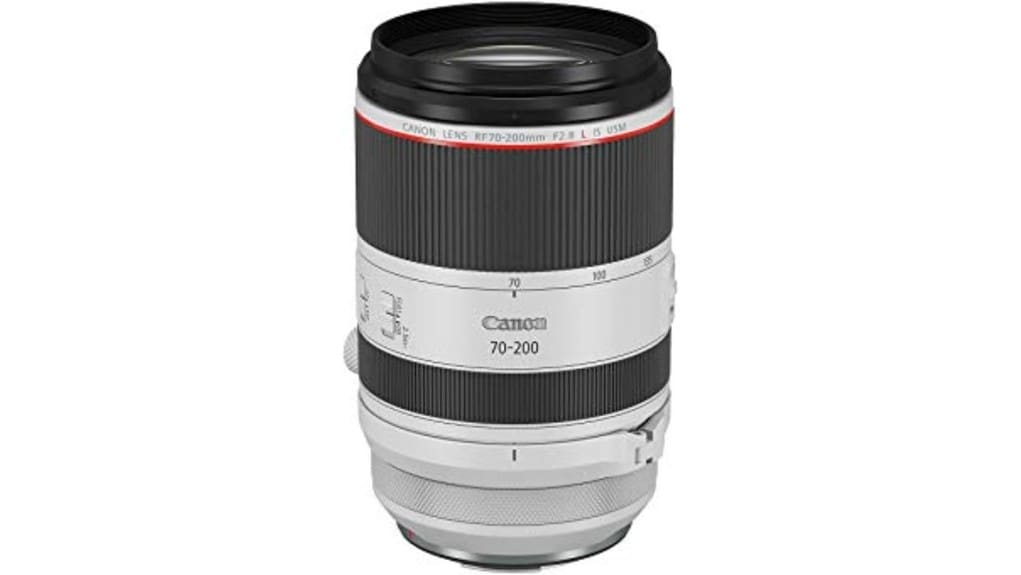
You’ll get a compact, pro-grade 70–200mm f/2.8 that keeps center sharpness across the zoom, yields creamy bokeh, and controls edge rendition well; it shows mild corner falloff at 70mm and tighter falloff toward 200mm. Dual Nano USM provides fast, quiet AF with minimal hunting on R5/R6 bodies, while optical IS combines with in-body stabilization for roughly five stops. Build is weather-sealed and lightweight for EOS R users, and further details and comparisons follow.
Some Key Takeaways
- Consistent f/2.8 aperture from 70–200mm delivers excellent center sharpness and reliable low-light performance.
- Dual Nano USM provides fast, quiet autofocus with minimal hunting on R5/R6-class bodies.
- Optical IS pairs with in-body stabilization for roughly five stops of shake correction.
- Compact, weather-sealed L-series build offers durable, ergonomic handling and programmable controls.
- Premium price justified by optical quality, resale value, and suitability for sports, portraits, and pro workflows.
What to Expect From the Canon RF70-200MM F2.8 L USM
Expect a high-performance telephoto zoom optimized for Canon’s RF mount: the RF70-200mm F2.8 L USM delivers a constant f/2.8 aperture across 70–200mm, Dual Nano USM autofocus, and up to 5 stops of optical image stabilization in a compact, lightweight L-series package compatible with full-frame and APS-C EOS R bodies. You’ll find robust weather sealing and evident build quality, with a durable white-magnesium construction that resists dust and moisture. Ergonomics and controls are camera-oriented: rubberized zoom and focus rings, a programmable control ring, and tactile AF/MF and stabilization switches positioned for quick access during operation. Perfect Tripods offers related tripod gear that complements this lens for more stable telephoto shooting with sturdy tripod support.
How the Lens Performs: Sharpness, Bokeh, and Close-Focus (70–200mm, F/2.8)
Moving from build and handling to image rendering, the RF70-200mm F2.8 L USM produces consistently high sharpness across the frame, with center resolution outstanding at all focal lengths wide open and only mild corner falloff at 70mm that tightens noticeably by 135–200mm. You’ll find microcontrast excellent, preserving fine detail into the edges; edge rendition stays controlled with minimal softening except at extreme corners. Out-of-focus areas render smoothly—bokeh is creamy with pleasant gradational zones and low onion-ring artifacts. Lateral and longitudinal chromatic aberration are well suppressed in raw files, requiring little correction in post for typical shooting. For those using tripods, pairing the lens with a sturdy ball head can help maximize stability and framing precision.
Autofocus, Stabilization, and Real-World Handling With EOS R Bodies
When paired with EOS R bodies, the RF70-200mm F2.8 L USM delivers fast, reliable AF and effective stabilization that keep subjects sharp across a wide range of shooting scenarios. You’ll get Dual Nano USM-driven fast tracking and quiet subject tracking performance, with minimal hunting on R5/R6-class cameras. Optical IS combines with in-body IS for up to ~5 stops correction, aiding low-light handheld use. The lens’ compact, lightweight construction improves lens balancing on smaller EOS R bodies, reducing fatigue. Controls are intuitive; you’ll appreciate the handling finesse during rapid framing adjustments and when maintaining steady compositions for extended periods. It’s an excellent choice for mirrorless photographers looking for essential gear that complements small, lightweight systems.
Use Cases and Sample Results: Sports, Portrait, and Landscape Workflows
Apply the RF70-200mm F2.8 L USM across sports, portrait, and landscape workflows to exploit its constant f/2.8 aperture, Dual Nano USM AF, and up to 5 stops of IS. For sports workflows, you’ll freeze action at 1/1000s–1/2000s with ISO dialed down on R5/R6 bodies, relying on reliable subject acquisition and tracking; tight framing at 200mm isolates subjects with shallow depth of field. For portrait workflows, you’ll use 70–135mm for headshots and 135–200mm for compressed looks, benefiting from smooth bokeh and accurate eye AF. For landscapes, you’ll stop to f/8–f/11, stabilize on tripod or IS, and stitch panoramas for maximum resolution. Consider pairing the lens with a camera stabilizer when shooting handheld in low light to maximize sharpness and reduce motion blur.
Is It Worth Buying? Price, Alternatives, and Who Should Buy It?
After testing the RF70-200mm F2.8 L USM across sports, portrait, and landscape workflows, you can judge its value by weighing performance against cost and alternatives. You’ll pay a premium for consistent f/2.8, Dual Nano USM AF, optical stabilization and robust weather sealing, but strong user reviews and Canon L optics support higher resale value. If budget limits you, consider older EF 70-200mm L variants with mount adapters or third-party RF options that sacrifice some autofocus speed or stabilization. Buy this lens if you need a compact, professional telezoom for mixed pro/am workflows and long-term system investment. For outdoor shoots where stability matters, pairing the lens with a heavy-duty tripod can significantly improve image sharpness and handling.
Some Questions Answered
Does This Lens Require a Firmware Update for Certain EOS R Bodies?
Yes — some EOS R bodies may need a firmware update for full firmware compatibility. You’ll want to check Canon’s support page for your camera model; updates can improve autofocus performance and lens communication. Install any recommended body firmware before use to guarantee Dual Nano USM behaves at its best and stabilization and metadata reporting are accurate. If you’re buying used, verify both camera and lens firmware versions to avoid unexpected issues.
Is There Weather Sealing for Heavy Rain or Dusty Environments?
Yes — you’ll get robust weather resistance. The lens features extensive environmental testing and sealed construction at key joints, switches, and mounts to resist rain, dust, and splashes. It’s designed to operate reliably in adverse conditions but isn’t guaranteed for continuous heavy rain immersion or deep dust storms. You should still use protective measures (rain cover, quick drying) in prolonged severe exposure to preserve long-term performance.
Can I Use 82MM Filters Without Vignetting Across Zoom Range?
Yes — you can use 82mm filters without noticeable vignetting across the 70–200mm range on full-frame bodies. Your filter compatibility is good thanks to the lens’s optical design and recessed front element; vignetting tests show minimal corner darkening at 70mm wide-open, and it disappears stopped down or at longer focal lengths. For APS-C cameras you’ll also avoid vignetting, though always confirm with your specific filter thickness and adapter setup.
How Does It Balance on Gimbals or Stabilizers for Video Work?
You’ll find it balances well on gimbals and stabilizers: its compact, lightweight build gives a balanced heft that’s easy to tune on most arms. The optical IS and Dual Nano USM minimize micro-vibrations, so you get smooth tracking during pans and tilts. You’ll still need to fine-tune counterweights and motor strength for heavier cameras, but overall setup time and motor load remain modest, yielding stable handheld-style footage.
Is There an Option for a Tripod Collar From Canon or Third Parties?
Yes — you can use a tripod collar. You’ll fit Canon’s own tripod collar (available as an accessory) for secure lens mounting, or choose from several third party mounts offering lightweight, Arca‑style plates and rotating collars. You’ll want a collar rated for the lens’s weight and with precise locking and alignment to avoid stress on the camera mount. Inspect compatibility, clamp width, and finish to guarantee stable balance on gimbals or tripods.