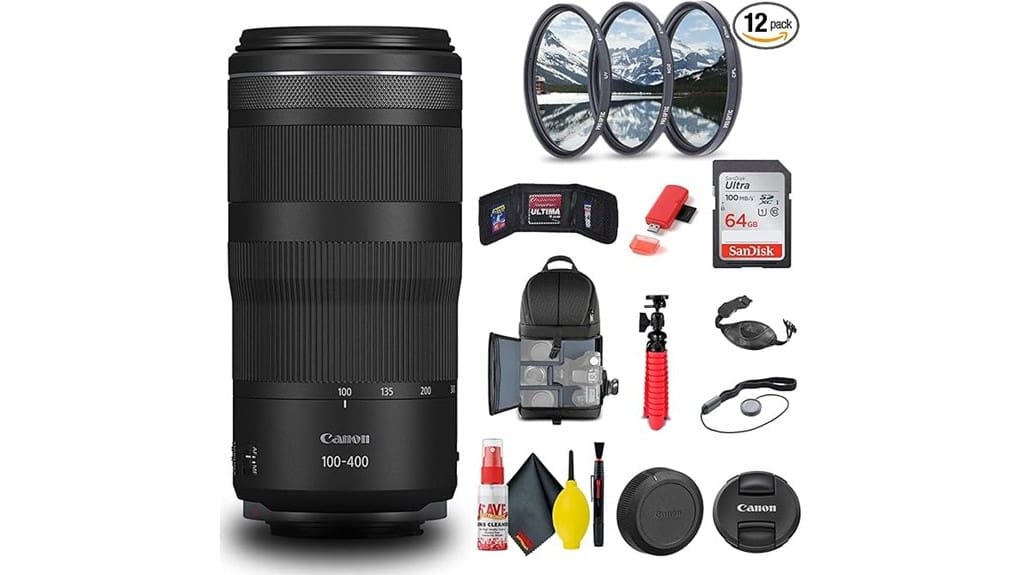
You’ll find the Canon RF 100‑400mm f/5.6‑8 IS USM is a lightweight, reach‑first telezoom that’s built for travel and casual wildlife or sports shooting. You’ll get solid center sharpness, Nano USM autofocus that’s brisk and reliable, and Coordinated IS that steadies handheld long‑reach shots. It won’t match pro glass in low‑light or corner microcontrast wide open, but its compact size, close‑focus versatility, and value make it a practical choice—keep going and you’ll learn specifics on handling, optics, and alternatives.
Some Key Takeaways
- Lightweight, affordable 100–400mm telezoom giving good reach for wildlife, travel, and casual sports on RF bodies.
- Coordinated IS and Nano USM deliver steady handheld shooting and brisk, reliable autofocus for single-shot tracking.
- Very good center resolution at 100–300mm with modest edge softening at 400mm wide-open, improved when stopped down.
- 0.41× close-focus and compact design enable tight framing without heavy gear, ideal for run-and-gun shooting.
- Trade-offs include slow max aperture (f/5.6–8), limited low-light performance, and more modest corrections versus pro L glass.
Quick Verdict: Who This Canon RF 100‑400mm Is Best For
If you need a lightweight, affordable telephoto that travels well and handles everyday wildlife, casual sports, and travel shooting, this RF 100–400mm is built for you. You’ll appreciate how its compact design, Coordinated IS, and Nano USM prioritize usable results over pro-level speed. It’s a smart beginners’ telephoto: optical stabilization and close-focusing let you frame subjects tight without exotic technique. For budget wildlife shooters and travelers, the lens balances reach, image control, and cost, delivering practical sharpness and magnification. You shouldn’t expect ultra-fast apertures or extreme durability, but you’ll get dependable performance for everyday telephoto needs. It pairs especially well with lightweight tripods and monopods for improved stability and comfort during long shoots, making it a great match for tripod accessories.
Handling and Build: Weight, Controls, and Portability in the Field
Although it doesn’t feel like a pro telephoto, the RF 100–400mm‘s 4.01-pound listed weight and compact profile make it noticeably easier to carry and maneuver for extended shoots, so you’ll spend less energy panning for birds or tracking action. You get genuinely lightweight handling without sacrificing perceived solidity; materials resist flex but the product listing notes no water resistance beyond basic weather sealing. Controls are logical: zoom and focus rings are damped well, and button placement for AF lock and custom functions is reachable without changing grip. The tripod collar is simple, removable, and balances the lens cleanly on monopods or gimbals. For outdoor photographers using heavier gear, pairing this lens with a heavy-duty tripod designed for stability can significantly improve long-exposure and tracking performance.
Optical Performance: Sharpness, AF Speed, Stabilization, and Close‑Focus Testing
Sharpness here is deliberate rather than dazzling: the RF 100–400mm delivers very good center resolution across the range, with microcontrast holding up well at 100–300mm and only a modest softening toward the extreme edges and at 400mm wide-open. You’ll find corner falloff improves stopped down; diffraction appears beyond f/16. AF speed is brisk with Nano USM—reliable for single-shot tracking—and hunting is rare on modern RF bodies. Coordinated IS steadies handhold shots up to claimed stops, aiding composition. CA is well controlled but needs minor correction at high-contrast edges. Bokeh quality is smooth, with pleasant out-of-focus rendering. This makes the lens a strong, practical option for DSLR enthusiasts seeking versatile long-telephoto performance.
Real‑World Use Cases: Wildlife, Sports, Travel, and Video on RF Bodies
When you need a lightweight, reach-first telezoom for unpredictable subjects, the RF 100–400mm f/5.6–8 IS USM shines by balancing portability with usable image quality and stabilization. You’ll use it for wildlife stalking where Nano USM AF and 0.41x close-focus let you fill frames without bulk; coordinated IS helps handheld shots at longer focal lengths. For sports panning you’ll exploit responsive AF and manageable weight to track action, though aperture limits require higher ISO in low light. In travel packing it saves space and reach. On RF video bodies, coordinated IS and smooth focus deliver reliable video stabilization and practical run-and-gun performance. It’s also a great match for mirrorless shooters looking for essential, compact accessories to complement their kit.
Buy or Skip? Value, Alternatives, Kit Contents, and Final Recommendations
If you prioritize portability and reach over top-tier low-light performance, the RF 100–400mm f/5.6–8 IS USM is a compelling value—its light weight, Coordinated IS, and Nano USM make it very usable for wildlife, travel, and run‑and‑gun video, and the surprising 0.41× close‑focus boosts versatility; however, you should weigh that against the slow maximum aperture, modest optical corrections compared with pricier pro zooms, and a short 90‑day warranty when deciding if it’s the right buy. Buy if you need affordable reach and low weight. Consider alternatives (RF 100–500mm, used L glass) if you need faster glass. Kit contents are strong—filters, backpack, card, tripod—so factor accessory recommendations into the price. Resale value will be reasonable but lower than Canon L telephotos. Teleconverters can extend reach affordably but affect aperture and autofocus performance, so consider compatibility carefully with teleconverters.
Some Questions Answered
Is This Lens Weather-Sealed for Shooting in Rain?
No — it’s not weather-sealed, so you shouldn’t rely on it in rain. You’ll note the listing states it’s not water resistant and lacks official sealing. For practical use, avoid extended exposure; conduct sealing tests yourself if you plan wet-weather shooting. Use rain covers, protective housing, or a weather-sealed camera body and keep quick-dry towels handy. That minimizes risk while you test performance in damp conditions.
Can It Be Used on APS-C RF Bodies and What’s the Reach?
Yes — you can use it on APS‑C RF bodies, and you’ll get increased APS C reach. On an APS‑C sensor the 100–400mm behaves like a 160–640mm equivalent field of view (1.6x crop), so you’ll fill the frame more tightly and extend Subject framing for distant wildlife or sports. Expect similar autofocus and IS performance; depth of field and light-gathering stay tied to the lens’s f/5.6–8 aperture values.
Does It Accept Canon Teleconverters and Maintain AF Performance?
Yes — you can mount Canon teleconverters, but teleconverter compatibility and autofocus limitations matter. Using a 1.4x or 2x TC increases effective focal length but reduces maximum aperture (to about f/8 or f/11), which can force AF to slow or hunt on some RF bodies. You should test your specific camera for reliable AF at smaller apertures, and expect reduced AF speed and tracking performance with heavier TCs in practical shooting.
How Does Battery Life Change With Coordinated IS Engaged?
You’ll see increased battery drain when Coordinated IS is engaged because the camera and lens both power stabilization. Expect roughly 10–30% higher consumption depending on IS modes, shooting rate, and focal length. Using Active or Coordinated IS modes and high continuous AF rates pushes drain toward the higher end. To manage runtime, switch IS off when unnecessary, use lower-power IS modes, carry spare batteries, and reduce continuous-shoot settings.
Is the Lens Compatible With Third‑Party Lens Caps or Hoods?
Yes — you can use aftermarket caps and generic hoods, but check fit and functionality first. You’ll need 67mm filter-thread caps or a matching snap-on cap; some aftermarket caps fit loosely or block lens controls. Generic hoods that match the 100–400mm profile usually work, though third‑party hoods may vignette at wide tele or not lock as securely. Inspect alignment, mounting stability, and front-element clearance before extended use.