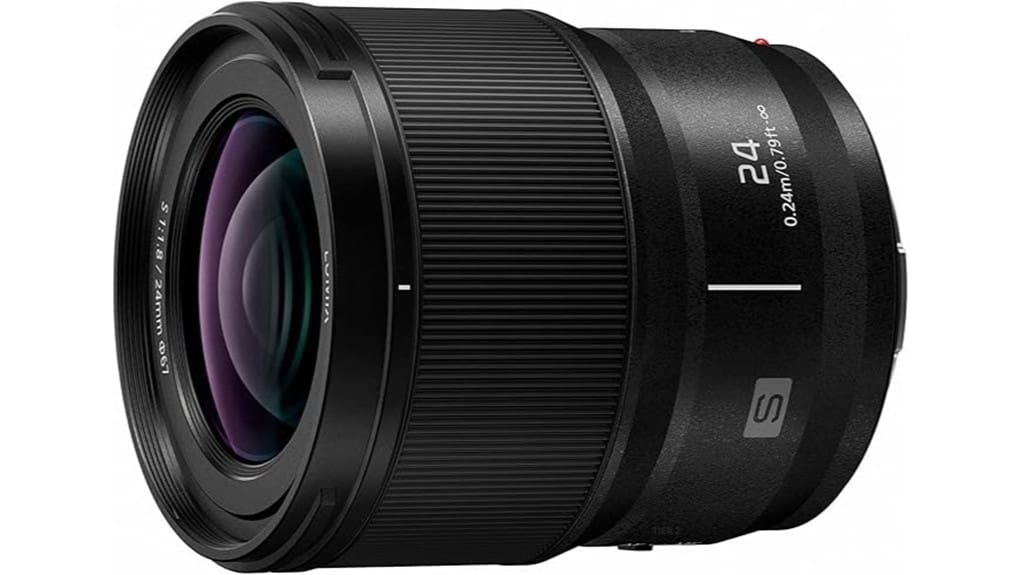
You’ll find the Panasonic LUMIX S S‑S24 24mm F1.8 gives you compact, video‑ready wide performance with strong center sharpness and preserved microcontrast at F1.8, good mid‑frame resolution that tightens stopped down, and mildly lagging full‑frame corners. AF is fast with minimal breathing, aperture control is smooth and clickless, and build is lightweight with weather sealing. It trades some f/1.4 light‑gathering for portability and predictable handling — continue and you’ll get detailed comparisons and use cases.
Some Key Takeaways
- Excellent center sharpness at f/1.8 with preserved microcontrast, improving slightly when stopped down.
- Wide 24mm field and f/1.8 aperture suit landscapes, environmental portraits, and run‑and‑gun video.
- Fast, low‑breathing AF and smooth, clickless aperture control favor hybrid photo/video use.
- Compact, weather‑sealed build balances light weight with reliable field durability.
- Corners lag on full‑frame wide open and may limit critical architecture or interior work.
Real-World Image and Video Results With the S‑S24 24mm F1.8
When you put the S‑S24 on a full‑frame L‑Mount body, its wide 24mm field and F1.8 aperture deliver predictable, high‑contrast results across landscapes, environmental portraits, and run‑and‑gun video; sharpness is strong from center to mid‑frame even wide open, while corner performance tightens noticeably stopped down. You’ll notice fast AF and minimal breathing aid handheld video and night timelapses, with smooth aperture pulls for cinematic exposure ramps. Its compact build reduces rig weight compared with larger wides, improving mobility for street scenes and travel. Color rendition is neutral with reliable microcontrast, letting you prioritize grading rather than corrective fixes. This makes the lens a great fit for mirrorless camera enthusiasts looking for essential, lightweight gear for travel photography.
Optical Performance Breakdown: Sharpness, Bokeh, and Close‑Focus Behavior
Building on the real‑world results, let’s examine how the S‑S24 performs optically: it delivers strong center sharpness at F1.8 with microcontrast that preserves fine detail, while mid‑frame resolution remains very good and improves only marginally stopped down. You’ll notice corners lag slightly on full‑frame at wide apertures, indicating measurable micro contrast falloff toward edges. Out‑of‑focus rendering is pleasant for a 24mm with smooth bokeh progression, though background highlights show mild onion‑ringing. Longitudinal and lateral chromatic aberration are well controlled, requiring minimal correction. Close‑focus (0.24 m) yields usable 0.15× magnification with maintained sharpness. This performance makes the lens a strong choice for photographers who enjoy macro close‑ups as well as wider environmental close‑ups.
Autofocus, Aperture Control, and Video Readiness in Everyday Shooting
Tap into the S‑S24’s AF and aperture systems and you’ll find a lens designed for decisive, video‑friendly operation. You get high‑speed AF with minimal breathing, so focus shifts stay accurate compared with slower wide‑angle primes. In low light AF tests the drive remains competent, though absolute speed depends on body processor. The aperture ring and electronic control deliver smooth, clickless changes for continuous exposure, supporting a cinematic aperture ramp without stepping artifacts. For hybrid shooters who switch between stills and video, the S‑S24 balances responsiveness and refinement, trading marginally for maximum aperture brightness versus heavier f/1.4 competitors. It’s an excellent match for enthusiasts interested in follow focus and smooth focus control.
Handling, Build Quality, and Weather Resistance for Travel and Outdoor Use
Shifting from its AF and aperture behavior to physical use, the S‑S24’s compact, lightweight construction makes it a practical pick for travel and outdoor work where mobility matters. You’ll notice compact ergonomics: the lens balances on L‑Mount bodies, control rings are predictable, and swapover among S‑series F1.8 lenses requires minimal re‑adjustment. Build quality is solid without excess bulk; materials feel engineered rather than ornate. Weather sealing is present—dust-, splash-, and freeze‑resistant ratings let you shoot in marginal conditions with confidence. Compared to heavier 24mm alternatives, the S‑S24 trades absolute robustness for portable, reliable field performance. It pairs especially well with travel tripods designed for photographers who prioritize lightweight gear and on-the-go stability.
Who Should Buy It and How It Compares to Similar 24mm Options
While it’s compact and bright enough for many pros, the S‑S24 really suits photographers who prioritize portability and low‑light reach over the absolute edge in optical correction. You’ll favor it for Street photography, Astro landscapes, and Documentary weddings when you need F1.8 speed, close 0.24m focusing, and light weight for long days. Compared with sharper, heavier 24mm primes, the S‑S24 trades ultimate microcontrast for better handling and weather resistance. For Architecture interiors you may prefer a rectilinear 24mm with superior corner performance; for general travel and low‑light work, the S‑S24 is a balanced, practical choice. As part of a kit for travel photographers, pairing the lens with a compact carbon fiber tripod can maximize stability without adding much bulk.
Some Questions Answered
Is This Lens Compatible With APS-C L‑Mount Cameras for Cropped-Field Use?
Yes — you can mount the lens on APS C L‑mount cameras; APS C compatibility is supported by the L‑mount system. You’ll experience a Field of view crop roughly 1.5x (effectively ~36mm equivalent), so framing becomes tighter versus full‑frame. You’ll retain the F1.8 aperture optics, though depth‑of‑field and bokeh characteristics change perceptually. Compared to native APS‑C primes you’ll trade some compactness for full‑frame image quality and consistent handling.
Does the Lens Include Image Stabilization (Ibis or Optical)?
No, it doesn’t include optical stabilization; the lens is unstabilized. You’ll rely on sensor stabilization (IBIS) in your camera body for shake reduction. Technically, the lens omits optical stabilization to save size and weight, so performance depends on body IBIS effectiveness and shutter speed. Comparatively, stabilized primes offer extra handheld latitude on non-IBIS bodies, while this lens pairs best with mirrorless bodies that provide strong sensor stabilization.
What Filter Thread Size Does the S‑S24 Use for Accessories?
The S‑S24 uses a 67mm filter size for accessory options. You’ll find this thread standard among many full‑frame wide primes, so you can share filters and step‑up rings with similar lenses. Technically, 67mm balances front element diameter and optical design, offering good vignetting control compared with smaller threads. Objectively, choosing 67mm gives more accessory compatibility and flexibility when comparing filter systems and lens swap workflows.
Is There a Dedicated Lens Hood Included in the Box?
Yes — a dedicated hood is included. You’ll find the hood listed among the box contents, improving flare control and protection compared with using generic hoods. The supplied hood matches the lens’s optical design and mount profile, so vignetting is minimized. In comparative terms, having a purpose-built hood in the box offers better fit and performance versus aftermarket options, and keeps your setup consistent with S-series handling and sealing standards.
Does Panasonic Offer a Warranty and Repair Service for This Lens?
Yes — you get manufacturer warranty terms and authorized repair centers. You’ll find standard Panasonic warranty coverage for defects, with duration varying by region; extended plans may be available. For repairs, Panasonic directs you to authorized repair centers to preserve coverage and guarantee OEM parts. Compare regional terms and turnaround times before purchase, and register the lens to streamline claims; third-party repairs can void warranty and may use non-OEM components.