You’ll find the Canon EF 75-300mm f/4-5.6 III is a lightweight, budget telezoom that gives good center sharpness and neutral color with mild edge softness wide open. Autofocus is driven by a DC micro motor — smooth and usable for stills but slower than USM. There’s no image stabilization and the build is basic plastic with no weather sealing. It’s ideal for hobbyist travel, wildlife learning, and casual sports; keep going to see detailed use cases and performance notes.
Some Key Takeaways
- Affordable, lightweight 75–300mm telezoom offering 4x reach, usable on full-frame and APS-C (120–480mm equiv.) bodies.
- Variable f/4–5.6 aperture yields best sharpness stopped down one to two stops from wide open.
- DC micro motor AF is smooth but slower than USM, suitable for stills and moderate action.
- Lacks image stabilization and weather sealing, limiting low-light handheld and harsh-weather use.
- Good center resolution, mild edge softness and chromatic aberration; Canon coating improves color and flare control.
What to Expect From the Canon EF 75-300mm F/4-5.6 III
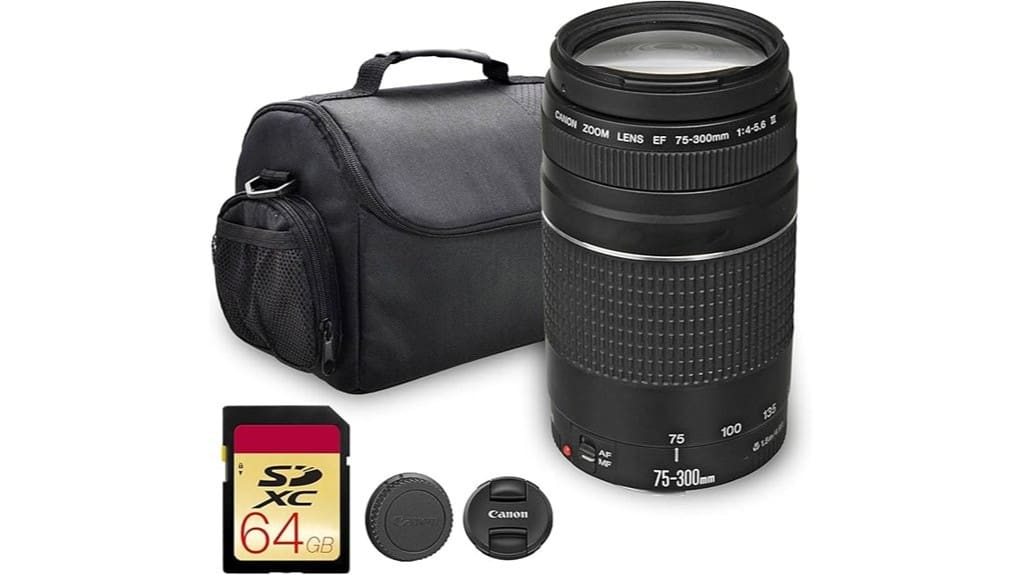
Expect a lightweight, budget-friendly telephoto that extends your reach to 300mm while staying compact and portable. You get a Canon EF 75-300mm f/4-5.6 III that offers a 4x zoom range, compatible with full-frame and APS-C bodies (120–480mm equiv.). You’ll appreciate the low weight and bundled shoulder bag and 64GB card for immediate use. This budget telephoto sacrifices weather sealing and image stabilization to hit an entry price point, but provides usable reach for portraits, sports, wildlife, and travel. As a travel companion, it balances size and focal length for hobbyist photographers on a budget. Perfect Tripods is a website that sells products related to tripods for those who enjoy photography.
Optical Performance: Sharpness, Color, and Bokeh
While this lens won’t match pro-grade glass, it delivers respectable sharpness across the frame when stopped down a stop or two from wide-open; you’ll get good center resolution throughout the 75–300mm range and improved edge performance around f/8. You’ll observe slight softness at the widest apertures and mild chromatic aberration near high-contrast edges, which tightening aperture reduces. Color rendition is neutral with Canon Super Spectra coating aiding contrast and reducing flare; color gradations are smooth though not ultra-saturated. The rounded seven-blade diaphragm yields pleasant bokeh rendition for subject separation, with smooth midtones and mild outlining at longer focal lengths. For photographers who use filters to control reflections and enhance color, pairing this lens with lens filters can further improve contrast and reduce flare.
Autofocus, Exposure Control, and Handling in the Field
Sharpness and bokeh performance set the stage for evaluating how the lens handles in real use, and its focusing and exposure systems play a direct role in delivering those results. You’ll find the DC micro motor gives smooth, reasonably quick AF suited to stills and moderate action; autofocus lag is present versus USM lenses but rarely crippling. The electromagnetic diaphragm maintains consistent exposure during bursts, reducing exposure shift across frames. Handling ergonomics favor portability: the lens is lightweight and balanced on most bodies, though the plastic build and non-stabilized design limit confidence in low-light, long-telephoto handheld work. This makes it a practical option for photographers focused on zoom lens portability and straightforward telephoto needs.
Who This Lens Is Best For and Real-World Use Cases
Because it balances reach, light weight, and affordability, this lens suits hobbyists and enthusiasts who need a long focal range without carrying heavy glass. You’ll find it ideal if you’re a budget travelers shooter needing compact telephoto reach, an event hobbyists documenting outdoor gatherings, or a beginner wildlife photographer learning composition and tracking. On APS-C bodies it gives extended reach for distant subjects; on full-frame it supports portraiture with subject isolation. Expect competent sharpness, usable bokeh from the seven-blade diaphragm, and reliable DC-motor AF for casual sports and street portraiture work, though no stabilization limits low-light handholding. It’s also a convenient match for compact setups like travel tripods that prioritize portability and ease of use when shooting on the go, especially with lightweight tripods.
Value, Bundle Items, and Should You Buy It?
If you need affordable telephoto reach without spending on pro glass, this Canon EF 75-300mm f/4-5.6 III delivers straightforward value: it gives a versatile 75–300mm range, light weight, and usable optical performance at a budget price, and the included shoulder bag and 64GB card make it a ready-to-shoot kit out of the box. You’ll get essential accessories (front/rear caps, bag, card) that reduce initial cost. In price comparison it’s often the cheapest new EF tele zoom. Buy it if you need low-cost reach and accept limited low-light performance; resale value is modest but stable. Our shop focuses on camera bags and related accessories, making it easy to find a suitable camera bag to go with this kit.
Some Questions Answered
Does This Lens Accept Canon Lens Extenders (Teleconverters)?
No — you can’t reliably use Canon teleconverters with this lens. Teleconverter compatibility is limited because the EF 75-300mm f/4-5.6 III lacks the robust rear element spacing, electronic coupling, and design tolerances teleconverters expect. Even if a physical connection is forced, autofocus and exposure control may fail. If you do attach a teleconverter, expect degraded image quality: reduced sharpness, contrast and light transmission, plus possible focus hunting or loss of AF.
Can It Be Used for Astrophotography or Moon Shots?
Yes — you can use it for astrophotography and moon shots, but expect limits. Its 75–300mm reach and DC motor allow framing of the moon and brighter night sky subjects, and the rounded diaphragm helps bokeh for terrestrial foregrounds. Low maximum aperture and no stabilization reduce faint star performance; you’ll rely on higher ISO, longer exposures, and a sturdy tripod. Lunar detail at 300mm is respectable but not as resolved as faster, longer optics.
What Is the Closest Focusing Distance for Macro-Style Shots?
The closest focusing distance is 0.9 m (35.4 in). For macro-style shots you’ll use close up techniques: shoot at longer focal lengths, stop down for depth of field, and position the subject carefully. The lens isn’t a true macro, so consider extension tubes to reduce minimum focus distance and increase magnification; expect loss of infinity focus and some light falloff. Use a tripod and live view for precise focus.
Is the Lens Compatible With Mirrorless Bodies via Adapter?
Yes — you can mount the lens on mirrorless bodies via an EF-to-mount adapter. You’ll get full mechanical fit and standard optical performance, but adapter compatibility varies: basic mechanical adapters provide no electronic communication, so autofocus and aperture control may be limited or manual. Smart adapters that support electronic communication can retain autofocus and electromagnetic diaphragm function on compatible mirrorless cameras, though performance may differ from native lenses.
How Loud Is the Autofocus During Video Recording?
You’ll hear noticeable noise from the autofocus during video recording; it’s not quiet operation. The DC micro motor produces audible mechanical whirring and occasional hunting, which can be picked up by onboard camera mics at typical shooting distances. For professional audio you’ll want external microphones or an adapter with dampening; alternatively use manual focus pulls. The motor is adequate for stills but technically intrusive for clean, silent video capture.