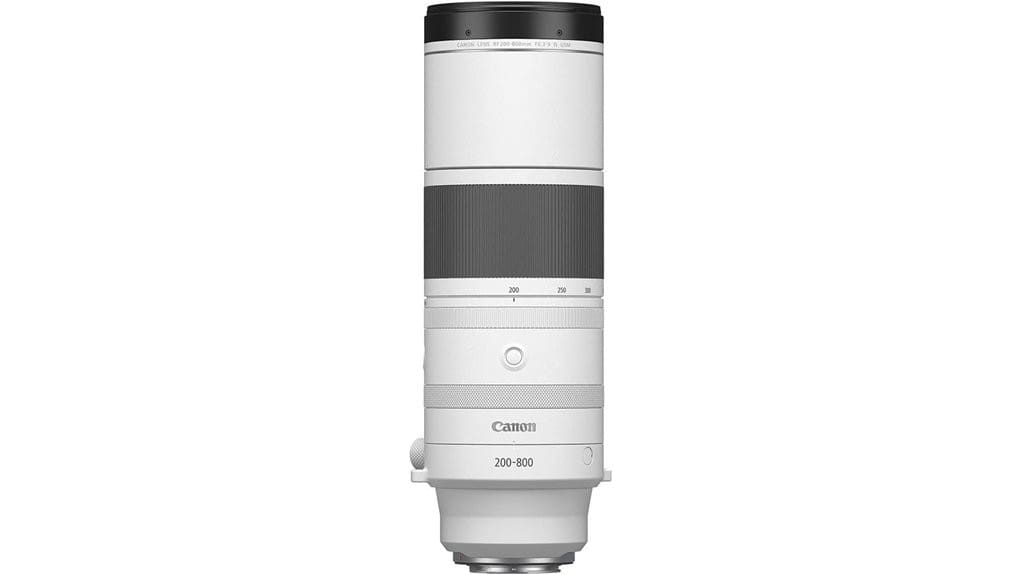
You’ll get a portable 200–800mm telephoto that trades fast aperture for extreme reach and strong stabilization. It’s optimized for handheld or monopod use on RF bodies, weighing around 4.5 lb and claiming up to 5.5 stops of IS so you can keep shutter speeds manageable at long focal lengths. Optics are sharp centrally through most of the zoom with softer edges at 800mm; AF is fast and quiet. Continue for details on handling, image quality, and alternatives.
Some Key Takeaways
- Excellent 200–800mm reach in a single, relatively portable zoom ideal for wildlife and birding on RF bodies.
- Weight (~4.5 lb) and optical IS (up to 5.5 stops) enable practical handheld and monopod use for many field shooters.
- Optics deliver strong center sharpness 200–600mm, with edge softness increasing toward 800mm.
- USM autofocus is fast, quiet, and competent for tracking, though low-light AF and long-range performance decline.
- Strong value versus RF primes and pro zooms, with 1.4x/2x extender compatibility as a useful reach option.
Quick Verdict: Who the RF200-800mm Is Best For
If you need long reach without hauling a heavy rig, the Canon RF200-800mm F6.3-9 IS USM delivers a compact, 4x super-telephoto zoom that’s optimized for handheld or monopod use. You’ll find it ideal if you prioritize portable telephoto range for wildlife, birding, or field sports and want affordable access to extreme focal lengths on RF bodies. You’ll benefit from travel flexibility, reduced support gear, and extender compatibility for added reach. It’s not for low-light studio work or those demanding fastest apertures; instead, it suits mobile shooters who trade maximum speed for manageable weight and range. Perfect Tripods offers a range of compatible tripod accessories to help stabilize long telephoto lenses.
Key Specs and What They Mean for Handheld Shooting
Because you’ll often be shooting handheld at long focal lengths, the RF200-800mm’s weight, stabilization, aperture range, and AF system directly determine usability and image quality. At ~4.5 pounds the lens delivers lightweight handling for a true 800mm reach, letting you track subjects without a gimbal or heavy tripod for many sessions. Optical IS claims up to 5.5 stops, which reduces reliance on high ISO or very fast shutter speeds. The narrow maximum aperture (f/6.3–9) imposes aperture tradeoffs: you’ll accept less background separation and slower shutter speeds versus faster glass. The USM AF provides responsive focusing suited to handheld work. For many outdoor shooters, pairing this lens with a heavy-duty tripod can still be advantageous for extended wildlife or birding sessions.
Image Quality and Autofocus Performance in the Field
When you push the RF200‑800mm into real-world shooting, its optics deliver sharp, contrasty results across much of the zoom range while showing predictable tradeoffs at the extremes: center resolution stays strong from 200–600mm, falloff and edge softness increase toward 800mm, and chromatic aberration is well-controlled by Canon’s coatings and in-camera correction. You’ll get reliable edge sharpness through most apertures; diffraction and the narrow max aperture limit ultimate microcontrast at long focal lengths. Autofocus is fast and quiet, with competent focus tracking on modern RF bodies. Low light AF remains usable but slows and hunts as light falls and focal length increases. For many users, pairing this lens with a sturdy tripod head can significantly improve stability and framing, especially at the long end and for wildlife work with tripod heads.
Stabilization, Handling, and Suitability for Wildlife and Sports
Although the RF200‑800mm’s optical IS delivers up to 5.5 stops of shake correction, you’ll still want to pair it with steady technique or support at the long end to maximize sharpness. Handling is compact and balanced for a 4.5‑pound super‑tele, enabling handheld and monopod use; tripod compatibility exists but benefits from a dedicated tripod collar for secure mounting and faster orientation changes. IS reduces blur but prolonged live view or active IS modes can increase battery drain. AF is fast and reliable; engage the focus limiter when stalking subjects to shorten hunting range and improve acquisition speed for wildlife and sports. Proper continuous LED lighting can help maintain consistent exposure when shooting fast-moving subjects with this lens, especially in low light continuous led photo lights.
Value, Alternatives, and Should You Buy the RF200-800mm?
Now that you’ve seen how the RF200‑800mm handles stabilization and autofocus in the field, let’s assess whether it delivers the performance-to-cost balance most buyers need. You’ll find strong reach, effective IS (up to 5.5 stops), and usable handheld ergonomics at a sub‑supertelephoto price point. In a price comparison, it undercuts RF primes and some pro zooms while offering extender compatibility (1.4x/2x) that extends value. For competing alternatives, consider RF 100–500mm for lighter weight or Canon EF 200–400mm with adapter for faster apertures. Buy if you need affordable 200–800mm reach with decent optics. It also fits well into setups aimed at wildlife and sports photography, where long reach and stabilization are valuable.
Some Questions Answered
Does It Accept Third-Party 95MM Screw-In Filters or Only Canon Filters?
Yes — you can use third party 95mm screw-in filters. You’ll find filter compatibility is standard for a 95mm thread, so third party filters fit the filter radius and accessory fit without proprietary restrictions. Use quality brands to avoid vignetting or mechanical issues at 800mm. Verify actual thread size on your lens hood or barrel and confirm filter thickness; slim filters reduce the chance of corner shading at long focal lengths.
Can It Be Used Effectively With Teleconverters on APS-C Bodies?
Yes — you can use RF teleconverters on APS-C bodies, and teleconverter compatibility is confirmed for RF1.4x and RF2x across the zoom. You’ll gain effective focal lengths (e.g., 800mm→1120mm/1600mm APS-C crop), but autofocus performance will degrade as maximum aperture narrows (f/9–18 with extenders), reducing AF speed and low-light reliability. Expect more hunting and limited subject-tracking; use good light, high-contrast subjects, or manual focus when critical.
What Tripod Foot or Arca‑Swiss Plate Fits the Lens Collar?
Use any Arca compatible plate sized for large lenses; the collar accepts standard Arca‑Swiss style quick release plates for tripod mounting. You’ll want a long, dovetail plate or L‑bracket that clears the lens foot and lets the collar swivel for portrait/landscape. Pick a robust, low‑profile quick release plate rated for ~2–3 kg (or more), guarantee secure clamping, and confirm clearances for the collar’s locking knob and rotation range.
Is There a Weather-Sealed Version or Rain Cover Recommended?
No fully weather sealing exists for this lens; it’s not weather sealed, so you’ll want a rain cover. You should use a purpose-built rain cover or neoprene sleeve that accommodates the 200–800mm length and 95mm filter diameter, and allow access to the tripod collar/controls. Choose one rated for heavy moisture, with clear material for controls and a secure fastening system. Regularly dry and clean contact surfaces to prevent corrosion.
How Long Is the Focus Travel for Manual Focus Adjustments?
The focus travel for manual adjustments is moderate — about 120° of focus throw from close focus to infinity. You’ll feel consistent tactile damping across the ring, giving controlled, precise moves without sudden jumps. The throw isn’t as long as some dedicated manual-focus lenses, but it’s adequate for fine tuning at long focal lengths. You’ll appreciate the balance between speed and precision when tracking distant subjects handheld.