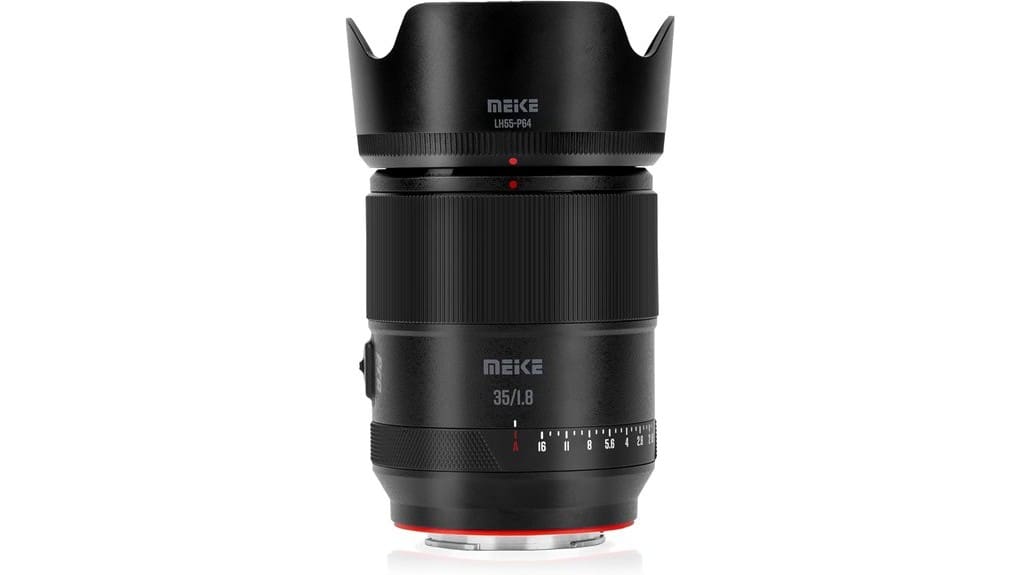
You’ll get a compact, metal-built 35mm f/1.8 STM that delivers strong center sharpness wide open and micro-detail rivaling mid-range native primes. Edge and corner acuity improve by f/2.8–f/4, with silky bokeh from a 9-blade diaphragm and controlled CA that’s correctable in RAW. STM AF is quiet and accurate for stills and casual video, though not as tenacious as top Sony lenses; there’s no optical IS but in-body stabilization helps — keep going to see specifics on handling, firmware and value.
Some Key Takeaways
- Sharp center wide open with contrast and micro-detail comparable to mid-range native 35mm primes.
- Corners soften on full-frame but improve significantly by f/2.8–f/4.
- Smooth bokeh from a 9-blade diaphragm with minimal outlining; slight longitudinal CA at extreme apertures/close focus.
- Quiet, quick STM autofocus suitable for video; no optical IS, relies on in-body stabilization.
- Compact metal build, good value vs OEM lenses, firmware-updatable AF with Type-C support.
How the Meike 35mm F1.8 STM Performs on Sony E Cameras
Mount the Meike 35mm F1.8 STM on any Sony E body and you’ll get a sharp, fast 35mm prime that competes well with native mid‑range lenses. You’ll notice compact size that keeps balance on full‑frame bodies like the A7III or A7C, and it won’t strain smaller APS‑C rigs. Autofocus is driven by an STM motor delivering quick, accurate locks and silent operation suitable for video. Build feels utilitarian but precise; control rings are responsive. Compared to native options it offers similar focal rendering and lower cost, with firmware upgradability addressing occasional AF quirks across Sony bodies. It’s a great option for mirrorless camera enthusiasts who value essential gear designed specifically for mirrorless systems.
Image Quality: Sharpness, Bokeh, and Chromatic Aberration
When you shoot with the Meike 35mm F1.8 STM, you get a lens that delivers strong center sharpness wide open with contrast and micro-detail rivalling many mid‑range native 35mm primes. You’ll find edge sharpness improves markedly by f/2.8–f/4; corners remain slightly softer on full‑frame but usable for landscapes. Out‑of‑focus rendering is smooth, offering silky bokeh with minimal outlining thanks to the 9‑blade diaphragm and optical design. Chromatic aberrations are controlled: lateral CA is modest and correctable in RAW, while longitudinal CA appears as slight magenta/green fringing at extreme apertures and close focus distances. This makes it a practical choice for photographers who also require reliable lens calibration tools to fine-tune focus and maximize image quality.
Autofocus, Stabilization, and Real-World Low-Light Use
Although not class-leading, the Meike 35mm F1.8 STM‘s autofocus is reliable and responsive in most everyday situations, thanks to its stepping motor design that balances speed with quiet operation. You’ll notice low autofocus latency for static subjects and routine tracking, though it trails high-end native Sony lenses under challenging motion. The lens relies on in-body stabilization and camera-driven digital stabilization modes rather than optical IS, so you must depend on body IS and firmware. In low-light you’ll exploit f/1.8 and effective multi-coating to reduce hunting; performance is competent for stills and casual video but not elite low-light work. Mastering light meters can help you better expose challenging scenes when using this lens, especially in low-light situations.
Build, Handling, and Compatibility With Full-Frame and APS-C Sony E Bodies
After testing autofocus and low-light performance, you’ll notice the Meike 35mm f/1.8 STM feels built more like a value-focused third-party lens than a flagship Sony optic. Its compact size and metal build give a reassuring heft without bulk; you’ll appreciate the low center of gravity on A7-series bodies and nimble balance on APS-C bodies like the A6400. Button placement is minimal and logical — AF/MF toggle and programmable contact sit where you expect. The focus ring is smooth, slightly damped, with precise manual override. Mount compatibility is solid across full-frame and APS-C Sony E systems. For photographers who use tripods frequently, the lens’s balance and modest weight make it a good match for many compact tripod setups.
Value Assessment: Price, Firmware Support, Warranty, and Who Should Buy
Because it balances specs and cost, the Meike 35mm f/1.8 STM represents a strong value for shooters who want fast glass without a flagship price. You get a sharp 35mm prime, STM AF, ED and aspherical elements, and multi-coating at a fraction of OEM lenses. Firmware updates via Type-C and Android real-time support give practical upgrade paths; note Mac/iOS limitations. Warranty is one year with common 30-day return windows through retailers. For budget buyers and enthusiast hobbyists it’s a clear buy; pros who require brand service, stabilization in-lens, or top-tier autofocus may prefer native-brand alternatives. The site focuses on helping buyers choose the right portrait optics with guidance on lenses and accessories, including portrait camera lenses.
Some Questions Answered
Does This Lens Include a Lens Hood in the Box?
No, the package typically doesn’t include a lens hood. You’ll get basic in box accessories like rear and front caps, body cap, warranty card, and manual, but a dedicated lens hood is usually omitted. Compared to many competing 35mm f/1.8 primes, manufacturers often include hoods; here you’ll need to buy one separately if you want flare control and extra protection. Check retailer listings to confirm final accessory contents.
What Is the Minimum Focusing Distance?
The minimum focusing distance is 0.3 meters. You’ll achieve close focusing down to 0.3 m (about 11.8 inches), letting you fill the frame more than many 35mm primes. This minimum distance yields a modest magnification useful for tight environmental portraits and detail shots, though it won’t match macro lenses. In comparative terms, it balances everyday versatility with reasonable close-focus capability without specialized macro performance.
Is There Weather Sealing or Moisture Resistance?
No — you won’t get formal weather resistance or gasket sealing on this lens. It lacks dedicated environmental seals around mounts or control rings, so it’s less protected than many weather-resistant primes. You’ll need caution in damp or dusty conditions and should avoid heavy rain without additional protection. For consistent outdoor shooting, you’ll want a lens with explicit gasket sealing or use covers and careful handling to prevent moisture ingress.
Can It Be Used With Third-Party Adapters or Teleconverters?
Yes—you can use third party compatibility adapters, but results vary. You’ll retain mechanical mount fit on Sony E via common adapters; autofocus may be slower or less reliable. Using teleconverters will degrade teleconverter performance: expect reduced effective aperture, softer edges, and slower AF or hunting. Compare results practically—some adapters preserve EXIF and AF, others don’t. Test combinations before critical shoots and update firmware for best compatibility.
What Are the Filter Thread Size and Recommended Filters?
The filter thread size is 52mm. You’ll want 52mm filters: a circular polarizer for glare and contrast control, a UV protector for front-element safety and slight haze reduction, and neutral density filters to control exposure and enable motion blur at f/1.8. Compare slim-profile CPLs and NDs to avoid vignetting on full-frame; opt for multi-coated 52mm filters to minimize reflections and maintain sharpness across the frame.