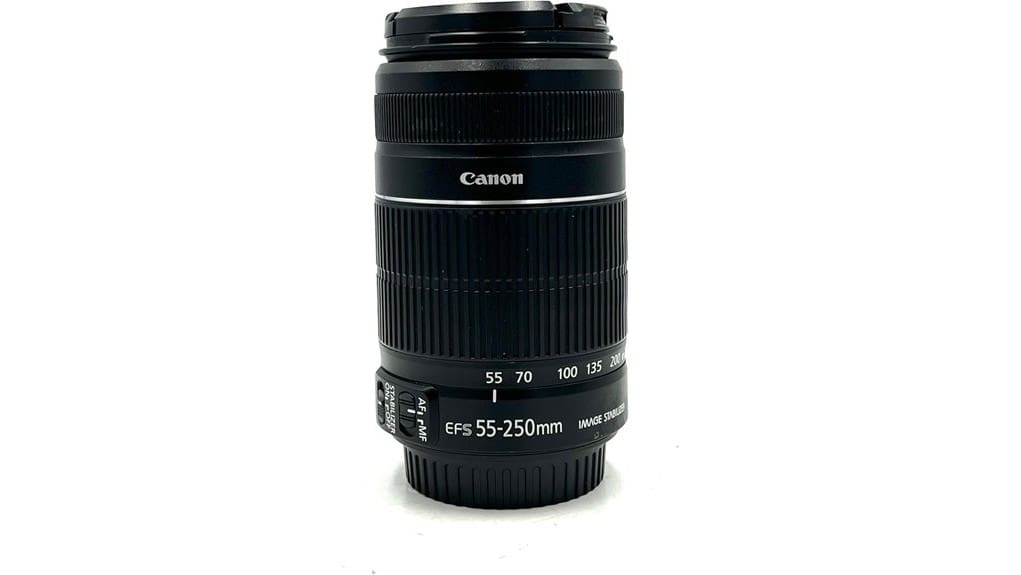
You’ll get a lightweight, affordable 88–400mm equivalent telephoto that’s sharp in the center from 55–135mm and improves when stopped down one to two stops. Autofocus uses a DC motor that’s reasonably quick and repeatable but not silent or pro‑grade, while the Optical Image Stabilizer offers roughly four stops of handheld correction. Build is polycarbonate with limited weather sealing and a variable f/4–5.6 max aperture, and the rest of the review explains practical uses, limits, and alternatives.
Some Key Takeaways
- Lightweight, compact 55–250mm (88–400mm eq.) telephoto offering strong center sharpness, best at f/5.6–f/8.
- Optical Image Stabilizer provides about four stops of handheld correction for low-light and telephoto use.
- Variable f/4–5.6 max aperture limits low-light performance and depth‑of‑field control compared with faster lenses.
- DC motor AF is reasonably quick and repeatable but not as fast or silent as pro-grade systems.
- Best value for APS‑C enthusiasts seeking reach and portability; skip if you need pro-level speed, build, or weather sealing.
What the 55–250mm IS II Gives You (Key Specs and Real‑World Benefits)
While small and light, the Canon EF-S 55–250mm f/4–5.6 IS II delivers a practical telephoto range (88–400mm equivalent on APS-C) for subjects at a distance, combining a 4.5:1 zoom ratio with a 0.31x maximum magnification and a 3.6 ft close-focus to handle portraits, sports, and wildlife. You get a budget telephoto that pairs compact portability with effective reach: 55–250mm zoom, UD element, Super Spectra coatings, seven-blade diaphragm, and 58mm filter thread. The DC motor autofocus and Optical Image Stabilizer give usable handholding flexibility, while 12 elements in 10 groups balance size against chromatic control. This lens is a solid pick for DSLR enthusiasts and photographers seeking essential gear for travel and everyday shooting, especially when space and weight are concerns compact portability.
How It Performs: Sharpness, Autofocus, and Stabilization Tests
Because this lens balances compactness with a practical telephoto range, you’ll want to know how it performs under scrutiny: we tested sharpness across focal lengths and apertures, measured autofocus speed and consistency, and evaluated the Image Stabilizer’s real-world shake correction. You’ll find center sharpness strong from 55–135mm at f/5.6–f/8; edge performance softens toward 250mm and wide apertures. Sharpness consistency is good for the class, improving stopped down one to two stops. The DC-driven AF is reasonably quick and repeatable but not silent. Stabilization longevity is excellent for handheld low‑light use, delivering roughly four stops of correction. This makes it a sensible choice for photographers seeking reliable lens adapters compatibility with compact telephoto setups.
Real Shooting Scenarios: Wildlife, Sports, Portraits, and Travel Use
When you need a lightweight telephoto for travel, wildlife, sports, or portraits, the Canon EF-S 55-250mm f/4-5.6 IS II delivers a practical balance of reach, stabilisation, and portability that suits APS-C shooters. You’ll use its 88–400mm equivalent reach for wildlife stalking at distance, relying on IS for handheld capture. For sports panning, the lens’ weight and IS let you track subjects with slower shutter speeds, though AF isn’t pro-grade. In portraits, focal length and 7‑blade diaphragm yield usable portrait bokeh at longer focal lengths. Travel packing benefits from compact dimensions and 390 g weight for long days. Our site also recommends pairing it with camera backpacks designed for photographers on the move.
Strengths and Trade‑Offs: Who Should Buy This Lens and Why
Although compact and affordable, the Canon EF-S 55-250mm f/4-5.6 IS II targets APS-C shooters who need extended reach and reliable stabilization without adding bulk or cost. You’ll get a budget telephoto that delivers usable sharpness across the range, effective Optical Image Stabilizer performance (≈4 stops), and a lightweight, beginner friendly build that’s easy to handle on hikes or at events. Trade-offs include a variable slow maximum aperture, modest autofocus speed compared with higher-end lenses, and limited weather sealing. Buy it if you prioritize reach, portability, and low cost; skip it if you need pro-level speed or robustness. It’s a great match for photographers focused on mirrorless camera lenses who want an affordable, portable telephoto option.
Buying Advice: Where It Fits vs Alternatives and Value‑for‑Money Guidance
You’ve seen where the 55–250mm IS II shines and where it compromises; now let’s place it against alternatives and judge value. You’ll find it excels for enthusiasts needing reach, light weight, and reliable image stabilization at a low cost. Compare price comparisons with third‑party 70–300mm and Canon EF 70–200mm options: the IS II undercuts professional glass but lags in autofocus speed and weather sealing. Assess build quality against alternatives—polycarbonate construction keeps weight down but reduces durability. If you prioritize budget, portability, and ~4 stops IS, it’s strong value; pros seeking ruggedness or faster optics should upgrade. For those assembling travel kits, consider how tripod head choice affects portability and stability, especially when pairing with lightweight tripod heads that balance the lens’s reach and your shooting needs.
Some Questions Answered
Is This Lens Compatible With Full‑Frame Canon Bodies?
No — you can’t mount this EF‑S lens directly on full‑frame Canon bodies; it’s designed for crop compatibility with APS‑C EF‑S mounts. You could use third‑party mount adapters or an EF‑S‑to‑EF adapter with limitations, but expect vignetting, reduced image circle coverage, and potential mechanical/electronic issues. For full‑frame cameras you should choose native EF lenses to preserve frame coverage, autofocus reliability, and image quality without adapters.
Does the Lens Include a Lens Hood or Case in the Box?
No, the box typically doesn’t include a lens hood or carrying case. You’ll get the Canon EF-S 55-250mm f/4-5.6 IS II lens with caps and documentation; optional accessories like a dedicated lens hood or carrying case are sold separately. You should plan to purchase a 58mm hood or protective pouch if you need flare control or transport protection. Check retailer listings for bundle offers that may add these items.
Can I Use 58MM Screw‑On Filters Like Polarizers and ND Filters?
Yes — you can use 58mm screw‑on filters like polarizers and ND filters. The lens has a 58mm filter thread and a front element that accepts screw‑on filters directly. Be aware that using a polarizer requires rotation; the lens’ front element may rotate slightly during focusing, so check for unintended polarization changes. Thick filters can vignette at 250mm; choose slim profiles for wide telephoto use to avoid edge darkening.
What Warranty Length Does Canon Provide for This Lens?
The warranty length is one year. You’ll receive a one-year limited warranty; coverage details include manufacturing defects in materials and workmanship under normal use, with Canon repairing or replacing components at their discretion. The warranty won’t cover incidental damage, misuse, normal wear, or unauthorized repairs. You should retain proof of purchase and register the product where required to expedite claims. Check Canon’s official terms for regional variations and specific exclusions.
Is the Lens Weather‑Sealed for Shooting in Rain or Dust?
No — it isn’t weather‑sealed. You won’t get official weather resistance, so avoid rain and dusty conditions. The lens lacks gasketed mounts and sealed elements, so moisture testing would likely reveal vulnerability to water ingress and dust entry under real‑world use. You should use protective covers, rain sleeves, or an umbrella and avoid heavy exposure; for sustained adverse conditions, choose a sealed lens or body with robust environmental sealing instead.