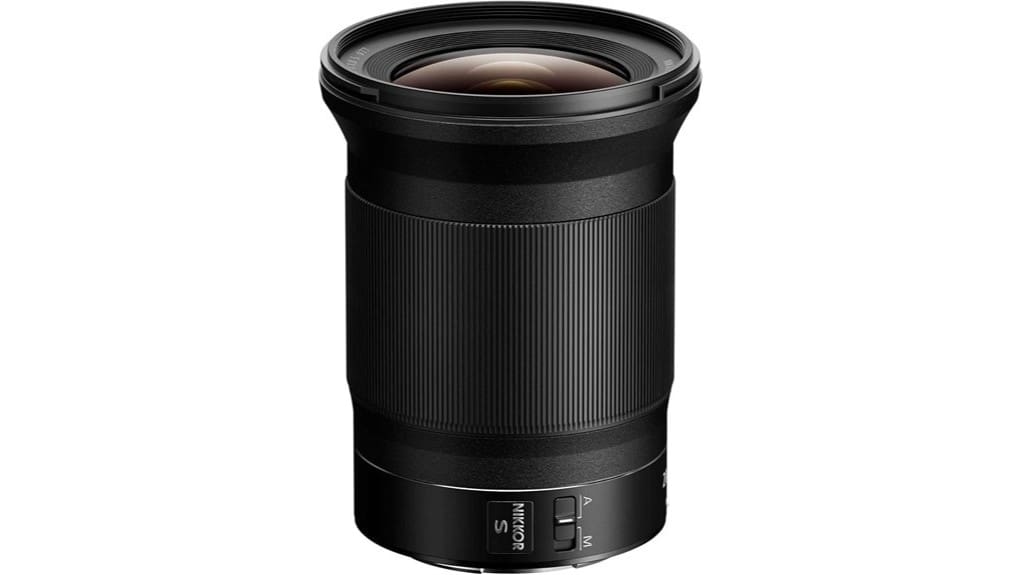
You’ll find the NIKKOR Z 20mm f/1.8 S delivers pro-grade edge-to-edge sharpness, fast, reliable autofocus, and excellent coma control for astrophotography. Its f/1.8 aperture and smooth nine-blade bokeh give you low-light versatility and pleasing background highlights, while Nano Crystal Coat and ED elements keep flare and chromatic aberration low. It balances well on Z6/Z7/Z9 bodies, uses 77mm filters, and for the price you’re buying build and optical quality—keep going to see specifics.
Some Key Takeaways
- Outstanding sharpness center-to-near-edge at f/1.8, with peak razor-sharp results stopped down to f/4–f/8.
- Nano Crystal Coat and ED elements minimize flare and chromatic aberration, delivering high-contrast images.
- Fast, reliable autofocus with smooth manual control; relies on camera IBIS for stabilization.
- Excellent coma control and pleasing nine-blade bokeh, making it great for astrophotography and environmental portraits.
- Premium build, 77mm filters, and native Z compatibility suit Z6/Z7/Z9 users, though price competes with third-party alternatives.
Verdict up Front: Is the NIKKOR Z 20MM F/1.8 S Worth It?
Cut to the chase: if you shoot landscapes, astrophotography, architecture, or environmental portraits on a Nikon Z body, the NIKKOR Z 20mm f/1.8 S is worth strong consideration. You’ll face a buyer’s dilemma balancing price against pro-grade build, advanced coatings, and fast f/1.8 aperture. Your value assessment should weigh durable construction, native Z compatibility, 77mm filter use, and a compact 17.76 oz form factor against alternatives and system priorities. If you need a versatile ultra-wide that integrates seamlessly with Z6/Z7/Z9 bodies and prioritizes image quality and handling, this lens justifies serious consideration. As a shop focused on gear for mirrorless camera enthusiasts, we often recommend considering native Z compatibility when choosing lenses for optimal performance.
Optical Performance: Sharpness, Bokeh, and Low-Light Results
When you push the NIKKOR Z 20mm f/1.8 S hard, its optical pedigree shows: resolution is impressively high from center to the near-edges at wide apertures, and stopping down to f/4–f/8 delivers razor-sharp results across the frame. You’ll get strong edge contrast that preserves detail in complex scenes, while Nano Crystal Coat and ED elements keep flare and chromatic aberration tightly controlled. Bokeh is smooth for an ultra-wide, with nine blades producing pleasing highlights and natural falloff. Low-light performance impresses: f/1.8 yields usable shutter speeds and clean files, aided by excellent coma control on point sources. For shooters who enjoy close-up work, pairing this lens with dedicated macro techniques can elevate your ultra-wide close-ups to a new level.
Autofocus, Stabilization, and Physical Handling in Real Use
Although it’s a wide prime, the Z 20mm f/1.8 S focuses with surprising speed and assurance, thanks to Nikon’s all-new multi-focusing system that locks onto subjects quickly and re-centers with minimal hunting. You’ll notice fast AF in stills and video, with dependable focus accuracy even at f/1.8. On bodies with IBIS you get predictable stabilization behavior; the lens itself relies on camera stabilization rather than internal OIS. Handling ergonomics are excellent: balanced on Z-series bodies, the focus ring is smooth with a firm detent for manual override, and the 77mm filter thread and bayonet hood aid practical, professional use. For shooters looking to accessorize, consider an L-bracket for secure tripod mounting and easier landscape framing.
Who Should Buy It: Shooting Scenarios and Camera Compatibility
If you shoot landscapes, astro, architecture, or environmental portraits and want edge-to-edge sharpness with a fast f/1.8 aperture, the NIKKOR Z 20mm f/1.8 S is designed for you. You’ll benefit if you’re a landscape photographer needing high resolution across the frame, or an astrophotography enthusiast chasing pinpoint stars at wide apertures. It pairs naturally with Z6/Z6 II, Z7/Z7 II and Z9 for full-frame performance; Z5 and Z50 work as well (Z50 crops field). You’ll also use it on adapted F-mount bodies via FTZ. If you require ultra-wide, high-contrast results, this lens fits. The lens is especially well-suited for photographers who prioritize edge-to-edge sharpness in wide-angle compositions.
Alternatives, Price Value, and Warranty/Ownership Notes
Having outlined who gets the most from the NIKKOR Z 20mm f/1.8 S, let’s look at alternatives, pricing, and ownership considerations so you can weigh value against needs. You’ll compare the Z 20mm to wider or cheaper options (like third-party 20–24mm primes or Nikon’s older F-mount options via adapter) for a clear price comparison and performance trade-off. Factor resolution, build, and autofocus priority against cost. Note warranty caveats: Nikon’s one-year US limited warranty applies only to authorized purchases; gray-market units won’t receive Nikon USA support. Keep proof-of-purchase and inspect return policies before buying. For further protection of your gear information and purchase records, consider using camera insurance information holders to organize warranties and receipts.
Some Questions Answered
Does It Accept 77MM Screw-In Filters Like ND or Polarizers?
Yes — you can screw 77mm filters like ND or polarizers onto the lens’ front. You’ll use 77mm adapters and the lens’ 77mm filter thread; that accepts standard screw-in filters. Be cautious with filter stacking, since adding multiple filters can cause vignetting or flare on a 20mm ultra-wide. For best results use a single high-quality filter or slim-profile elements and test for any corner darkening before critical shoots.
Can It Be Used for Astrophotography Without Noticeable Coma?
Yes — you can use it for astrophotography without noticeable coma. Its coma performance is excellent thanks to advanced S-Line optics and ED elements, so stars stay round toward the corners. You’ll see excellent star sharpness comparison against many fast ultra-wides, especially stopped to f/2.8–f/4. You should still test for your sensor and framing, but overall it delivers very low coma and impressive edge-to-edge stellar detail.
Is There a Focus Breathing Issue During Video Recording?
You won’t see significant focus breathing during video recording; the Z 20mm f/1.8 S stays stable when shifting focus, so framing remains consistent. You should, however, watch for slight edge softness when racking focus wide open—stopping down a bit reduces it. Use manual focus pulls and focus peaking for critical work. Overall, it’s well-behaved for video, offering minimal focus breathing and controllable edge softness with proper aperture and technique.
Does It Support In-Camera Lens Corrections for Z-Series Bodies?
Yes — you’ll get in camera corrections on Z-series bodies that support lens correction profiles. The camera applies a built-in lens profile to correct distortion, vignetting and chromatic aberration automatically for the Z 20mm f/1.8 S. You can override or fine-tune corrections in camera menus or RAW software if needed. Check firmware and camera model compatibility to make certain the latest lens profile is available for best results.
Can Third-Party Lens Caps and Hoods Fit Securely?
Yes — aftermarket caps and generic hoods can fit securely, but you’ll want to confirm sizes and quality. The lens uses a 77 mm front thread, so buy Aftermarket caps sized 77 mm and Generic hoods designed for 20mm ultra-wides or with the same bayonet fitting. Choose well-reviewed, rigid plastics or metal caps and hoods with proper bayonet mounts to avoid light leaks, vignetting, or a loose fit during active use.