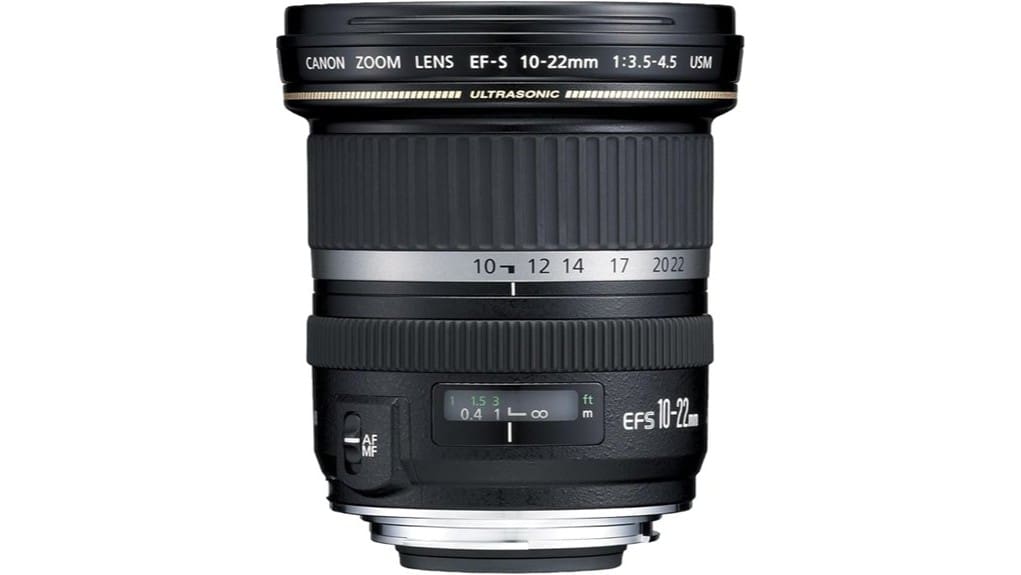
You’ll find the Canon EF-S 10–22mm f/3.5–4.5 USM gives you dependable wide-angle coverage on APS-C bodies, with sharp center-to-edge performance at 10–16mm and manageable corner softness near 22mm that tightens by f/8. Its USM delivers fast, reliable AF with full-time manual override, and a 9.5‑inch close‑focus lets you emphasize foregrounds for interiors and panoramas. It’s compact and portable with some vignetting and CA you can correct in RAW — continue for specifics and comparisons.
Some Key Takeaways
- Excellent wide-angle coverage for APS-C bodies (10–22mm ≈ 16–35mm full-frame), ideal for landscapes and architecture.
- Sharp centers wide-open at 10–16mm, with slight corner softening toward 22mm improved by stopping down to f/8.
- Fast, reliable USM autofocus with full-time manual override and modest focus breathing for video.
- Compact, lightweight build favors portability, though exhibits some vignetting and measurable edge softness.
- Good used-market value; consider tripod for critical compositions and RAW corrections for distortion and chromatic aberration.
Quick Verdict: Who the 10-22mm F/3.5-4.5 USM Is Best For
While you’re shooting on an APS-C Canon EOS body, the EF-S 10-22mm f/3.5-4.5 USM gives you a dependable wide-angle tool for landscapes, architecture, and interiors where you need expansive coverage and rectilinear rendering. You’ll find it suits landscape photographers who require consistent edge-to-edge performance and manageable distortion control for panorama stitching. For architectural interiors, you’ll value the framing flexibility at short distances and the 9.5-inch close-focus for emphasizing foreground elements. Autofocus is quick thanks to USM, and full-time manual lets you refine critical focus. It’s optimized for EOS DSLRs and practical for field use. For many photographers, pairing this lens with a sturdy tripod improves image sharpness and helps with precise compositions.
What the Lens Offers: Key Specs and Optical Features
Because the EF-S 10-22mm f/3.5-4.5 USM is built specifically for APS-C Canon DSLRs, it delivers a true wide-angle 10–22mm range (approx. 16–35mm full-frame equivalent) with a variable maximum aperture of f/3.5–4.5. You get an ultra wide perspective for landscapes and interiors, with circular aperture design aiding highlight rendering. Optical construction uses specialized elements to reduce aberrations and maintain contrast across the zoom. Aperture behavior is progressive—f/3.5 at 10mm, narrowing toward f/4.5 at 22mm—so exposure planning matters. Distortion control is addressed in design and corrected easily in RAW workflows. It’s an excellent choice for photographers focused on wide-angle composition who want reliable performance without the weight and cost of pro-level glass.
Real-World Performance: Sharpness, AF Speed, and Close-Focus Behavior
Although not a professional-grade tele, the EF-S 10-22mm delivers consistently strong real-world sharpness across its range, fast AF performance thanks to the USM, and useful close-focus behavior that expands creative framing. You’ll find sharpness consistency center-to-edge at 10–16mm wide-open, with slight corner softening toward 22mm that you can correct stopping down to f/8. The USM yields rapid, reliable acquisition and smooth tracking for most handheld scenarios; full-time manual lets you refine focus instantly. Close-focus (9.5 in) produces usable subject isolation and perspective; expect modest focus breathing when racking focus for video or critical framing. Teleconverters can extend reach for many lenses but are best used with compatible optics for optimal results, especially when considering teleconverter compatibility.
Strengths and Trade-Offs: Build, Handling, and Image Quality Compared to Competitors
When you compare the EF-S 10-22mm to similarly priced wide-angle zooms, its compact, lightweight construction and USM-driven autofocus give it a clear handling advantage for handheld work and run-and-gun shooting. You’ll appreciate the solid construction feel despite modest weight; controls are positive and the focus ring supports full-time manual override. Optically, center resolution is strong at mid apertures, but you must accept measurable edge softness at wide settings and some vignetting that competitors may correct better. Chromatic aberration is controllable in RAW. Overall trade-offs favor portability and AF performance over absolute corner-to-corner uniformity. For photographers using tripods, choosing the right tripod head can further improve handling and stability, especially for wide-angle compositions and long exposures — consider a head that balances smooth panning with secure locking, such as a fluid or ball head.
Should You Buy It? Pricing, Alternatives, and Final Recommendation
Having weighed handling, AF speed, and optical compromises, you’ll now judge whether the EF-S 10-22mm delivers value against its price and alternatives. You’ll find new retail often commands a premium for build and USM performance; watch for seasonal discounts or bundle deals to improve entry cost. Buying in used condition can yield strong optical return if elements are clean; verify aperture and AF operation. Alternatives like third-party wide-angle zooms offer similar ranges at lower cost but with trade-offs in coatings and AF. Resale value stays reasonable for Canon glass, so you can recover part of your investment. Consider also the impact of battery performance on shooting endurance and whether spare batteries are readily available.
Some Questions Answered
Does This Lens Include Image Stabilization (IS)?
No, it doesn’t include image stabilization. You won’t find optical stabilization or gyro sensors in this lens; Canon left IS out to keep weight and cost down. You’ll rely on fast shutter speeds, camera IS (if body-equipped), or a tripod for shake control. The lens offers USM autofocus and close-focusing ability, but stabilization duties fall to technique or camera-body stabilization systems rather than any onboard optical or gyro-based mechanism.
Is It Compatible With Full-Frame Canon Cameras?
No — it isn’t compatible with full frame cameras. You’ll get mount and mirror clearance issues using an EF-S lens on full frame bodies. For APS-C bodies the lens delivers expected wide-angle coverage, but on full frame you’d face mechanical incompatibility or severe vignetting if adapted. Consider sensor cropping implications: on APS-C you effectively crop focal length, retaining field of view; on full frame you need an EF-design wide-angle instead.
Does It Come With a Lens Hood and Carrying Pouch?
No, it typically doesn’t include a lens hood or carrying pouch in the box; you’ll get the lens, lens cap, and basic storage case/packaging only. You’ll need to purchase a dedicated lens hood and a padded pouch or bag separately for protection and flare control. Check the specific retailer or kit listing—some bundles add a hood or soft pouch, but standard Canon retail packs supply just the lens, lens cap, and minimal storage case.
Can I Use This Lens for Video Without Focus Breathing?
No — you’ll see noticeable focus breathing with this lens. Its wide-angle zoom shifts framing as focus changes, so it’s not ideal for breathing-free rack focus. You can mitigate the effect by using manual focus and a manual follow focus system to make smoother, repeatable pulls, but you won’t eliminate the focal-length-induced framing change. For critical video work, consider lenses specifically optimized for minimal focus breathing.
Is It Weather-Sealed for Shooting in Rain?
No — it isn’t weather-sealed, so you shouldn’t assume rain-ready performance. You’ll face weather resistance limitations and sealing concerns with this EF-S lens; its barrel lacks dedicated gaskets and protective barriers. If you’ll shoot in wet conditions, you’ll need external protection (rain cover, sealed housing, or quick-dry kit) and cautious handling. For professional reliability in rain, choose a lens explicitly specified as weather-sealed or use all-encompassing environmental protection.