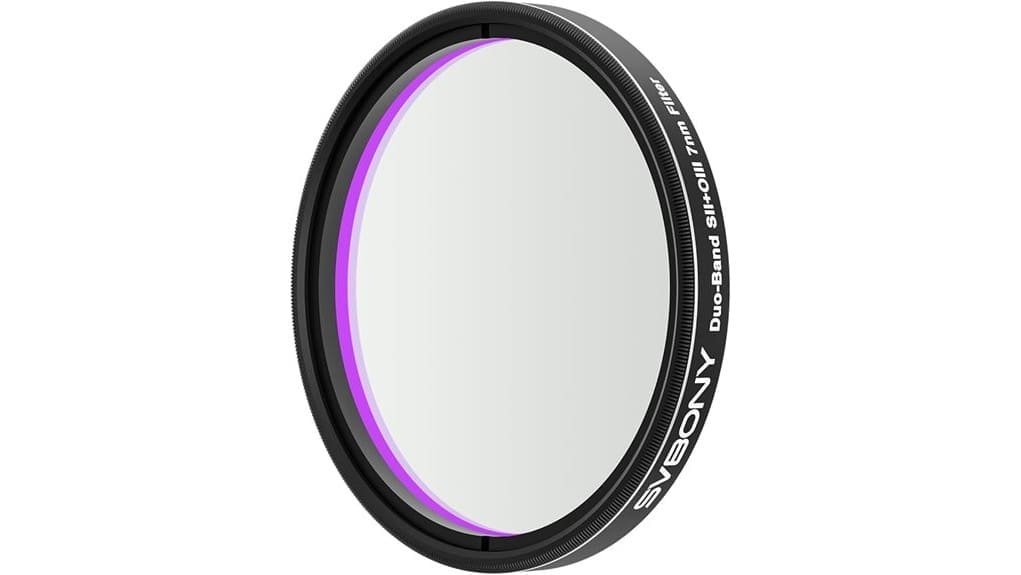
If you shoot emission nebulae from light-polluted skies or under moonlight, the SVBONY SV220 dual-band SII+OIII filter can boost contrast by isolating two 7 nm lines with OD5 rejection and high-transmission coatings. It’s compact, fits standard 2″ slots or 48 mm adapters, and works well on fast optics (~f/4) and APS-C sensors for targeted HII, PN, and SNR work. It’s budget-friendly with a 1-year warranty—keep going to see detailed performance, mounting tips, and alternatives.
Some Key Takeaways
- SVBONY SV220 is a dual narrowband SII+OIII (7 nm each) filter aimed at emission nebula imaging from light-polluted or moonlit skies.
- It sharply rejects skyglow (OD5 cutoff) and uses high-transmission coatings to improve emission-line contrast while preserving throughput.
- Best for fast optics (~f/4), targeted HII regions, planetary nebulae, and SNRs; reduces continuum and light-pollution noise.
- Fits standard 2″ filter slots and 48 mm adapters; verify backfocus and sensor coverage for full-frame or focal-reduced setups.
- Budget-friendly with a 1-year warranty and 30-day returns; alternatives include Astrodon, Baader, ZWO, and IDAS for coatings and support.
Who Should Buy the SVBONY SV220 and When to Use It
If you image emission nebulae from light-polluted sites or during bright-moon sessions, the SVBONY SV220 is for you: it’s a 2″ SII+OIII dual narrowband (7 nm each) filter that boosts contrast on HII regions, planetary nebulae, and supernova remnants while sharply cutting artificial skyglow (OD5). You’ll find it suits beginner astrophotographers and urban imagers who use fast optics (≈f/4 or faster) and standard 2″ filter slots. It’s compact (50.8 mm), lightweight (80 g), and multi-coated for high transmission. Use it when sky background dominates, for targeted emission-line work, or during moonlit imaging sessions. Keep your gear dry with silica desiccants to prevent moisture-related issues when storing and transporting the filter in humid conditions camera desiccant.
How the SV220’s SII+OIII Dual-Band Optics Improve Nebula Contrast
Because the SV220 isolates both SII and OIII emission with narrow 7 nm passbands, it preserves nebular line signal while rejecting broad-spectrum skyglow, so you’ll get much higher line-to-background contrast on HII regions, planetary nebulae, and supernova remnants. You’ll notice narrowband isolation reduces continuum and light-pollution noise, letting line-rich structures stand out. High transmission coatings maintain useful photon throughput despite tight bandwidths, so exposure times stay practical on fast optics. The dual-band design captures two dominant nebular lines simultaneously, simplifying acquisition and post-processing. Use with f/4 or faster systems to maximize resolved contrast and signal efficiency. Proper storage in a dry cabinet helps protect filters and other camera gear from humidity-related damage.
Real-World Performance: Tests on Emission, Planetary, and SNR Targets
When you put the SV220 on real targets, its dual 7 nm SII/OIII bands deliver a marked increase in contrast for emission nebulae, planetary nebulae, and supernova remnants while keeping exposure times reasonable on fast optics. You’ll notice sharper emission lines against suppressed sky background, especially under light-polluted or moonlit conditions. Use disciplined filter calibration and robust exposure stacking to recover faint filamentary structure; bias, dark, and flat frames remain essential. On planetary nebulae the OIII peak yields high definition of cores, while SII reveals outskirts and SNR shocks. Dynamic range limits require careful gain choice to avoid saturation. Polarizing filters can further help manage reflections and improve sky contrast when imaging from urban locations by reducing scattered light skyglow.
Compatibility, Mounting, and Recommended Camera/Telescope Setups
Although designed for straightforward 2″ filter slots, the SVBONY SV220 also threads into 48 mm adapters, so you can mount it directly to most telescopes and cameras that accept standard 2″ filters or 48 mm threads. You’ll use common mounting adapters for DSLR, mirrorless, and dedicated astronomy cameras; confirm thread compatibility before ordering. Sensor coverage is sufficient for small to medium APS-C sensors without vignetting on fast scopes; full-frame may need test frames. Watch field rotation with alt-az mounts during long exposures. Check backfocus considerations for focal reducers and off-axis guiders to maintain parfocality and avoid focus shift. For transporting and protecting your setup in the field, consider using a rugged Pelican case to keep filters and adapters safe.
Value, Warranty, and Alternatives Worth Comparing
If you’re weighing value, the SVBONY SV220 delivers narrowband performance (7 nm SII/OIII, OD5 cut-off) and a 1-year warranty plus 30-day returns at a budget-friendly price, making it a cost-effective choice for imaging emission nebulae under light-polluted or moonlit skies. You’ll get measurable contrast gains versus broadband filters; factor in weight, build, and lack of water resistance. For price comparison, check branded narrowband options (Astrodon, Baader) and mid-range alternatives (ZWO, IDAS) for coatings and warranty length. The seller’s return policy is 30 days; after warranty, maintenance is available but buyer-borne. Mastering color accuracy with checker cards can help you evaluate how filters affect color rendition in your astrophotography.
Some Questions Answered
Can the SV220 Be Used Visually With an Eyepiece?
Yes — you can use it visually with an eyepiece. You’ll find the SV220 offers eyepiece compatibility for visual observing, but it’s designed as a narrowband imaging filter (SII/OIII, 7 nm each). You’ll see improved contrast on emission nebulae and reduced light pollution, though overall brightness drops and it’s best on fast scopes (≈f/4 or faster). Expect dimmer stars and manual handling since it’s not water resistant.
Is the Filter Safe for CCD Cameras With Sensor Cooling?
Yes — you can use the filter with cooled CCDs, but note constraints. You’ll get high transmission and narrowband isolation, and thermal cycling shouldn’t harm the optical glass or coatings under normal use. However, the filter isn’t specified for vacuum compatibility or sealed desiccation, so prolonged vacuum or extreme dew/freeze cycles could risk coating stress or moisture. Use proper vacuum-rated holders or desiccation if you’ll expose it to harsh cooled-camera environments.
How Should I Clean the SV220 Without Damaging Coatings?
Use a microfiber swab and a gentle solvent to clean the SV220 without damaging coatings. Blow off loose dust with a bulb blower, then apply minimal gentle solvent to the microfiber swab (never spray the filter). Wipe in one direction with light pressure, rotating swabs as they pick up debris. Rinse with a fresh solvent-dampened swab if needed, then air-dry. Store the filter in its plastic box to prevent contamination.
Does the SV220 Affect Autofocus or Guiding Accuracy?
No, the SV220 won’t noticeably degrade autofocus impact or guiding precision when used properly. Its dual 7 nm SII/OIII bands reduce broadband light but pass strong emission lines, so contrast for guide camera stars may drop in very narrow-band scenes. You’ll get best results with a sufficiently sensitive guider or off-axis guider, slightly longer exposures, and focus checks after filter insertion, since filter thickness and coatings can introduce minor backfocus shifts.
Are There Temperature or Storage Limits for Long-Term Use?
Yes — you should store it within moderate storage temperature ranges and avoid extremes. Keep storage temperature stable (room temperature recommended, avoid prolonged exposure below freezing or above ~40°C). Maintain low humidity; the filter has limited humidity tolerance and isn’t water resistant, so store in a dry, desiccated container. Avoid rapid temperature swings to prevent coating stress. Follow manufacturer care and use the included plastic box for long-term storage.