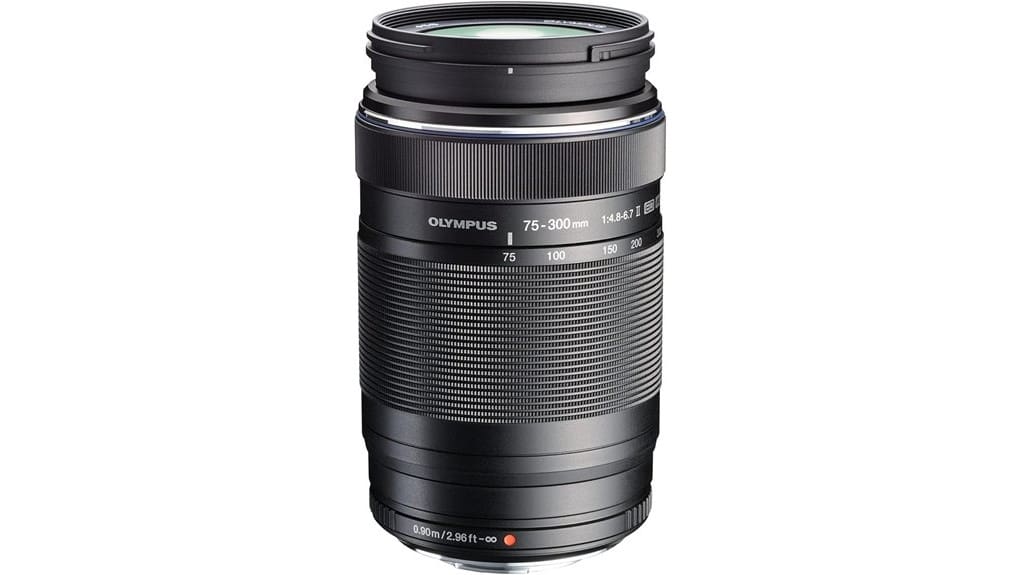
You’ll get a compact, lightweight super-telephoto that keeps center sharpness across 75–300mm with mild edge falloff at the long end. Autofocus is fast and quiet via MSC, with reliable tracking and slower response near close-focus limits (0.9 m at 75mm, 1.5 m elsewhere). Contrast and microcontrast are strong with controlled CA; bokeh is generally smooth. Be mindful of flash blockage and filter stacking. Continue for detailed handling, limitations, and alternative options.
Some Key Takeaways
- Lightweight, compact super-telephoto offering 150–600mm equivalent reach ideal for travel and birding on Micro Four Thirds.
- Sharp center resolution across the zoom range with mild edge falloff at longest focal lengths.
- Fast, quiet MSC autofocus with reliable continuous tracking and minimal hunting for wildlife action.
- Controlled chromatic aberration and good microcontrast; minor longitudinal fringing in high-contrast highlights at wide apertures.
- Practical handling and balance for handheld, monopod use, but watch for flash obstruction and vignetting with thick filter stacks.
Optical Performance and Image Quality at 75–300mm
Although it’s a compact super-telephoto, the Olympus M.Zuiko 75–300mm delivers consistently strong imaging performance across its range. You’ll notice sharp center resolution from 75 to 300mm with mild edge falloff at longest focal lengths. Contrast stays high, and microcontrast renders fine detail without aggressive sharpening. Chromatic aberration is controlled well; lateral CA is minimal and longitudinal color fringing appears only in high-contrast highlights at wide apertures. You can rely on predictable vignetting that’s correctable in-camera or in RAW. Bokeh quality is generally smooth for subject isolation, with minor nervousness in specular highlights near the frame edges. If you’re working on detailed close-ups, pairing this lens with dedicated macro techniques can yield even more striking results.
Autofocus, Close-Focus and Real-World Handling
Sharp optics are only part of the story — the M.Zuiko’s MSC drive gives you fast, quiet autofocus that handles both stills and wildlife action with minimal hunting. You’ll appreciate silent tracking during continuous AF; the mechanism keeps shifts smooth without drawing attention. Measure performance by acquisition time and consistency across the zoom range: it’s rapid at longer focal lengths but can slow near close-focus limits. Close-focus is 0.9 m at 75 mm and 1.5 m elsewhere, so framing tight subjects requires stepping back or cropping. Overall handling is pragmatic: predictable AF, low focus hunting incidence, and dependable manual override for precision. For hobbyists looking to upgrade their gear, consider how a dedicated follow focus system can improve smooth focusing and handling during active shoots.
Size, Weight and Portability for Outdoor Shooting
Because the M.Zuiko 75–300mm is built for Micro Four Thirds, you’ll notice it’s markedly smaller and lighter than comparable full-frame super-telephoto zooms, making it practical for long outdoor sessions where mobility matters. You get lightweight portability without compromising reach: the lens’ compact dimensions reduce pack volume and shoulder fatigue during hikes. Its mass and balance suit handheld tracking and monopod work; you’ll switch positions faster and carry spare gear more easily. Mechanically, the barrel extends minimally, maintaining center-of-gravity predictability. For field photographers prioritizing mobility and focal range, this lens optimizes transport efficiency and on-location responsiveness. This makes it an excellent match for photographers who value lightweight tripods and travel-friendly gear during extended shoots.
Limitations, Flash and Filter Cautions to Watch For
When using the M.Zuiko 75–300mm outdoors, watch for a few practical limits that can affect exposure and framing: the barrel and hood can obstruct on-camera flash illumination, close-focus varies significantly (0.9 m at 75mm, 1.5 m elsewhere) which restricts tight indoor or macro-style shots, and stacking thick or multiple filters may vignette or cut image edges. You’ll need to manage lens vignetting when adding screw-on filters or teleconverters; heavy filter stacks increase corner falloff and risk mechanical obstruction. Verify mount compatibility for accessories and flashes; some third-party units require adapters or spacing adjustments to clear the hood and maintain TTL metering. Consider choosing the proper hood and accessories for your setup to reduce flare and protect the front element while maintaining compatibility with lens hood options.
Who Should Buy It and Alternative Lenses to Consider
For photographers who need a compact, affordable super-telephoto for outdoor work, the M.Zuiko 75–300mm is a practical choice: it gives you long reach in a lightweight package with strong imaging performance and fast, quiet AF, but you should accept its variable close-focus limits and potential flash/filter obstructions. You should buy it if you prioritize portability for budget birding or want a travel telephoto that won’t burden your kit. Alternatives: Olympus 40-150mm Pro with TC for higher quality and closer focus; Panasonic 100-300mm for extended reach; prime super-telephotos if you demand max speed and resolution. This lens is particularly well-suited for users of Micro Four Thirds systems seeking compact telephoto performance without the bulk of full-frame equivalents.
Some Questions Answered
Does This Lens Have Image Stabilization Built In?
No, it doesn’t have built-in image stabilization. You’ll rely on your camera’s in-body stabilization or faster shutter speeds for sharp telephoto shots. Autofocus performance is fast and quiet thanks to the MSC mechanism, so stabilization absence is partly mitigated by quick acquisition. Chromatic aberration is well controlled optically, but you should still check high-contrast edges at long focal lengths and consider post-processing corrections when needed.
Is It Weather-Sealed or Splash-Resistant?
No — it isn’t weather-sealed or splash-resistant. You won’t find official weather protection or a mount gasket on this lens, so you should assume exposure to rain or heavy moisture is risky. Given its compact design and cost-focused engineering, protection is limited to normal handling tolerances. If you need shoot-in-wet conditions, you’ll want additional weather protection (rain cover or sealed camera body plus aftermarket gasket solutions) to safeguard gear.
What Tripod Collar Options Are Available?
You’ll find a removable collar option that accepts an Arca compatible foot for tripod mounting, letting you balance quickly. The collar detaches cleanly when handheld use is preferred. Materials are light, keeping overall weight low while preserving rigidity. The Arca compatible foot aligns with standard plates, minimizing play. Confirm clearance for filters and flash since the collar and foot can affect access and may require a slim adapter for thick filters.
How Compatible Is It With Teleconverters?
It’s not well suited to teleconverters: adapter compatibility is limited and you’ll face significant focus limitations. Using an adapter plus a converter often prevents reliable autofocus, slows AF speed, and reduces effective aperture, hurting image quality and magnification gains. You can try third-party adapters, but expect vignetting, reduced contrast, and frequent manual-focus rescue. For consistent results you’ll want a native teleconverter-capable lens rather than forcing converters onto this design.
Can It Be Used for Astrophotography?
Yes — you can use it for astrophotography, but expect limitations. You’ll get reachable reach and decent sharpness, yet low maximum aperture reduces faint-star capture and forces high ISO/long exposures. You’ll manage focus stacking for deep-sky detail at higher magnifications, but tracking or stacking many short exposures is preferable. Watch for chromatic aberration on bright stars and edges; correct in postprocessing and avoid thick filters that worsen vignetting.