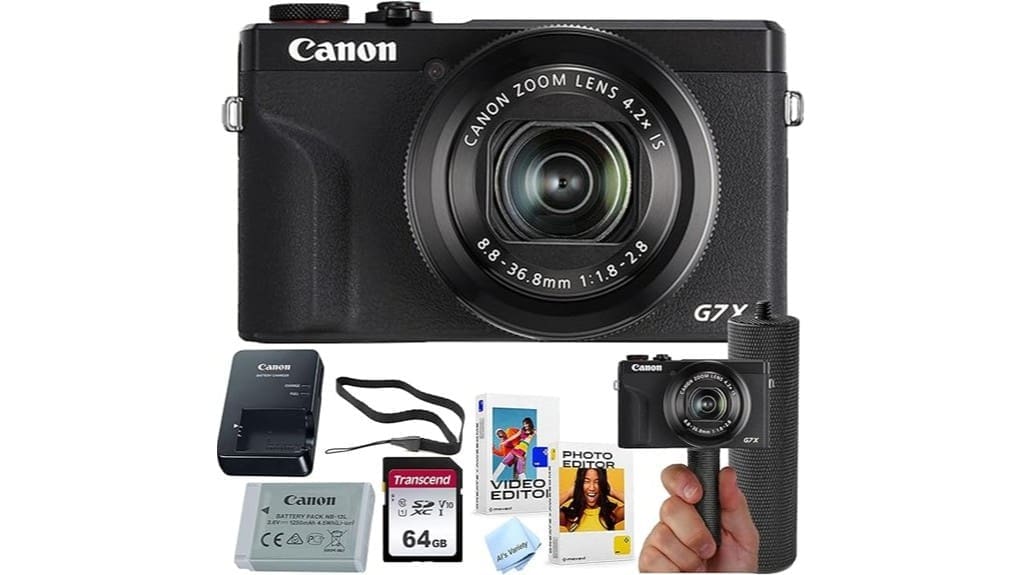
You’ll get a pocketable travel and vlogging camera that pairs a 20.1MP 1.0″ stacked sensor and DIGIC 8 with a 24–100mm f/1.8–2.8 zoom, fast 20 fps bursts, and responsive AF that holds during sustained shooting. Low‑light detail is strong for a compact, with conservative noise processing and usable stabilization to extend handheld speeds. Video offers 4K/30p, 1080/120p, vertical mode and clean HDMI for streaming; keep going to see full test results and comparisons.
Some Key Takeaways
- 20.1MP 1.0″ stacked CMOS sensor with DIGIC 8 delivers fast AF, 20 fps burst, and improved high-ISO detail for stills.
- 24–100mm equivalent f/1.8–2.8 zoom offers versatile framing, good low-light aperture, with noticeable edge softness at 100mm.
- Optical image stabilization and reliable AF maintain sharp handheld shots and subject tracking during bursts.
- Video: 4K30p with clean HDMI, 1080p120 for slow motion, vertical recording, and mic input for vlogging and livestreaming.
- Compact ergonomics, tilting touchscreen, Wi‑Fi/Bluetooth, and in-camera charging make it travel- and content-creator friendly.
Real-World Performance: Speed, Autofocus, and Low-Light Image Quality
When you push the shutter, the G7 X Mark III delivers noticeably swift results thanks to its 20.1MP 1.0″ stacked CMOS sensor paired with the DIGIC 8 processor: you can shoot up to 20 fps with minimal buffer lag and sensitive, low-noise output. You’ll rely on burst shooting for decisive moments; the processor sustains rates while maintaining AF responsiveness. Subject tracking is competent for small-sensor fast bursts, locking quickly on contrast and face cues. At elevated high ISO settings the camera preserves detail better than prior compacts, with conservative noise handling algorithms that trade fine-grain smoothness for retained edge definition. Proper maintenance — including using sensor cleaning kits — helps preserve that image quality over time.
Lens, Zoom Reach, and Stabilization: How the 24–100mm F/1.8–2.8 Combo Behaves
Pulling focus to the lens, the G7 X Mark III’s 24–100mm (35mm equivalent) f/1.8–2.8 zoom balances brightness and reach for everyday shooting. You’ll appreciate focal reach from wide-angle scenes to short telephoto portraits without changing lenses, and zoom convenience is genuine in a compact body. Wide apertures give reliable low-light performance and nuanced bokeh control at longer focal lengths, though edge softness appears toward 100mm. The optical image stabilizer provides measurable shake reduction; stabilization effectiveness helps maintain usable shutter speeds and smoother hand-held framing. Chromatic aberration and distortion are well-managed in-camera, producing clean, ready-to-use images. This combo is particularly useful for photographers who prefer working with prime lenses concepts and want a versatile, travel-friendly setup.
Video and Live-Streaming Tested: 4K, 120p, Vertical Mode, and HDMI Output
Shifting from stills, the G7 X Mark III proves its versatility in motion by offering clean 4K 30p capture, Full HD up to 120p for slow motion, and vertical recording tailored to social formats. You’ll get sharp 4K files with minimal rolling shutter and reliable autofocus for run-and-gun clips; 120p Full HD delivers usable slow motion with reduced detail versus 30p. For creators streaming, the camera supports 4K livestreaming workflows through Canon’s gateway and provides HDMI clean output for external encoders, preserving resolution without overlays. Microphone input and stabilization round out a compact, broadcast-capable package for vloggers. External camera monitors can further enhance framing, exposure, and focus accuracy for on-location shoots by providing larger, more detailed displays external camera monitors.
Ergonomics, Screen, Connectivity, and Battery Life in Daily Use
Usually the G7 X Mark III feels compact but purposeful in hand: its deep thumb rest and textured grip let you hold it securely for extended shoots, while the small body keeps all primary controls—mode dial, shutter, and front control ring—within easy reach for one-handed operation. You’ll notice reliable handgrip comfort during roaming shoots, though heavy rigs fatigue your wrist over hours. The 3.0″ tilting screen delivers strong touchscreen responsiveness for AF point selection and menu navigation. Bluetooth and Wi‑Fi provide fast transfer and remote control; battery life supports moderate day use, and in-camera charging eases field top-ups. For added comfort when shooting handheld for long periods, consider pairing the camera with a camera shoulder strap designed for ergonomic support.
Final Verdict and Who Should Buy the G7 X Mark III (Alternatives and Value)
Though compact, the G7 X Mark III delivers a potent blend of stills and video capabilities that will serve vloggers and travel shooters best: its 1.0″ stacked sensor and DIGIC 8 processing give clean, fast autofocus and up to 20 fps burst performance, while 4K/30p, 1080/120p, vertical video and clean HDMI/mic support make it a capable on-the-go content creation tool. You’ll get excellent image quality, pocketable optics (24–100mm f/1.8–2.8) and usable stabilization. Buy it if you prioritize portability and streaming. Consider budget alternatives for lower cost; check accessory compatibility for mics, grips and chargers. It also pairs well with essential mirrorless accessories like pocketable grips to improve handling and functionality.
Some Questions Answered
Does the Camera Have a Weather-Sealed Body?
No — the camera doesn’t have a weather-sealed body. You shouldn’t expect official weather resistance or pass any seal testing. The compact metal-and-plastic construction offers no IP rating, gasketed ports, or reinforced seals, so moisture and dust can penetrate under harsh conditions. If you need reliable protection, you’ll want a weather-sealed model or an aftermarket protective housing, and you should perform your own seal testing before trusting it outdoors.
Can It Shoot RAW and JPEG Simultaneously?
Yes — you can record RAW and JPEG simultaneously via Dual Capture. You’ll set RAW recording in image quality menus, enable RAW+JPEG (Dual capture) to save both formats per shot. RAW files give maximum latitude for color and exposure edits; JPEGs provide ready-to-use images with in-camera processing. Expect larger file sizes and slightly reduced buffer depth during continuous shooting when Dual capture is active; manage storage accordingly.
Is There Internal ND Filter or Time-Lapse Intervalometer?
No, it doesn’t offer an internal ND filter, and it lacks a dedicated intervalometer menu for automatic time‑lapse. You’ll have to use external ND filters for long exposures and a remote/intervalometer or post‑stacking for time‑lapse. The camera does support exposure bracketing for HDR workflows and motion smoothing options in video modes, so you can manage dynamic range and reduce judder, but automated interval capture isn’t built in.
Can It Charge and Record via USB Power Bank?
Yes — you can record while charging with a USB power bank, but it’s conditional. The camera supports battery passthrough via USB C compatibility for in-camera charging, so you’ll get continuous power during shooting. Make sure the power bank supplies stable 5V output and sufficient current; some banks that shut off at low draw may stop charging. Use a quality USB‑C cable and verify the bank maintains power under video-recording load.
Is Bluetooth Used for Geotagging or Only Pairing?
Bluetooth pairing primarily handles remote control and connection setup; it doesn’t record GPS data itself. You can use Bluetooth pairing to link the camera to your smartphone, then rely on the phone’s GPS for Location tagging via Canon’s app. That app transfers location coordinates to images (geotagging) while the camera stores them. So Bluetooth pairing enables Location tagging indirectly by syncing phone GPS data rather than providing onboard geolocation.