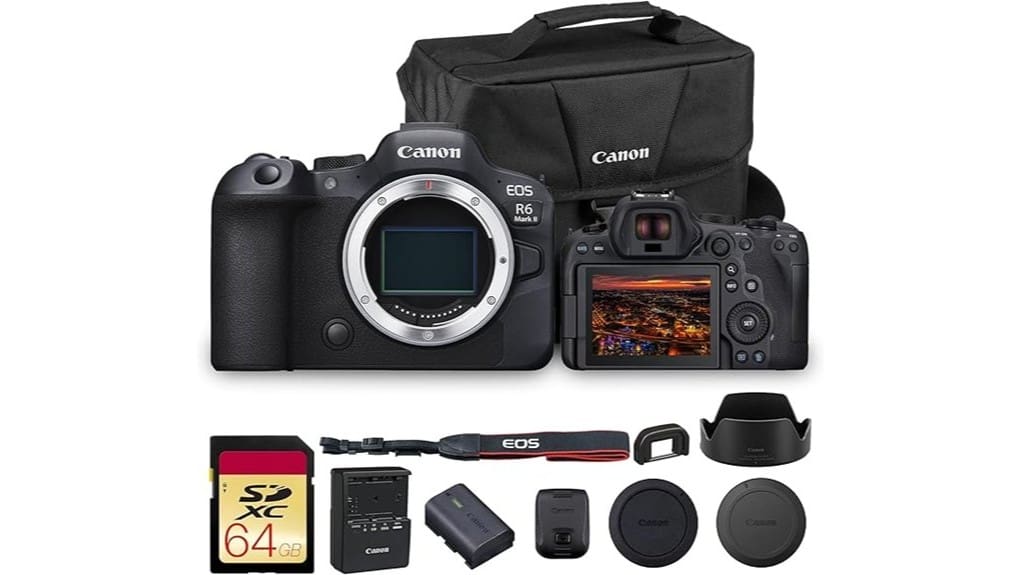
You’ll find the EOS R6 Mark II pairs a 24.2MP full‑frame sensor with DIGIC X to prioritize speed, dynamic range, and low‑light fidelity over sheer megapixels. It delivers reliable Dual Pixel CMOS AF II, robust eye/animal tracking, and up to 40 fps electronic bursts for sports and wildlife. Video-wise you get uncropped 4K60 from 6K oversampling, Canon Log 3, HDR PQ, and unlimited recording with pro codecs. Keep going and you’ll get full technical breakdowns and workflow notes.
Some Key Takeaways
- 24.2MP full-frame sensor with DIGIC X prioritizes speed, dynamic range, and low-light performance over sheer megapixels.
- Dual Pixel CMOS AF II offers reliable eye/animal tracking and deep-learning subject switching across the frame.
- Uncropped 4K60 (oversampled from 6K), Canon Log 3, HDR PQ, and unlimited recording suit serious video workflows.
- Electronic bursts up to 40 fps benefit sports and wildlife, though buffer and card speed affect sustained throughput.
- Solid magnesium-alloy body, improved grip, LP-E6NH battery, and wide accessory compatibility for professional hybrid shooters.
Quick Verdict and Who Should Buy the Canon EOS R6 Mark II
While it doesn’t chase flagship pixel counts, the EOS R6 Mark II delivers a tightly balanced mix of speed, low-light performance, and video capability that will satisfy professionals and serious enthusiasts alike. You’ll find a compact mirrorless body that pairs a 24.2MP full-frame sensor with DIGIC X processing to prioritize frame rates, autofocus reliability, and dynamic range over megapixel headroom. In this pros overview you’ll learn who benefits most: hybrid shooters needing uncropped 4K60, sports and wildlife photographers exploiting 40 fps electronic bursts, and videographers relying on Canon Log 3 and unlimited recording for streamlined workflows. The camera is also well-suited for users building out their kit with mirrorless accessories like lenses, grips, and stabilizers.
Image Quality, Sensor Performance, and Low‑Light Capabilities
Because Canon paired a 24.2MP full‑frame CMOS sensor with the DIGIC X processor, you get a sensor/processor combination tuned for high detail, wide dynamic range, and reliable low‑light performance rather than maximum resolution. You’ll notice sensor nuance in tonal shifts and highlight roll‑off, preserving detail across ±EV stops. The processor’s algorithms deliver effective noise control up to high ISOs, maintaining chroma fidelity and edge detail while suppressing luminance grain. Minimal rolling shutter and fast readout reduce artifacts in bright or mixed lighting. RAW retains headroom for exposure recovery; JPEGs are ready‑to‑use with conservative sharpening and accurate color. For the best results when evaluating these characteristics, ensure your display is calibrated using monitor calibration so tonal and color nuances are represented accurately.
Autofocus, Subject Tracking, and Burst Shooting in Real Use
Shifting focus from sensor behavior to how the R6 Mark II locks onto moving subjects, you’ll find its Dual Pixel CMOS AF II and DIGIC X processor working together to deliver consistent, high-confidence tracking across the frame. You’ll notice reliable eye tracking for people and animals, with configurable AF zones and priority options that minimize false locks. Subject switching is fast and predictable when targets cross or occlude, aided by deep-learning recognition. Burst performance supports 40 fps electronic shooting, but effective throughput depends on buffer management and card speed; burst latency remains low, though long RAW runs can increase write-induced pauses. Our gear selection emphasizes pairing your head with a fluid head designed for smooth pan and tilt to complement the R6 Mark II’s tracking capabilities.
Video Features, Codecs, and Workflow for Creators
When you move into the R6 Mark II’s video capabilities, you get a pragmatic, creator-focused toolset: uncropped 4K up to 60p is delivered by oversampling from 6K, Canon Log 3 and HDR PQ are supported for extended grading latitude, and unlimited recording time removes artificial session caps—features that together streamline both acquisition and postproduction workflows. You’ll find technical aids like focus peaking, zebra patterns, and simultaneous HDMI output for monitoring or external recorders. Pay attention to codec compatibility: internal XF-AVC and IPB/All-I options affect edit performance and storage. Plan a logistics workflow that balances bitrate, media management, and color pipeline efficiency. For high-bitrate recording and reliable offloading, consider using CFexpress cards optimized for video workflows.
Handling, Battery Life, Accessories, and Final Buying Recommendations
Dial in the grip and balance quickly: the R6 Mark II’s refined magnesium-alloy body and redesigned grip give you confident handling with a broad range of lenses, and controls are laid out for efficient one-handed operation during extended shoots. You’ll appreciate grip comfort for long sessions; button placement and textured surfaces reduce fatigue. Battery longevity relies on the included LP-E6NH and efficient DIGIC X power management; expect solid day-long use with mixed stills/video. Charging options include the LC-E6 charger and in-camera USB-C charging for quick top-ups. Accessory compatibility is strong with R-mount lenses, grips, and third-party cages; buy based on workflow. For dependable shooting days, consider investing in a quality spare battery and camera charger to ensure uninterrupted power.
Some Questions Answered
Does It Have In-Body Image Stabilization (IBIS) and How Effective Is It?
Yes — you get in body stabilization. You’ll benefit from a 5‑axis IBIS system that delivers strong stabilization performance, typically around 8 stops with compatible lenses and subject conditions. You’ll see excellent shake reduction for handheld stills and smooth video, especially with electronic shutter shooting and autofocus active. Technically, IBIS integrates with lens stabilization and sensor-shift algorithms to maximize compensation across pitch, yaw, roll, X and Y axes.
Can It Use Older Canon EF Lenses With an Adapter?
Yes — you can use older Canon EF lenses with an EF adapter. With proper EF adapter and Mount compatibility, you’ll maintain electronic communication for autofocus, aperture control and stabilization. Lens performance depends on optical design and adapter quality; expect full Autofocus integration with most EF lenses via Dual Pixel AF II, though some very old or specialty lenses may show slower AF or limited metadata. Testing individual lenses is recommended.
What Weather-Sealing Level Does the Camera Offer?
You get robust weather sealing: the body uses a magnesium alloy chassis with thorough dust protection and moisture resistance at key seams and controls. You’ll find gasketed buttons, a sealed memory card/battery compartment and a tightly fitted mount to help keep out particles and water spray. This isn’t rated to IP standards for submersion, but it’s engineered for reliable operation in rain, dust storms and harsh outdoor shooting conditions.
Is Dual Card Slot Configuration Supported for Backup/Overflow?
Yes — you get a dual card slot setup that supports backup recording and overflow recording. You can configure storage mirroring for real‑time backups or set sequential overflow recording when one card fills. The camera’s card management lets you designate RAW/JPEG separation, stills/video distribution, and automatic switching. This gives you flexible data protection and workflow options for continuous shooting, long video takes, and secure asset handling in professional scenarios.
How Long Does the Battery Take to Fully Recharge With Included Charger?
With the included LC-E6 charger, battery charging for the LP-E6NH typically takes about 2 hours to reach full capacity from empty. You’ll see charging times vary slightly with remaining charge, battery temperature, and charger input voltage. The charger uses a constant-current/constant-voltage profile and stops when full, protecting cell health. For faster turnaround you can keep a spare LP-E6NH charged or use a compatible multi-battery charger.