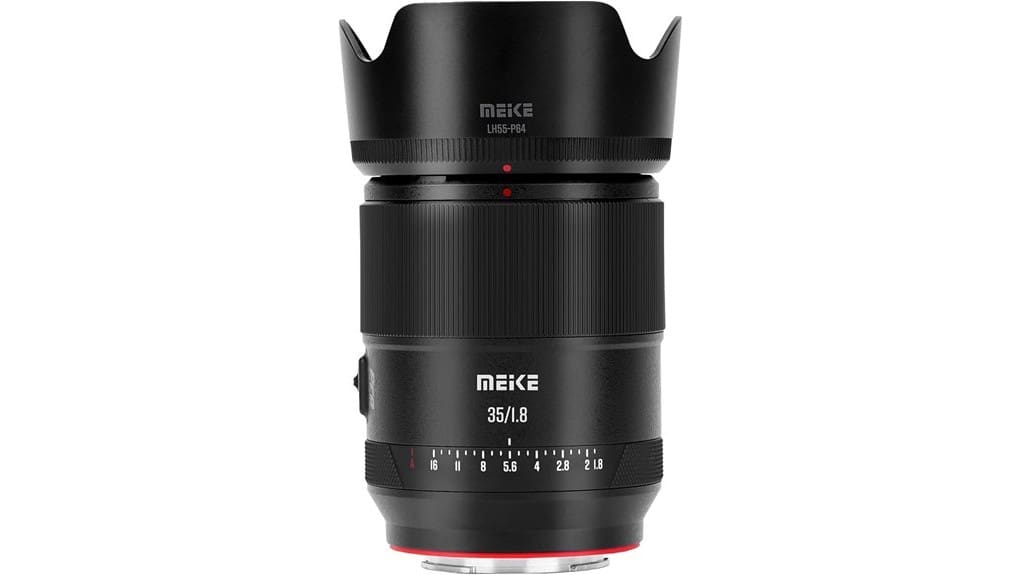
You’ll find the Meike 35mm F1.8 Pro is a compact, affordable 35mm that pairs a 12-element, 10-group design with three ED and two aspherical elements for strong center sharpness, smooth bokeh, and controlled aberrations. A high‑polymer build keeps weight down while offering a tactile, damped feel and an adjustable aperture ring. STM with NanoDrive gives near‑silent, fast AF suited to hybrid shooters, though corners won’t match top‑end glass — continue if you want full test details.
Some Key Takeaways
- Optically strong: excellent center resolution wide open, peaks around f/5.6, with improved edge sharpness by f/2.8–f/4.
- Build and handling: lightweight high-polymer construction with damped focus ring and tactile adjustable aperture ring.
- Autofocus/video: STM + NanoDrive enables fast, near‑silent AF and smooth focus pulls, with occasional micro‑hunting in low contrast.
- Image character: neutral slightly warm tones, smooth rounded bokeh, controlled chromatic aberration and reduced flare.
- Value proposition: compact, affordable hybrid 35mm ideal for portraits, street, and video; lacks weather sealing and top-tier corner microcontrast.
Optics and Build at a Glance: 35mm F1.8 Design, Special Elements, and Physical Feel
While Meike’s 35mm F1.8 looks compact at first glance, its 12-element/10-group optical layout—featuring three ED elements and two aspherics—gives you markedly higher resolution and tighter control of chromatic aberration than many budget primes in this class. You’ll notice authentic color rendering and reduced flare across the aperture range. Mechanically, the high-polymer construction keeps weight down without sacrificing rigidity. Compared with similar lenses, its optical ergonomics are thoughtful: a damped focus ring and an adjustable aperture ring place controls where you expect them. The tactile finish feels durable and precise, reinforcing a premium impression relative to competitors. This makes it a strong match for photographers who prioritize handling and camera grip comfort during extended shoots.
Autofocus, Video Features, and Real-World Focusing Performance
Because Meike pairs an STM drive with its NanoDrive Auxiliary System, you get noticeably faster and quieter focusing than many third‑party primes at this price, and that translates to smoother subject acquisition in both stills and motion. You’ll notice fast focusing in handheld street work and reliable quiet tracking during interviews; Eye AF and electronic aperture control integrate cleanly with Sony bodies. Continuous AF holds subjects well but isn’t as aggressive as flagship lenses, so anticipate occasional micro‑hunting in low contrast. For video, motion smoothness is very good: focus pulls are subtle and near‑silent, making this lens a strong budget choice. This makes the lens a practical addition for mirrorless camera enthusiasts looking for essential, affordable gear like mirrorless accessories.
Image Quality Tested: Sharpness, Bokeh, Color Rendering, and Aberration Control
When you push the Meike 35mm F1.8 Pro through real-world tests, its optical strengths become clear: resolution is strong from center to mid-frame wide open and tightens up noticeably by f/4, bokeh stays smooth with pleasingly rounded highlights thanks to the aspherical elements, and colors render with neutral, slightly warm tones that suit skin and landscape work without heavy in-camera correction. You’ll see consistent sharpness grading: center sharpness excels at f/1.8, edges improve by f/2.8–f/4 and peak near f/5.6. Bokeh is creamy versus rivals, chromatic aberration stays controlled via ED glass, and a brief color comparison favors natural hues. Meike positions this lens for portrait shooters seeking portrait-focused optics that balance image quality and affordability.
Use-Case Examples: Street Portraits, Landscapes, and Hybrid Stills/Video Workflows
Although its mild wide-angle perspective reads more natural than a classic 35mm, the Meike 35mm F1.8 Pro adapts neatly across street portraits, landscapes, and hybrid stills/video workflows thanks to its balance of sharp center resolution, controlled edges, and smooth bokeh. You’ll favor it for candid moments: close enough for environmental context without distortion, fast AF and quiet STM help preserve authenticity. For landscapes, the combination of ED and aspherical elements yields fine edge detail and minimal flare versus cheaper 35mm options. In hybrid workflows, the adjustable aperture ring and silent drive make it more practical for night scenes and run-and-gun video. When shooting outdoors, pairing this lens with a heavy-duty tripod can further stabilize compositions and improve long-exposure sharpness.
Verdict and Buying Guidance: Who This Lens Suits, Alternatives, and Value for Money
The strengths highlighted above point clearly to who’ll get the most from the Meike 35mm F1.8 Pro: photographers and hybrid shooters who want a compact, affordable 35mm that balances sharp center resolution, reliable edge performance, and quiet, fast AF for run-and-gun work. You’ll appreciate its build, STM/NanoDrive focus, and video-friendly aperture ring if you shoot street, portraits, or run-and-gun video. If you need ultimate corner-to-corner microcontrast or weather sealing, consider higher-end Zeiss or Sony G Master options; for tighter budgets, Sigma or other third-party budget alternatives offer similar value. Resale value is modest but reasonable. It’s especially practical for photographers focusing on telephoto lenses who require portability and versatile performance.
Some Questions Answered
Does It Include Weather Sealing or Moisture Resistance?
No — it doesn’t feature full weather sealing or advertised moisture resistance. You’ll find solid build quality with high-polymer construction that keeps weight down and durability decent, but it’s not rated for harsh conditions. Compared to sealed pro lenses it lacks gasketed mounts and explicit moisture protection. If you need outdoor reliability, you’ll want a weather-sealed alternative or thorough durability testing before trusting it in wet environments.
Is the Aperture Ring De-Clickable for Cine Use?
No — the aperture ring isn’t natively de-clickable for cine use. You’ll get click detents for tactile steps, so aperture modulation is limited compared with fully clickless cine lenses. That said, the adjustable aperture ring and electronic aperture adjustment let you perform smooth exposure ramps via camera control or firmware-driven clickless conversion if supported. Comparatively, dedicated cine lenses still offer superior, continuous aperture modulation and silent, fluid operation.
What Is the Minimum Focusing Distance and Maximum Magnification?
The minimum distance is 0.35 m and the magnification ratio is 0.16x. You’ll appreciate that 0.35 m minimum distance gives close subject framing for street portraits and detail shots compared with many 35 mm lenses that sit around 0.3–0.4 m. At 0.16x magnification ratio you won’t achieve true macro, but you’ll get respectable subject size and background separation, useful for environmental close-ups and candid work.
Does It Retain EXIF and Lens Stabilization Compatibility on All Bodies?
Yes — you’ll get EXIF retention on compatible Sony E bodies, so focal length, aperture and focus info embed normally. Stabilization compatibility depends on the camera: the lens lacks in-body stabilization, but it works fine with camera-body OSS/IBIS systems, so you’ll benefit from sensor-shift or OSS-enabled bodies. Comparatively, you’ll see full metadata like native Sony lenses and stabilization only when the camera provides it, not from the lens itself.
Are There Native Lens Profiles for Sony Cameras in Editing Software?
No—there aren’t official Sony profiles for this third‑party lens in most editing suites. You’ll rely on Third party profiles provided by Meike or community-made Sony profiles that users create for Lightroom/Camera Raw. You’ll find Sony profiles for native Sony lenses more consistently, so compare results: Sony profiles usually offer more accurate distortion and vignetting correction, while third‑party profiles can vary in quality and may need manual tweaks.