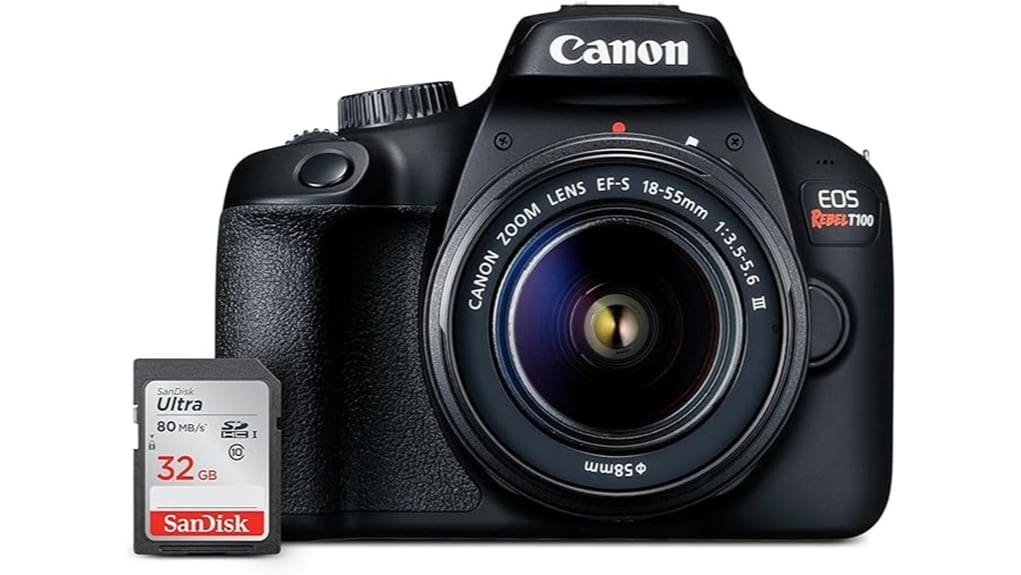
You’ll find the Canon EOS Rebel T100 is a budget-friendly, entry-level DSLR that gives you clean 18MP APS‑C images, an optical viewfinder, and basic Wi‑Fi, but it trades away speed, AF points, and high‑ISO headroom compared with newer rivals. The bundled 18–55mm lens is soft wide open and video features are modest, so it’s best for portraits, travel, and casual use rather than fast action or advanced filmmaking. Keep going and you’ll get specifics on weaknesses, handling, and alternatives.
Some Key Takeaways
- Budget-friendly 18MP APS‑C DSLR with optical viewfinder and EF‑S 18–55mm kit lens, aimed at beginners.
- Delivers clean low‑ISO images, but dynamic range and high‑ISO performance lag newer APS‑C cameras.
- Autofocus is precise for static subjects via the viewfinder, but slow for continuous tracking and Live View.
- Full HD video and in-camera Creative Filters are fine for casual use but lack advanced controls and responsiveness.
- Good starter system with Wi‑Fi smartphone control; consider used Rebel T7, Nikon D3500, or Sony a6000 for more speed or image quality.
Canon EOS Rebel T100 at a Glance : Key Specs and Price
Meet the Canon EOS Rebel T100, a budget-friendly entry-level DSLR that puts an 18MP APS-C CMOS sensor, an optical viewfinder, and an EF‑S 18–55mm f/3.5–5.6 III kit lens in your hands for everyday shooting. You get clear entry specs: 18MP, 3.0 fps continuous, precise autofocus, Full HD video, Creative Filters, Guided Live View, and built-in Wi‑Fi with Canon Camera Connect. At budget pricing it competes with advanced compacts and mirrorless bodies, but you’ll trade speed, advanced AF points, and cutting-edge video features for affordability. It’s sensible for learners, though limitations are evident compared to newer alternatives. If you’re shopping for accessories, consider essential mirrorless camera gear like lenses and adapters to expand functionality and future-proof your system.
Image Quality and Performance in Real-World Shooting
When you shoot with the EOS Rebel T100 in everyday conditions, its 18MP APS‑C sensor delivers clean, well‑defined images at base and low ISOs, though dynamic range and high‑ISO performance lag behind newer APS‑C rivals. You’ll appreciate solid color accuracy straight from JPEGs, with pleasant skin tones and faithful saturation for landscapes. Shadows clip sooner than on modern sensors, so you’ll need careful exposure or subtle highlight recovery in RAW. The bundled 18‑55mm lens is capable but shows softness and vignetting wide open. Continuous shooting is slow for action, so you’ll prefer this body for portraits, travel, and casual street work. For consistent results in mixed lighting, consider using a white balance card to ensure accurate color rendition.
Autofocus, Exposure Modes, and Low-Light Usability
Having established how the sensor and lens perform in everyday shooting, let’s look at how the camera finds and exposes subjects—areas where the T100 shows both strengths and limits. You’ll appreciate the precise autofocus system for stills; phase detection in the optical viewfinder locks quickly on static subjects, though continuous tracking and Live View AF are slower. Exposure modes are friendly: Scene Intelligent Auto and Creative Auto simplify choices, and exposure bracketing is available for cautious users. In low light you’ll rely on higher ISOs and slower shutter speeds; noise rises sooner than on newer models, so expect limits. For remote shooting and easier shutter control consider adding a camera remote to expand your setup and reduce shake.
Video, Creative Features, and Connectivity for Sharing
Although the T100 records Full HD video that’ll satisfy casual shooters, its movie capabilities lag behind newer entry-level models in autofocus responsiveness and manual control. You’ll get usable clips for family and travel, but you won’t rely on continuous AF for fast action or fine-grained exposure tweaks. Creative Filters add fun looks in-camera, yet they’re limited compared with apps or newer cameras’ profiles. Connectivity helps: built-in Wi‑Fi and the Canon Camera Connect app give Smartphone liveview and remote shutter control for framing and basic starts/stops. You can also craft Wireless timelapse sequences, though interval flexibility is modest. For remote shooting and sharing, the T100 pairs well with wireless camera remotes to simplify triggering and composing shots.
Who Should Buy the Rebel T100 and Better Alternatives
Think of the Rebel T100 as a straightforward entry-level DSLR that suits beginners who want a dependable step up from smartphone shooting without spending much: if you value an optical viewfinder, basic manual controls, and bundled glass (the EF‑S 18‑55mm kit) for family photos, travel, or learning exposure, it’ll do the job. You should buy it if you’re budget beginners wanting reliable stills, guided modes, and simple Wi‑Fi sharing. But if you want faster autofocus, higher resolution, better low‑light performance, or advanced video, consider used Canon EOS Rebel T7, Nikon D3500, or mirrorless options like Sony a6000—better long‑term value for travel photographers. For those building a kit, consider accessories and lenses from a dedicated camera gear retailer to expand your capabilities over time.
Some Questions Answered
Does the Camera Include a Battery and Charger in the Box?
No — a battery included in the box isn’t guaranteed; you’ll often get the camera body, lens, and a 32GB SD card, but confirm the seller. You should check charger compatibility since some kits omit the dedicated charger and expect you to use USB charging or an existing Canon charger. Compare listings critically: official bundles usually include a battery and charger, while discounted or used packages may not, so verify before buying.
Is There Built-In Image Stabilization in the Camera Body?
No — you won’t find sensor stabilization in the body. You’re limited to lens-based optical stabilization or electronic stabilization in post or video mode. Compared to cameras with in-body image stabilization, this setup gives less shake control with non-stabilized lenses, so you’ll need stabilized glass or faster shutter speeds. Critically, electronic stabilization can crop and soften footage, so weigh lens choices and shooting technique for sharper results.
Can the EF-S 18-55MM Lens Be Replaced With Full-Frame EF Lenses?
Yes — you can mount full-frame EF lenses on your EF‑S camera body, but they’ll behave differently. Lens compatibility is generally good: EF lenses fit EF‑S mounts without adapters. You’ll get crop-factor framing and slightly different depth-of-field. Third party adapters aren’t needed and can introduce issues, though they exist for other mounts. Critically, some full-frame lenses may be bigger, heavier, or optically overqualified for the APS‑C sensor.
What File Formats (Raw/Jpeg) Does It Record Natively?
It records both RAW support and JPEG quality natively: you’ll get RAW (Canon .CR2) files plus selectable JPEG quality levels (Fine, Normal). RAW gives maximum editing latitude and preserves highlight/shadow detail; JPEG quality offers smaller files and in-camera processing for quick use. Critically, RAW files need post-processing, while JPEGs suit immediate sharing. You’ll often shoot RAW+JPEG if you want flexibility plus ready-to-use images.
Is There a Microphone Input for External Audio Recording?
No — there’s no external mic jack on the camera, so you can’t plug in an external mic directly. You’ll need to rely on the built‑in mic or use separate audio recorders and sync in post. If you try adapters, note audio adapters won’t add a proper mic input unless they’re specific recorder interfaces; they’re often finicky and limited. Compared to models with mic jacks, this is a clear limitation for serious video work.