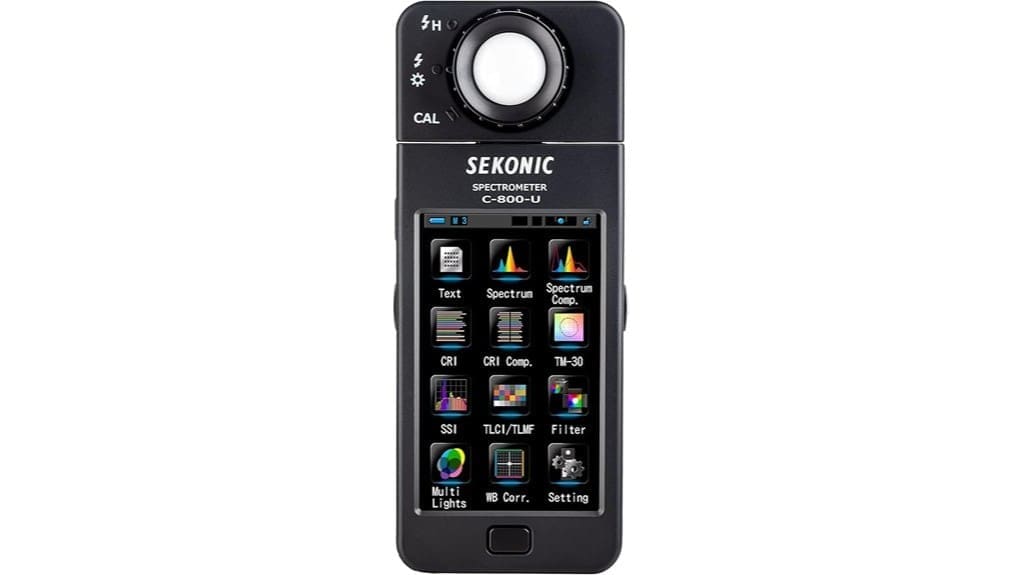
You’ll get lab-grade spectral detail in a rugged, touchscreen handheld that’s built for production use. It measures full spectral power from 380–780 nm, reports CCT, CRI, TLCI, TM-30-18, SSI and CIE xy, and flags metameric risks. The swivel head and 4.3″ touchscreen speed setup and on-set checks. It’s fast on LEDs, HMIs and flash, detects spikes and flicker, and fits pro workflows—keep going and you’ll find deeper performance, workflow and value analysis.
Some Key Takeaways
- Provides full 380–780 nm spectral measurements with numeric CCT, CRI, TLCI, TM-30-18, SSI, and CIE x,y outputs.
- Dense spectral curves detect LED spikes, phosphor blends, HMI continuity, narrowband artifacts, and metameric failure risks.
- CMOS sensor and 270° swivel head enable rapid, low-noise reads across LEDs, HMIs, fluorescents, and flash with flash-sync timing.
- 4.3-inch touchscreen and logical menu hierarchy deliver fast, field-ready workflow and quick calibration for studio or location shoots.
- Targeted at cinematographers, gaffers, and colorists needing spectral fidelity and SSI/TM‑30 metrics; pricier than basic CCT/CRI tools.
What the Sekonic Spectrometer (401-800) Actually Measures and Why It Matters
Because accurate color and light metrics drive decisions on set, the Sekonic Spectrometer (401-800) measures the spectral power distribution across 380–780 nm to give you a precise readout of what’s actually emitting from a light source. You get numeric CCT, CRI, TLCI, TM-30-18 and SSI values, plus CIE x,y coordinates and gamut metrics that anchor color metrology to practical shoots. Its CMOS sensor and broad illuminance ranges let you quantify LEDs, HMI, fluorescents and flash for consistent reproduction. That means you can evaluate spectral fidelity, guarantee light reproducibility between fixtures, and make data-driven choices fast and confidently. It’s an ideal tool for photographers who want to ensure their monitors and prints match real-world lighting and color standards, including monitor calibration.
Hands-On: Setup, Interface and Daily Workflow With the 4.3 Touchscreen
Now that you know what the Sekonic Spectrometer measures, getting it into your workflow is quick: power on, orient the 270° swivel head toward the source, and use the 4.3-inch color touchscreen to walk through calibration and measurement modes in seconds. You’ll appreciate tight menu navigation—logical hierarchy, clear labels, fast access to presets. Gesture responsiveness is solid; taps and swipes register without lag. Setup takes minutes, and routine checks become streamlined. Battery life comfortably lasts a shoot day with moderate use. Screen durability feels robust for field work, and the compact form factor keeps the unit unobtrusive on set. The device is a great fit for photographers focused on color calibration and accurate color management.
Performance Deep-Dive: Spectrum, CCT, CRI/TLCI/TM-30 and SSI Results
When you probe into the Sekonic Spectrometer’s measurement output, you’ll immediately notice the unit’s ability to present dense spectral data and derived metrics with clarity and consistency; its 380–780 nm coverage and CMOS sensor produce clean spectral curves that reveal LED spikes, phosphor blends, and HMI continuity with little noise. You’ll get precise CCT and chromatic stability readings, and CRI/TLCI and TM-30 values that map predictably to perceived color. Spectral granularity lets you inspect narrowband artifacts, SSI comparisons are actionable, and gamma response tracking aids camera matching. You’ll spot metameric failure risks early and quantify them. The company also offers compatible cleaning fluids and tools for maintaining optical accuracy, including products formulated for sensor and lens care to preserve measurement fidelity with sensor cleaning fluids.
Real-World Matching: LED, HMI, Fluorescent and Flash Tests (Speed and Accuracy)
Having established how the Sekonic presents dense spectral curves and reliable color metrics, you can judge its real-world matching speed and accuracy across LEDs, HMI, fluorescents and flashes. You’ll get rapid reads on LEDs, detecting LED flicker and resolving multi-peak spectra so RGB/RGBAW fixtures match reliably. HMI and fluorescent profiles show minimal spectral drift between measurements, aiding consistent mixes. Flash tests report precise CCT and SSI quickly and note Flash sync timing with usable flash illuminance data. Color metamerism flags when spectral similarity hides perceptual mismatch, letting you tweak gels or LUTs with confidence. These features are especially useful for photographers who use RGB lighting to craft vibrant, controllable scenes.
Who Should Buy It and Value Verdict (Use Cases, Limits, and Alternatives)
Although it’s compact, the Sekonic Spectrometer (401-800) packs pro-grade metrics and fast reads that make it a clear tool for cinematographers, gaffers, colorists and serious photographers who need precise spectral data on set or in the studio. You should buy it if you require full-spectrum 380–780 nm analysis, SSI and TM-30 metrics, rapid LED matching, and a touchscreen workflow that survives location work. Buyer demographics skew pros and advanced enthusiasts; hobbyists may find features excess. In a cost comparison it’s pricier than basic colorimeters but delivers spectral detail rivals spectrometers twice its size. Alternatives exist if you only need CCT/CRI. Our store also recommends secure NAS options for photographers who need reliable storage for high-resolution spectral and image data on-location with redundant backups.
Some Questions Answered
Does It Support Firmware Updates via USB or Wi‑Fi?
Yes — you can update firmware, but only via USB-C cable; there’s no built‑in Wi‑Fi. For firmware maintenance you’ll connect the spectrometer to a computer, run Sekonic’s update utility and follow prompts. That wired connectivity option keeps updates reliable and secure, though it means no over‑the‑air convenience. If you need remote management, you’ll have to route through a connected laptop or look for future models with expanded connectivity options.
Can Measurements Be Exported as CSV or Spectral Files?
Yes — you can export measurements. File exportability includes CSV and spectral file formats (commonly .csv and spectral data outputs), so you’ll get raw spectrograms plus derived metrics. Data formatting is clear and tabular for CSV, with wavelength/intensity pairs and metadata (CCT, CRI, SSI, etc.). You’ll transfer files via USB (or Wi‑Fi if supported by firmware), letting you integrate readings into spreadsheets, color analysis tools, or lighting-matching workflows.
Is There a Replaceable Battery or Rechargeable Option?
Yes — you get a replaceable battery pack and a rechargeable option. You’ll access the battery compartment to swap cells for extended field use, and you can top up via the included charging dock for quick turnaround between shoots. This combo gives flexible power management: replaceable packs for long days, the dock for routine charging. It’s practical, reliable, and fits professional on-location workflows without awkward downtime.
Does It Include a Protective Carrying Case or Calibration Cap?
Yes — it ships with a protective pouch and a dust cover to shield the unit during transport and storage. You’ll still want a padded case for rugged travel, since the supplied pouch’s thin padding protects mainly from scratches and dust rather than heavy impacts. The dust cover lets you perform dark calibration without removing hardware, but for frequent field work upgrade to a robust carrying case for better shock and weather protection.
Is There Smartphone App Integration for Remote Control?
Yes — you can use mobile control via Bluetooth pairing to operate the unit remotely. The Sekonic pairs quickly with a smartphone app for live readings, remote trigger, and data transfer. You’ll appreciate instant spectral readouts, saved profiles, and quick fixture matching on your phone. It’s a solid, tech-forward workflow addition for on-set color checks, though you should verify app updates and phone compatibility before relying on it in critical shoots.