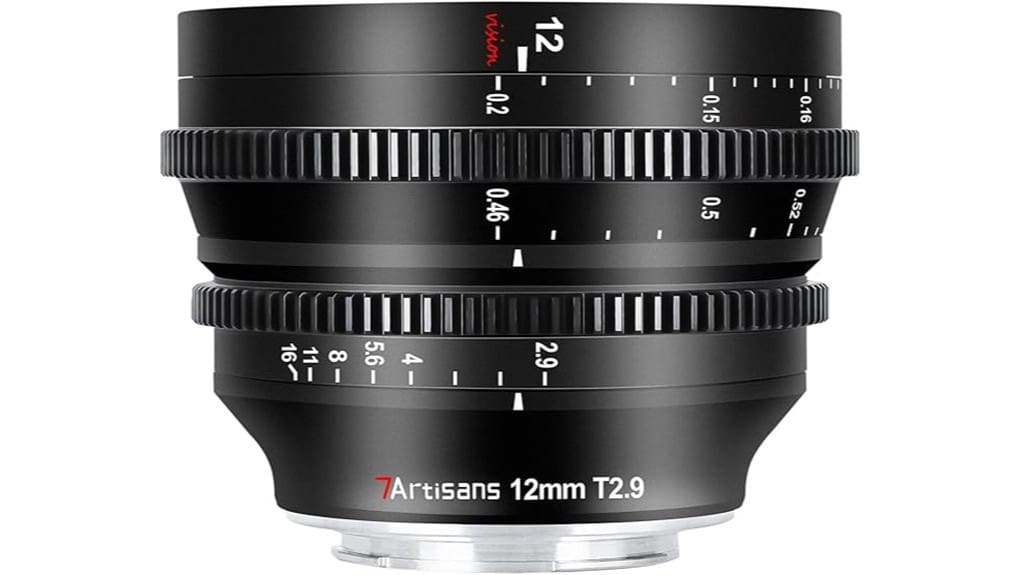
You’ll get a compact, weather-sealed 12mm T2.9 cine lens that gives roughly a 100° Super 35 field, crisp center detail with mild edge falloff, and controlled distortion for straight lines. T2.9 handles low-light streets and star work without extreme ISO; close-focus to 0.14 m lets you nail foreground drama. Cine gearing, 270° throw, and light 1.33 lb build fit gimbals and follow-focus rigs. Keep going to see tests, ergonomics, and buying advice.
Some Key Takeaways
- Wide ~100° practical field on Super35 with usable sharpness and mild edge falloff suitable for cinematic wide shots.
- T2.9 aperture enables night-street and star work without extreme ISO, with controlled flare and minimal coma.
- 0.14 m close-focus allows dramatic foregrounds and smooth wide-angle bokeh for creative compositions.
- Cine-friendly ergonomics: 270° focus throw, stepless gearing, robust metal barrel, and light 1.33 lb weight.
- Weather-sealed, six mounts, consistent color, and durable build make it a strong budget choice for indie and hybrid workflows.
What the 7Artisans 12mm T2.9 Cine Lens Is and Who It’s For
What makes the 7Artisans 12mm T2.9 cine lens worth adding to your kit? You get a compact, fast wide designed for run-and-gun and controlled set work, offering T2.9 speed for low-light tasks and starry-sky captures. You’ll appreciate a 270° focus throw and stepless gearing for precise pulling and follow-focus rigs. Weather sealing lets you keep shooting in damp or dusty conditions without pausing a shoot. The lens delivers consistent color rendition across frames, aiding grading and multishoot consistency. If you prioritize close-focus drama, durable build, and streamlined workflow, this lens fits indie filmmakers and hybrid shooters. This lens is also a practical choice for photographers who use lens adapters to mount cinema glass across multiple camera systems.
How the Optics and Field of View Perform in Real Use
How does the 12mm’s wide field translate on set? You get a usable wide angle that fills Super 35 frames with roughly 100° practical fov, letting you capture expansive interiors and dynamic foregrounds without chasing extra glass. Edge performance is surprising: details hold up toward the rim with mild falloff, so you can frame scenes confidently for VFX plates or architectural work. Distortion control is effective—straight lines stay honest with minimal correction in post. In practice the lens balances cinematic breadth and usable sharpness, integrating smoothly into run-and-gun and controlled-blocking workflows. Perfect Tripods stocks matching support and mounting options to ensure stable, repeatable framing for demanding shoots, making it easier to maintain rig consistency with tripod accessories.
Low-Light, Aperture, and Close-Focus Tests (T2.9, Stars, 0.14 M)
Having seen the 12mm hold edges and line integrity on set, you can expect similar discipline when light levels drop: the T2.9 aperture lets the lens pull usable exposure without forcing extreme ISO or long shutter times, and it performs well on night streets and star fields where you need clean highlights and controlled flare. You’ll frame tight foregrounds at 0.14 m for strong impact; foreground bokeh remains smooth for close subjects despite wide angle compression. For astrophotography, it handles long exposure startrails with minimal coma and manageable vignetting. Workflow-wise, meter conservatively, stabilize, and expose for highlights. For outdoor flash shooters, pairing the lens with external flash techniques helps balance foreground illumination with ambient light.
Focus Control, Build, Mounts, and Handling for Cine Work
Although compact, the 7Artisans 12mm feels purpose-built for cine rigs: its 270° focus throw and stepless gearing give you the fine, repeatable control required for precise rack focuses and slow push-ins, while the robust metal barrel and smooth dampening resist creep on gimbals and sliders. You get a smooth follow focus action with cinematic responsiveness; the extra-long travel lets you micro-adjust critical planes without overshoot. Robust construction mates well with matte boxes, rails, and varied mounting plates. Six mount choices and light 1.33 lb weight streamline multi-camera workflows, making handheld, gimbal, and slider setups effortless. This combination of cine-friendly features makes it a strong choice for photographers moving into cinematic workflows.
Final Verdict: When to Buy, Alternatives, and Value Assessment
Now that you’ve seen how the 270° focus throw, stepless gearing, and robust build perform on rigged setups, let’s judge where this lens fits in a production workflow. You’ll buy it when you need a compact superwide with cinema ergonomics, reliable close-focus, and usable low-light T2.9 performance without breaking the kit budget. For run-and-gun, documentary, and indie narrative rigs it’s sensible; for high-end VFX or ultra-fast primaries, consider pricier glass. Compare budget alternatives for mount flexibility and check resale potential—this lens holds value among indie shooters. Overall: practical, cinematic, and workflow-oriented value. Consider how lens mount adapters can expand compatibility with different camera systems by providing mount flexibility for varied production needs.
Some Questions Answered
Does It Support Autofocus With Adapted Cameras?
No — it doesn’t support autofocus with adapted cameras. You’ll use manual focus; the lens offers a 270-degree focus throw for precise pulls. You can rely on focus peaking in your camera or monitor to confirm critical sharpness. Electronic coupling is absent, so electronic lens adapters won’t enable AF. Use mechanical lens adapters for mount compatibility, plan follow-focus workflow, and leverage the long throw for cinematic, repeatable focus moves.
Is It Parfocal for Zoom-Adjacent Setups?
No — it isn’t parfocal for zoom-adjacent setups. You’ll need to recheck focus when changing focal length or swapping lenses. Expect minimal focus breathing but not true parfocal stability; the long 270-degree focus throw gives precise repeatable pulls, aiding matching between takes and follow-focus workflows. For multi-lens, multi-zoom rigs plan focus marks per focal length and verify on-camera, since parfocal reliability isn’t guaranteed.
Are Weather-Sealing or Moisture Protections Included?
No — it doesn’t include weather resistance or dedicated moisture protection. You’ll need to plan for exposure: use rain covers, protective matte boxes, or sealed housings when shooting in damp or windy conditions. Your workflow should prioritize lens swaps in sheltered areas and quick-dry microfiber towels on set. For demanding shoots, consider third-party sealing services or camera rigs with environmental seals to maintain consistent cinematic performance and avoid corrosion or fungus.
Does It Produce Heavy Vignetting on Full-Frame Sensors?
Yes — you’ll see heavy vignetting on full-frame sensors, especially at T2.9. Corner shading is pronounced and edge softness increases toward the frame periphery, so you’ll need to plan for corrections in post. For cinematic workflows, stop down to reduce darkened corners, or use controlled grading and masking. If you prioritize wide, even illumination, stick to Super 35 or MFT, or accept corrective workflow steps for full-frame use.
What Filters (Thread or Rear) Are Compatible?
You can use rear thread-mounted gelatin filters and a front adapter for larger screw-in or square matte-box filters. You’ll fit thin rear thread gels for IR, ND or diffusion without vignetting on Super35; the front adapter lets you attach 82mm (or specified) step-up rings, ND, polarizers or clamp-on matte boxes for cinematic control. This workflow keeps your focus throw unobstructed and preserves optical performance while giving flexible filtration options.