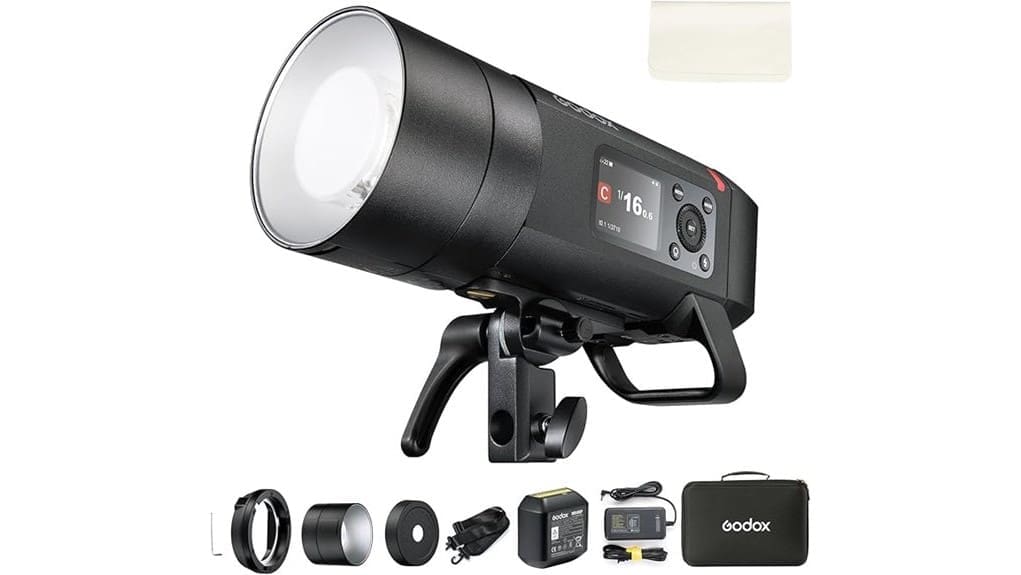
If you need a studio-grade 400 Ws monolight that’s truly portable, the Godox AD400 Pro II delivers—about 460 full-power pops from a removable lithium battery, ultra-fast 1/27,770 s flash durations, HSS to 1/8,000 s, and precise 1/512 power steps in a 2 kg body. Recycle times are 0.01–1 s and a 30 W bi‑color modeling lamp helps match ambient light. It’s ideal for wedding and location shooters; keep reading to see how it compares and what to watch for.
Some Key Takeaways
- 400 Ws portable monolight offers studio-grade output with handheld 2 kg battery operation for location shoots and run-and-gun weddings.
- Removable lithium-ion battery yields about 460 full-power pops and predictable discharge with battery locks and hibernation.
- Fast recycle times (0.01–1 s), precise 1/512 power steps, and flash durations to 1/27,770 s plus HSS to 1/8000 s.
- 30 W bi-color modeling lamp provides accurate previewing and ambient balancing; Bowens mount supports wide modifier compatibility.
- Built-in Godox 2.4 GHz system enables wireless grouping; lacks weather sealing and requires separate AC adapter for mains use.
What the Godox AD400 Pro II Actually Is and Who It’s For
Think of the Godox AD400 Pro II as a compact, 400 Ws outdoor-ready monolight that bridges studio power and on-location portability. You’ll see it’s aimed at pros who need reliable, punchy light without hauling a full kit. Compared to larger studio heads, it trades peak bulk for battery operation and faster setup. It suits wedding shooters, location portraitists, and small studio workshops where mobility matters. Rental market operators’ll appreciate broad appeal and accessories compatibility. Lighting education programs and budget pros can use it to teach lighting fundamentals without breaking the bank, while still offering pro-level control and consistency. For photographers who favor continuous LED setups, adding a continuous LED option to your kit can simplify color matching and previewing light in-camera.
Key Specs That Matter: 400Ws Power, Battery Life, Flash Duration, and Mounting
A few specs really define how the AD400 Pro II performs in the field: its 400 Ws output gives you studio-grade punch in a portable package, the removable lithium-ion battery delivers roughly 460 full-power pops per charge and supports quick 0.01–1 s recycle times, and flash durations down to 1/27,770 s (ultra-fast freeze mode) plus HSS to 1/8,000 s let you stop motion or use wide apertures in bright conditions; add a Bowens mount for broad modifier compatibility so you can swap softboxes, grids, and beauty dishes without changing ecosystems.
You’ll appreciate precise 1/512 power steps, consistent battery performance across cycles, and short recycle ceilings that outpace many rivals. Mount durability is solid—Bowens adapter fits snugly and tolerates frequent modifier swaps—so you’ll mix portability with professional light shaping. The AD400 Pro II pairs well with dedicated LED panels for versatile on-location lighting setups.
Real-World Performance: Portability, Recycle Speed, HSS, and Modeling Light in Use
Pack it up fast and you’ll notice the AD400 Pro II balances portable freedom with near-studio performance: at 2 kg with battery it’s light enough for handheld or small-stand setups, gives roughly 460 full-power pops per charge, and recycles between 0.01–1 s so you’re rarely waiting between frames. You’ll appreciate battery ergonomics—battery locks, hibernation, and predictable discharge—when shooting all day. High-speed sync to 1/8000 s lets you freeze action or open apertures in bright sun for shallow depth. The 30 W bi-color modeling lamp aids ambient balancing and previewing light quality without noticeably affecting battery life. It’s an excellent match for photographers who need reliable portable power for camera gear and off-camera lighting with power solutions.
Compatibility, Accessories, and How It Fits Into a Lighting Kit
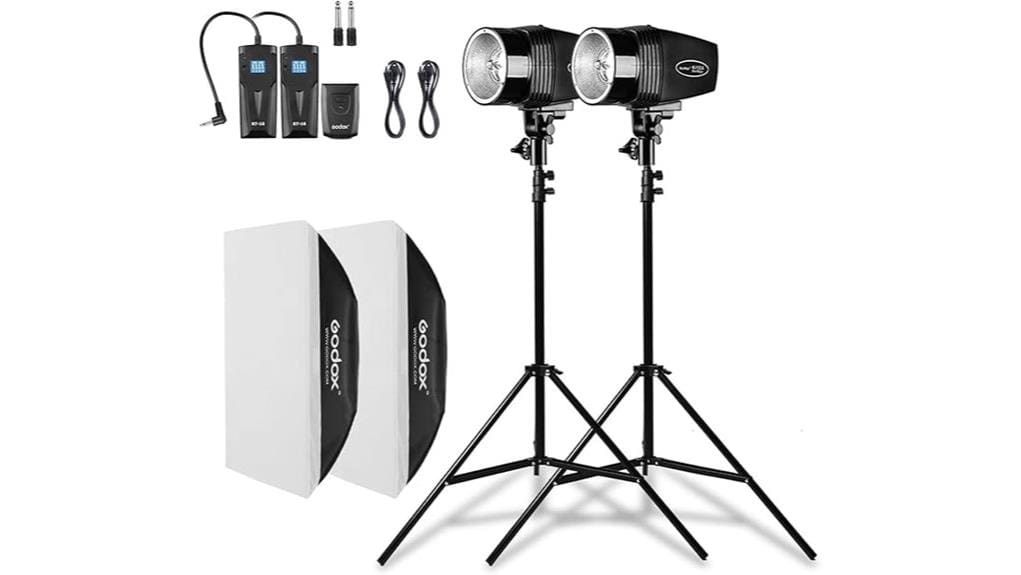
With its Bowens mount adapter and Godox 2.4 GHz X-system built in, the AD400 Pro II slots into most existing modifier ecosystems and wireless setups so you can reuse softboxes, grids, and triggers without buying new gear. You’ll appreciate Battery compatibility with the included lithium pack and AC option via the separate AC400 when comparing kit flexibility; expect ~460 full-power flashes per charge. The accessory ecosystem is broad: reflectors, umbrellas, and Bowens modifiers fit immediately, and Godox triggers and group indicators simplify multi-light control. For travel kits it’s compact and durable; for studio rigs it integrates cleanly with existing lighting collections. It’s an excellent choice for photographers building or expanding a softbox lighting kit.
Final Verdict: Strengths, Weaknesses, and Who Should Buy the AD400 Pro II
Although it’s aimed at professionals who need reliable portable power, the AD400 Pro II also makes sense for serious enthusiasts thanks to its 400 Ws output, ultra-fast 1/27770 s flash duration, and up to 1/8000 s HSS—features that give you studio-level control in the field. Strengths: compact 2 kg build, fast recycle, fine 1/512 power steps, reliable battery management and consistent color consistency from the 30 W bi-color modeling lamp. Weaknesses: no weather sealing, AC adapter sold separately, one battery per head limits continuous shooting without spares. Buy it if you need portable, high-quality single-light performance. Our shop offers a range of compatible accessories for umbrella lighting kits, including umbrella lighting and mounting options to expand your on-location setup.
Some Questions Answered
Can the AD400 Pro II Be Used in Rain or Humid Conditions?
No — you shouldn’t use it in rain or very humid conditions. The AD400 Pro II isn’t water resistant, so it lacks weather sealing; you’ll need moisture precautions like rain covers, plastic bags, or an umbrella and keep connectors dry. Compared to weather-sealed units, it’s lighter and portable but more vulnerable, so avoid exposure or use protective housings and quick-dry routines to prevent damage and maintain reliability.
Is There Built-In TTL or Only Manual Flash Control?
No, it doesn’t have built-in TTL; you get Manual control only. You’ll enjoy fine power control (1/512 increments), ultra-fast durations and HSS to 1/8000s, but TTL automation isn’t native. If you need TTL, you’ll have to pair it with a compatible Godox transmitter that enables TTL passthrough to TTL-capable flashes, though the AD400Pro II itself operates as a manual monolight for consistent, repeatable output.
How Loud Is the Fan or Cooling During Continuous Shooting?
The fan noise is noticeable but moderate during sustained bursts; you’ll hear a steady hum rather than a loud roar. Compared to studio monolights with bigger cooling, it’s quieter yet more active than small on-camera flashes. You’ll get brief pauses if thermal throttling kicks in under extreme continuous shooting, but the fan helps prevent long cooldowns. Overall, you can shoot confidently, just expect audible cooling during heavy use.
Can the Battery Be Charged on the Unit While Mounted on Light Stand?
Yes — you can charge the battery while the unit’s on a stand, but avoid cable strain. You’ll plug the AC400 (or appropriate charger) into the battery/AC port; it’s convenient for continuous use and comparative to studio monolights that require removal. Secure the charger cable so it won’t tug the mount or tilt the head. Use a strain-relief or tape, and don’t rely on the stand alone for heavy cable loads.
Are Third-Party Softboxes and Modifiers Fully Compatible With the Bowens Adapter?
Yes — you’ll find strong third party compatibility with the Bowens adapter; most third-party softboxes and modifiers mount securely. Modifier fitment compares well to native Godox options, though very cheap adapters or oddly shaped speedrings can cause gaps or alignment issues. You should verify speedring dimensions and fastening methods before buying. Overall, expect broad compatibility, but double-check vendor specs for exact fitment to avoid light leaks or instability.