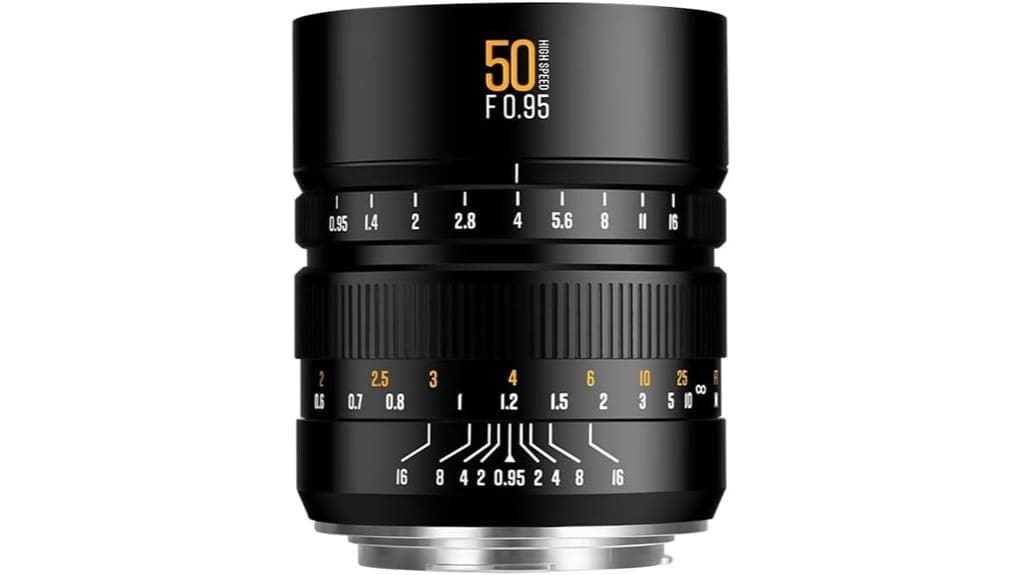
You’ll get an ultra-fast manual 50mm that gives creamy f/0.95 bokeh, usable sharpness at the focus plane, and strong subject separation on Sony full-frame E bodies. Expect noticeable vignetting and longitudinal CA wide open, with improved uniformity and microcontrast by f/1.4–2.0. The damped, long focus ring suits precise stills and cinematic pulls but sacrifices AF convenience. It ships with a 12-month warranty and support, and further details explain implementation, tradeoffs, and comparisons.
Some Key Takeaways
- Exceptional f/0.95 aperture provides extremely shallow depth of field and strong low-light performance for night portraits and cinematic videography.
- Usable sharpness at f/0.95 with improved uniformity and microcontrast when stopped to f/1.4–2.0.
- Creamy bokeh and smooth highlight rendering aid subject separation but show vignetting and longitudinal chromatic aberration wide open.
- Manual-focus design features a long, damped ring with fine-scale markings, ideal for deliberate stills and video pull-focus.
- Good build and Sony E mount fit, 12-month warranty and support, positioned mid-range versus premium F0.95 offerings.
How the Brightin Star MF 50mm F0.95 II Performs on Sony Full-Frame Bodies
When you mount the Brightin Star MF 50mm F0.95 II on a Sony full-frame E-mount body (for example an A7 III or A7R IV), the lens delivers a natural 50mm perspective while exploiting the camera’s sensor to render high-resolution detail and extremely shallow depth of field. You’ll appreciate consistent color rendition across the frame; micro-contrast and hue are stable from center to edge. The manual focus ring is damped for precise adjustments, aiding critical focus at f/0.95. Integrated hood improves flare resistance under strong backlight. Note that autofocus compatibility is not applicable—this is a dedicated manual-focus optic requiring you to focus directly. For mirrorless camera enthusiasts, pairing this lens with a well-chosen essential gear setup can enhance handling and image quality.
Image Quality: Sharpness, Bokeh, and Low-Light IQ at F/0.95
Although shooting at f/0.95 pushes the Brightin Star MF 50mm II to its optical extremes, you’ll find it delivers usable sharpness at the focus plane with characteristic softness toward the edges. You’ll get very shallow depth of field, isolating subjects with precise plane definition thanks to the lens’s optical formula and UD/HR elements. Cream bokeh renders out-of-focus highlights smoothly, aiding subject separation in portraits. For night portraits, the large aperture lets you lower ISO and retain color with controlled noise. Expect some vignetting and longitudinal chromatic aberration wide open; stopping to f/1.4–2.0 improves uniformity and microcontrast. For controlled studio results and consistent portrait lighting, pairing the lens with LED panels helps maintain even illumination and color accuracy.
Handling and Build: Manual-Focus Ergonomics, Hood, and Mount Fit
Because the Brightin Star 50mm F0.95 II is a manual-focus prime, you’ll engage directly with its focus throw and tactile controls, which are engineered for deliberate, precise adjustments rather than rapid autofocus snaps. You get a long, damped focus ring that offers predictable resistance and fine-scale markings for repeatable framing. Manual ergonomics favor control over speed: the ring diameter, knurling, and travel suit video pull-focus and careful still work. The integrated hood design is sturdy, sealed to the barrel, and minimizes backlight flare without adding bulk. Mount fit is precise on Sony E bodies, with secure indexing and no play. This lens is well-suited for photographers who appreciate precision and may benefit from using lens calibration tools to ensure optimal focus performance.
Who Should Buy This Lens: Use Cases and Practical Limitations
If you prioritize ultra-shallow depth of field and low-light performance for portrait, cinematic, or creative still work, the Brightin Star 50mm F0.95 II will serve you well; its f/0.95 aperture and classic 50mm perspective deliver subject isolation and background rendering that are hard to replicate with slower lenses. You should buy it if you shoot portrait sessions, cinematic videography, or low-light environmental portraits and value manual-focus control, dreamy bokeh, and full-frame coverage. Avoid it if you need autofocus, fast tracking, or highly compact travel gear—the manual focus, size, and handling limit run-and-gun and action work. Macro photographers may also find value in mastering macro techniques with compatible lenses and accessories for close-up work, particularly when learning about macro lenses and how they affect depth of field and magnification.
Price, Warranty, and Alternatives to Consider Before Buying
When evaluating the Brightin Star 50mm F0.95 II, weigh its street price and warranty against your workflow and alternatives: the lens ships with a 12-month warranty and 24-hour after-sales support, and its manual-focus, ultra-fast design typically positions it below premium-brand F0.95 options but above generic budget primes—so compare current retail pricing, return policies, and long-term service options to determine whether its value aligns with your need for ultra-shallow depth of field, full-frame coverage, and manual operation. For purchase decisions, perform price comparison, review warranty terms, assess alternative lenses (brand F0.95 and fast 50mm primes), and consider resale value if you may upgrade. A good place to start is consulting a dedicated camera gear guide to understand how this lens fits among common full-frame options.
Some Questions Answered
Does This Lens Work on APS-C Sony Bodies Without Vignetting?
Yes — you can use it on APS-C Sony bodies without significant vignetting. You’ll get a cropped field of view equivalent to ~75mm, preserving center sharpness while reducing full-frame edge falloff outside the smaller sensor area. Expect the same f/0.95 shallow depth characteristics centrally, though micro-contrast near frame edges may improve due to crop. Manual focus operation and integrated hood remain unchanged; test at wide apertures for peak results.
Can I Use This Lens for Video Focus Pulls Smoothly?
Yes — you can use it for video focus pulls. You’ll rely on manual focus and a follow focus for repeatable pulls; the focus ring feels precise and geared for rigs. Smooth bokeh makes shifts pleasing, though the extremely shallow f/0.95 depth requires careful marking. Expect minimal focus breathing thanks to optical design, but practice to confirm on your body. Use peaking and external monitors for accurate pulls in low light.
Is There Any Electronic Communication With the Camera Body?
No — the lens has no communication; it’s manual only. You’ll control aperture and focus mechanically without electronic contacts, metadata, or autofocus signals passed to the camera body. Exposure and focus confirmation depend on your camera’s manual aids (peaking, magnification). You’ll need to set aperture, ISO, and shutter speed on the camera; lens won’t transmit focal length or EXIF data. This design prioritizes optical performance and manual operation.
How Durable Is the Integrated Hood Against Impacts or Scratches?
The integrated hood offers moderate durability against impacts and scratches; you’ll find it resists everyday bumps but isn’t impervious to heavy strikes. Its material hardness provides surface protection and good edge retention under regular use, preserving shape and fit. For harsh handling or drops you should expect possible scuffs or deformation. You’ll want a protective case or careful handling to avoid damage beyond normal wear and maintain peak performance.
Are There Filter Threads or Ways to Attach Filters?
Yes — you can use filters. The front element lacks conventional threads, so you attach a removable adapter that accepts slim filters to avoid vignetting at f/0.95. The integrated hood remains in place while the adapter mounts. For diffusion or color gels you’ll use rear gel slots or a rear gel holder since the front styling prevents standard screw-in filters. This preserves optical clearance and minimizes mechanical interference.