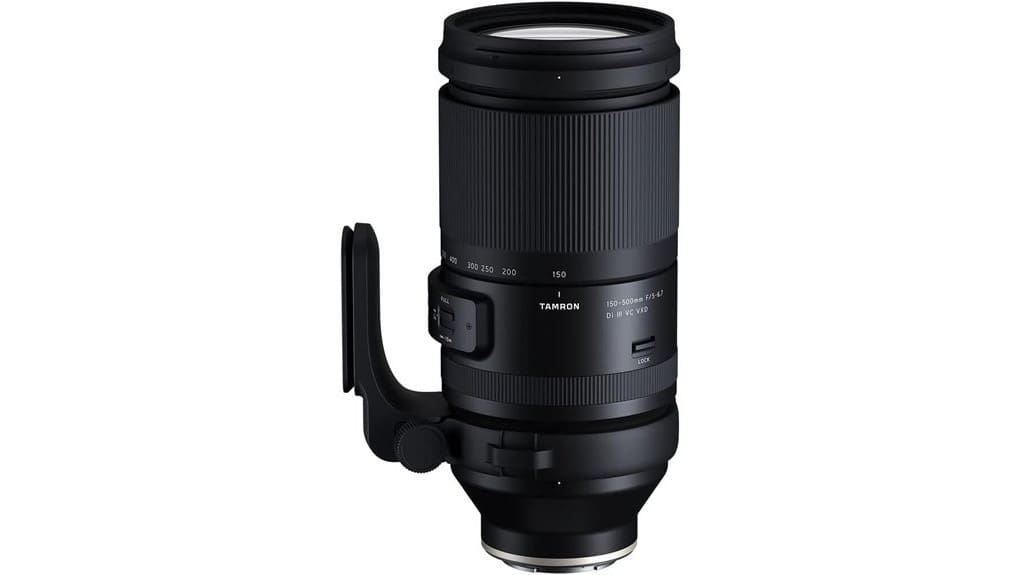

You’ll get a lightweight, reach‑first 150–500mm zoom that pairs Tamron’s VXD linear AF and effective VC stabilization to deliver reliable handheld shots on Sony full‑frame bodies. It’s sharp centrally, hunts rarely in good light, and gives 3–4 stops of stabilization at long focal lengths, though background separation and low‑light headroom lag pro telephotos. Build is weather‑resistant with handy ergonomics and an 82mm filter thread. Keep going and you’ll find detailed performance, settings, and buying tips.
Some Key Takeaways
- Excellent 150–500mm reach with VXD linear AF delivers fast, predictable focusing for birds, wildlife, and distant sports on Sony full-frame E-mount.
- VC stabilization provides roughly 3–4 stops of handheld benefit, improving keeper rates at long focal lengths.
- Sharpness is strong centrally through the range, with some falloff and softer edges at 500mm.
- Lightweight 4.14 lb design is portable for handheld shooting but not as fast or background-separating as pro primes.
- Good value with Tamron optics, 6-year USA warranty (authorized dealers), and included hood, caps, and 82mm filter thread.
Quick Verdict: Who Should Buy the Tamron 150–500mm F/5–6.7 and Who Should Not
Who needs the Tamron 150–500mm f/5–6.7? You will if you prioritize reach, stabilized handheld capability, and cost-effective performance on Sony full-frame bodies. The lens delivers VXD autofocus and VC stabilization that suit birds, wildlife, and distant sports where portability matters. Budget shooters who want ultra-tele reach without pro tele costs will find it compelling, though compromises in maximum aperture limit low-light headroom. You shouldn’t buy it if you require the fastest glass, extreme background separation, or primarily tripod use for studio-level sharpness. Objectively, it balances size, weight, and price for practical long-telephoto needs. For many shooters, pairing this lens with high-speed memory cards can help maintain burst performance and buffer clearing during extended wildlife or sports sessions.
Key Specs and Build Features That Matter for Long Telephoto Shooting
Because long-telephoto shooting amplifies every small handling and optical shortcoming, you should judge the Tamron 150–500mm by a compact set of specs and build traits that directly affect reach, stabilization, autofocusing, and weather reliability. You’ll value the 150–500mm range and 82mm filter size for reach and accessories; weight balance and overall mass (4.14 lb) determine handheld viability. VC stabilization and VXD linear-drive AF are core performance enablers. Check for telephoto ergonomics: tripod foot, zoom and focus rings, and any focus limiter for faster hunting. Assess build durability, weather sealing, fluorine coating, and resistance to zoom creep under gravity. Consider how this lens compares to other long-telephoto options for wildlife and sports, especially regarding reach and stabilization.
Real-World Performance: Autofocus, Stabilization, Sharpness, and Low-Light Handling
When you push the Tamron 150–500mm into real-world shooting, its VXD linear motor delivers fast, predictable focus locks and the VC stabilization lets you hold usable shutter speeds well beyond what focal length alone would permit. You’ll notice rare focus hunting in good light; subject acquisition is quick and reconfirmed. AF customization on compatible Sony bodies refines tracking behavior effectively. Stabilization testing shows consistent 3–4 stop gains at long ends, improving keeper rates handheld. Sharpness is strong centrally, with controlled falloff at 500mm. Lowlight metering remains reliable but noise rises as you push ISO for usable shutters; plan exposures accordingly. For those using dedicated support, a sturdy tripod system helps maximize sharpness and stability in long-telephoto work.
Best Use Cases and Sample Settings for Wildlife, Birds, Sports, and Handheld Shooting
Having seen how the VXD AF and VC stabilization perform in real use, you can tailor settings and shooting approaches to maximize this lens for wildlife, birds, sports, and handheld telephoto work. Use focal length selection pragmatically: 150–300mm for closer wildlife and sports, 400–500mm for distant birds. Rely on continuous AF with subject tracking for erratic motion; set high AF sensitivity for birds in flight. For handheld technique, brace elbows, use VC, and favor shutter speeds of 1/1000–1/2000s for birds/sports, 1/500s for larger wildlife. Balance ISO and aperture in exposure settings to preserve shutter priority and reasonable noise. Consider pairing this lens with a lightweight travel tripod for improved stability and versatility during long shooting sessions with telephoto focal lengths and varied subjects, especially when using travel tripods.
Value, Compatibility, and Buying Practicalities (Price, Warranty, Accessories, Alternatives)
Dig into the Tamron 150–500mm‘s value proposition by weighing its performance, build, and support against price and alternatives. You’ll find competitive optics, VC stabilization, and VXD AF justify a mid-to-high price tier versus native primes and heavier super-telephotos. For Sony E users compatibility is native; APS-C gives ~225–750mm reach. Check price comparison across authorized dealers and grey-market listings for savings. Warranty details matter: Tamron’s six-year limited USA warranty applies when bought from authorized Tamron USA channels; retailers may add a voluntary 30-day return. Included hood, caps, and 82mm filter thread reduce accessory costs; consider lighter alternatives if weight or budget constrain you. Also consider the broader selection of mirrorless accessories available from specialty retailers.
Some Questions Answered
Does This Lens Accept Teleconverters and Which Ones Are Compatible?
Yes — you can use select teleconverters, but teleconverter compatibility is limited; Tamron recommends using tested 1.4x or 2.0x converters designed for Sony E mounts. You should expect reduced autofocus performance with any teleconverter, especially at smaller effective apertures (f/8+). Objectively, a 1.4x preserves AF better than 2.0x; evaluate AF speed/accuracy for your camera body and shooting conditions before committing to teleconverter use.
How Weather-Sealed Is the Lens for Harsh Conditions?
You’ll find the lens is moderately weather sealed: Tamron lists water resistance and uses seals at key joints, mount, and switches, providing basic moisture resistance for light rain, spray, and dusty conditions. It’s not fully submersible or rated to an IP standard, so you shouldn’t rely on it for prolonged exposure in heavy storms or salt spray. Use additional protection (rain cover, silica packs) in harsh environments to be safe.
Can It Be Used Effectively for Astrophotography or Moon Shots?
Yes — you can use it for astrophotography and moon shots, but manage expectations. Its long reach and VC help framing and handheld moon shots, yet f/5–6.7 limits low light performance for faint deep-sky targets. You’ll get good lunar detail, though chromatic aberration can appear on high-contrast edges and stars; stop down a bit and apply CA correction in post. Use tripod, long exposures, and precise focus for best results.
What Tripod Collar Options Are Available or Included?
The lens ships without a tripod collar; you’ll need an aftermarket detachable collar or use the integrated foot on compatible third‑party plates. You can attach a detachable collar that clamps to the barrel for balanced support and rotation, or rely on an integrated foot-style plate from some adapters that mates to Arca-type heads. Evaluate stiffness, quick-release compatibility, and alignment — choose a collar with secure locking, precise fit, and adequate load rating.
How Does Focus Breathing Affect Video Use?
Focus breathing can cause noticeable framing shifts during zooms, so you’ll need to compensate for composition changes when recording; parfocal behavior (or lack thereof) determines how stable framing remains while zooming. If the lens isn’t truly parfocal, zooming during a take will alter focus and field-of-view, requiring refocusing or dolly adjustments. For critical video work you’ll prefer minimal focus breathing and consistent parfocal performance to maintain stable, repeatable shots.