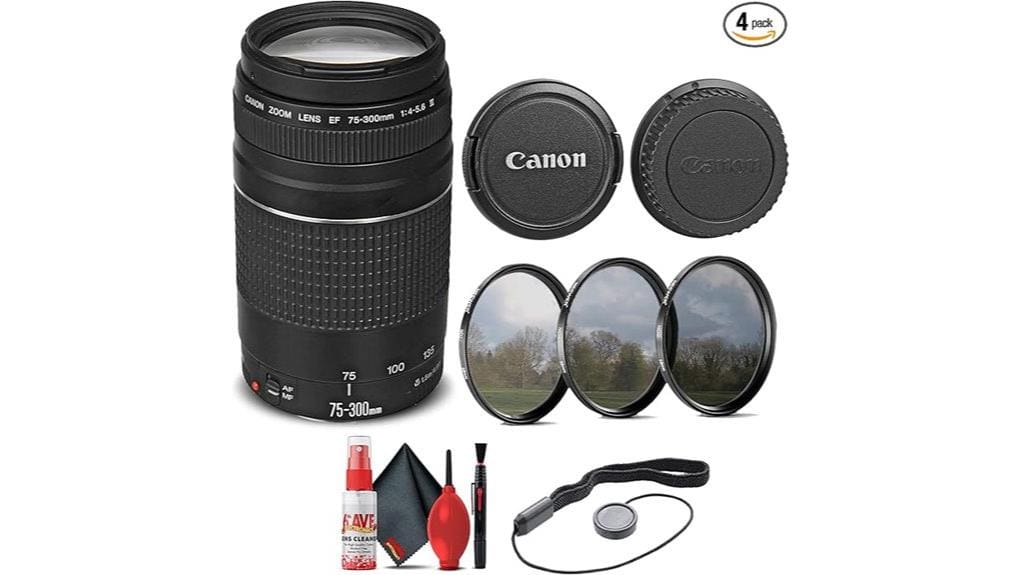
You’ll get a lightweight, budget telephoto that’s great if you want extra reach without spending much. It covers 75–300mm for portraits, travel, and casual sports, but the f/4–5.6 aperture limits low‑light work and depth control. Sharpness is decent in the center but softens toward 300mm and at the corners; autofocus is driven by a slower DC micro motor and there’s no stabilization. It’s a practical cost‑conscious choice—keep going to see how it performs in real scenarios.
Some Key Takeaways
- Lightweight, affordable 75–300mm telezoom ideal for hobbyists and travel shooters seeking extended reach without heavy cost.
- Variable f/4–5.6 aperture limits low-light performance and shallow-depth-of-field control compared with pro telezooms.
- Image quality is usable at mid apertures but softens toward 300mm with some chromatic aberration and corner softness.
- DC micro motor autofocus is adequate for stills but can hunt with fast action, and the lens lacks image stabilization.
- Plastic build and no weather sealing favor portability over durability; better AF/optics found in used USM or stabilized alternatives.
Quick Verdict: Who the 75–300mm F/4–5.6 III Is Best For
Although it’s an entry-level telephoto, the 75–300mm f/4–5.6 III gives you a lightweight, affordable way to reach medium and long focal lengths, making it ideal for hobbyists, travel shooters, and beginners stepping up from kit lenses. You’ll appreciate its compact build and straightforward operation if you’re a budget shooter or a beginner telephotographer exploring portraits, sports, or distant subjects without heavy investment. It won’t match pro-grade optics or fast apertures, but it delivers usable reach, decent autofocus, and simple handling. Choose it when portability, cost control, and focal-range flexibility matter more than maximum image refinement. Consider pairing it with mirrorless camera accessories to enhance portability and usability for travel and hobby photography.
Key Specs and What They Mean for Real-World Use
When you scan the 75–300mm’s spec sheet, a few practical takeaways jump out: the 4x zoom range gives flexible framing from short telephoto portraits to long-reach wildlife or sports, the f/4–5.6 aperture limits low‑light performance and depth‑of‑field control compared with faster glass, and the lightweight construction helps handheld shooting but signals compromises in build and optical refinement. You’ll appreciate Super Spectra lens coatings reducing flare and preserving contrast in high‑contrast scenes. Expect aperture tradeoffs at longer focal lengths—slower max apertures demand higher ISOs or slower shutter speeds. The 7‑blade diaphragm shapes bokeh modestly; portability wins over pro-level robustness. This lens is a solid budget-friendly option for beginners interested in portrait work and telephoto versatility.
Image Quality and Autofocus Performance Tested (Portraits, Sports, Telephoto)
Because the 75–300mm balances reach and weight, you’ll see clear strengths and predictable limitations in real shooting: sharpness is acceptable across the range at typical working apertures but softens noticeably toward 300mm and at the extreme corners, contrast stays reasonable thanks to Super Spectra coatings though micro-contrast and fine detail lag behind higher‑end telezooms, and chromatic aberration and some coma can appear in high‑contrast edges—especially wide open. For portraits the bokeh rendering is smooth enough at longer focal lengths, and focusing consistency from the DC micro motor is good for stills; in sports you’ll need fast bursts and expect occasional focus hunt. Stabilization performance isn’t available in this lens, so you must rely on higher shutter speeds or in-body stabilization when shooting handheld at long focal lengths. This lens is aimed at enthusiasts who value telephoto reach while keeping weight and cost manageable.
Handling, Build, and Compatibility With Canon Bodies and Adapters
If you hold the Canon EF 75–300mm f/4–5.6 III you’ll notice a lightweight, compact construction that favors portability over ruggedness, with a mostly plastic barrel and mount that keeps weight down but won’t match pro-grade weather sealing. You get predictable balance on mid-size DSLRs and handheld shooting benefits from lightweight handling, though stability at 300mm can demand a monopod. Autofocus is driven by a DC micro motor; there’s no full-time manual override, so switching to manual focus is deliberate. The EF mount fits Canon DSLRs and cinema bodies directly; mount adapters work for mirrorless systems but check flange distances and AF compatibility. For photographers using third-party accessories, choosing the right camera mounting plate can improve handling and tripod balance.
Should You Buy It? Alternatives and Value-for-Money Recommendations
Having covered handling and compatibility, next consider whether the EF 75–300mm f/4–5.6 III matches your needs and budget. You’ll get a lightweight, full-frame telephoto with usable optics and fast DC micro motor AF, ideal if you need reach on a tight budget. For better build, AF speed, or image quality, consider budget alternatives like used Canon EF 70–300mm IS USM or third‑party 70–300mm zooms; they often deliver superior long term value. If you shoot professionally or in low light, invest in stabilized, faster-aperture lenses. Buy this lens if cost and portability are your primary priorities. For photographers storing large RAW files, consider fast, reliable cfexpress cards to keep up with high-speed shooting.
Some Questions Answered
Does the Lens Come With Image Stabilization (IS)?
No — it doesn’t include image stabilization. You won’t get optical stabilization or vibration reduction in this model, so you’ll rely on fast shutter speeds, camera bodies with in-body image stabilization, or a tripod for steady telephoto shots. The lens uses a DC micro motor for autofocus and Super Spectra coatings for flare control, but it lacks IS/Vibration Reduction hardware, which limits handheld low-light or long-telephoto usability compared to stabilized alternatives.
Is This Lens Weather-Sealed or Moisture-Resistant?
No — the lens doesn’t have weather sealing or notable moisture resistance. You shouldn’t rely on it in rain, mist, or dusty environments without extra protection. Its lightweight, budget design lacks gaskets or sealing at the mount and controls, so moisture and particles can enter. If you need telephoto use in adverse conditions, you’ll want a weather-sealed lens or protective measures like rain covers, plastic wraps, or camera housings.
Can the Lens Be Used With Teleconverters Effectively?
You can use teleconverters, but don’t expect stellar teleconverter performance; image quality will drop. The lens’ basic optical design and variable f/4–5.6 aperture pair poorly with 1.4x or 2x converters, reducing sharpness, contrast, and AF reliability. You’ll get more reach, but you’ll sacrifice resolution and low-light performance. If teleconverter use is essential, test combinations first and prioritize high-quality optics or a native longer telephoto for best image quality.
What Is the Minimum Focus Distance for Close-Up Work?
The minimum distance is 1.5 meters (4.9 feet). At that close-focus point you’ll get a modest magnification ratio of about 0.2x (1:5), so you won’t achieve true macro reproduction. You’ll be able to fill the frame with medium-telephoto subjects, but very small details will remain small. If you need higher magnification, you’ll want extension tubes, close-up diopters, or a dedicated macro lens for greater reproduction and working distance control.
Are There Third-Party Mounting Adapters for Mirrorless Use?
Yes — you can use third-party mounting adapters for mirrorless use. You’ll find adapter options from Metabones, Viltrox, Fotodiox and Novoflex that provide EF-to-E-mount, EF-to-L-mount, EF-to-Z-mount, and EF-to-FX compatibility. Check mount compatibility and electronic pass-through: some adapters provide AF confirmation and aperture control via the DC motor, others are passive and require manual focus. Verify flange distance, build quality, and return policies before buying.