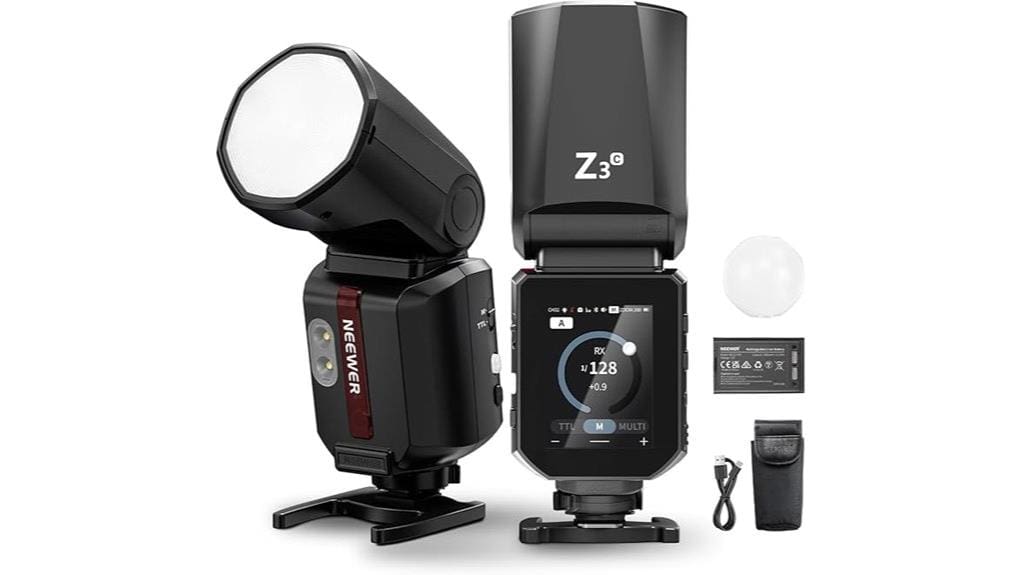
You’ll get studio-level punch from the compact Neewer Z3-C 100Ws, with 1/8000s HSS, ~1.7s recycle, and good color consistency near 6000K. It’s built for on-camera portrait and content work, with a responsive touchscreen, physical dials, and two modeling lamps for previews. Battery life is solid for travel shoots, though wireless quirks and only four groups limit complex rigs. It’s a strong budget-friendly option—keep going to see detailed pros, cons, and real-world tips.
Some Key Takeaways
- 100Ws output delivers studio-level punch in a compact, hot-shoe‑mountable unit ideal for travel and on‑camera use.
- Fast performance: 1/8000s HSS, ~1.7s recycle, and up to 100 consecutive full‑power flashes.
- Accurate color (~6000K) with 0.1 EV steps and strong battery life (3000mAh, ~500 full‑power flashes).
- Intuitive controls: HD touchscreen, physical dials, one‑touch UI, and two 3300K modeling lamps with 10 brightness levels.
- Wireless: built‑in 2.4G Q‑system (4 groups, 32 channels) but limited groups, mixed interoperability, and no transmitter included.
Neewer Z3-C at a Glance: Key Specs and Who It’s For
While it’s compact enough to mount on your Canon hot shoe, the Neewer Z3-C packs serious studio-level features: 100Ws output, 1/8000s HSS, front/rear curtain sync, and up to 100 consecutive full-power flashes—perfect for portraits, action, and content creation. You’ll appreciate the compact build and touch-screen controls that keep adjustments fast on shoots. As a budget option, it delivers pro-level sync and modeling lights without breaking the bank. Its portrait suitability is clear—consistent color, magnetic diffuser, and reliable grouping. If you travel, this travel flash balances power, portability, and wireless compatibility for on-location work. It’s also a great match for photographers using continuous LED lighting who want a portable strobed option to broaden their toolkit.
How the Z3-C Performs: Power, Recycle Speed, and Flash Consistency
Pushes plenty of usable light for its size — the Z3-C’s 100Ws output gives you studio-level punch on a travel-friendly flash, and you’ll find it holds up well across a range of situations from portraits to backlit scenes. You’ll appreciate reliable flash consistency: color stays near 6000K and output steps in 0.1 EV make fine-tuning predictable. Recycling is quick — about 1.7 seconds — so you won’t miss many decisive moments shooting events or fast action. Battery longevity is strong too: the 3000mAh cell delivers many full-power firings per charge, keeping you shooting longer without swapping batteries. It pairs well with wireless flash triggers for off-camera setups, making remote control and multi-flash coordination much easier with wireless flash triggers.
Controls, Modeling Lights, and Usability On-Camera
Because Neewer designed the Z3-C around a touchscreen and simple physical controls, you’ll get to adjustments fast and stay focused on your subject. The high-definition color touchscreen ergonomics are responsive and logical, letting you tweak power, mode, and modeling light with one touch. Two 3300K modeling lamps offer ten brightness levels, so you can preview lighting without guessing. Physical dials and a clear Battery indicator keep you informed and reduce menu dives on set. Mounted on-camera, the Z3-C feels balanced, controls reachable, and adjustments immediate—practical for portraits, run-and-gun, and creator workflows where speed matters. Perfect Lighting recommends considering video light panels when selecting gear to complement the Z3-C.
Wireless Compatibility and Syncing: Q-System, X-System, and Practical Limits
When you need reliable off-camera control, the Z3-C’s built-in 2.4G Q-system gives you flexible options—four groups, 32 channels and 99 IDs—so you can trigger and organize multi-light setups without adding a separate transmitter. You’ll appreciate master/slave roles and X-system RX compatibility, but note transmitter dependency: full Q transmit control needs a QZ-C. Expect firmware quirks; some X/Q interoperability requires updates and won’t run simultaneously. Group limitations matter in complex rigs—only four groups may force creative layering. Watch for channel interference in crowded venues and test range and sync before critical shoots to avoid surprises. This makes understanding speedlight compatibility crucial when planning multi-flash setups.
Real-World Verdict: Strengths, Weaknesses, and Should You Buy It?
While it’s not flawless, the Z3-C delivers strong value for photographers who need portable power and flexible wireless control. You’ll appreciate battery life—up to 500 full-power flashes—fast recycle, and consistent color. Build quality feels good for field work, though metal contacts and hinge could be sturdier. Portability tradeoffs are clear: it’s compact and light for run-and-gun shoots, yet less capable than studio heads for modifiers. The user interface is excellent—responsive touch screen and one-touch controls speed workflows. Weaknesses: mixed system compatibility and no transmitter included. Verdict: buy if you want a capable, budget-friendly on-camera flash. Many buyers will also browse our light kit essentials when planning video and photography setups.
Some Questions Answered
Does It Include a Protective Carrying Case or Pouch?
No — it doesn’t include a protective pouch or hard case in the standard package. You’ll get the speedlite, diffuser, and battery accessories, but you’ll need to buy a protective pouch or hard case separately if you want added protection for travel or rough handling. If you value secure storage, consider a padded soft pouch for quick carry or a compact hard case to protect the head and controls during transport and shoots.
Can I Use Third-Party Chargers for the Battery?
Yes — you can use third party chargers, but you should be cautious. Third party chargers may work with the Battery but can raise charging safety issues and potentially void warranty concerns if they cause damage. You’re better off using the manufacturer’s recommended charger or a reputable brand with matched specs and protections (overcharge, temperature). If you must use a third party unit, keep an eye on battery temp, charge cycles, and keep receipts for warranty claims.
Is There a Built-In USB Port for Firmware Updates?
No — there’s no built-in USB port for firmware updates. You’ll need to update firmware via the manufacturer’s suggested method (often using a dedicated transmitter or service tool), or check for a firmware upgrade path that uses a separate USB adapter. That said, confirm with Neewer support or the manual because compatibility notes (Firmware updates?) and system limitations can change; they’ll tell you the exact update procedure and any required accessories.
Does It Support TTL Metering With Canon Cameras?
Yes — it supports TTL compatibility with Canon integration. You’ll get automatic TTL metering when mounted on Canon hot-shoe cameras, letting the flash balance exposure for portraits, backlit scenes, and fast action. You’ll also use HSS, front/rear curtain sync, and manual control when needed. It’s practical for content creators who want quick, reliable TTL results, though full Q-system transmitter features require the separate QZ-C transmitter.
What Is the Flash Head Tilt/Swivel Range?
The flash head tilts 0° to 90° and swivels left/right within its rotation limits of 0°–270° (commonly 0°–90° up, 0°–7° down depending on mount). You’ll use those bounce angles to direct light for ceilings, walls, or wraparound fills. That range gives flexible rotation limits for portrait and event work, letting you quickly reposition for softer, more flattering light without moving the whole camera or modifier.