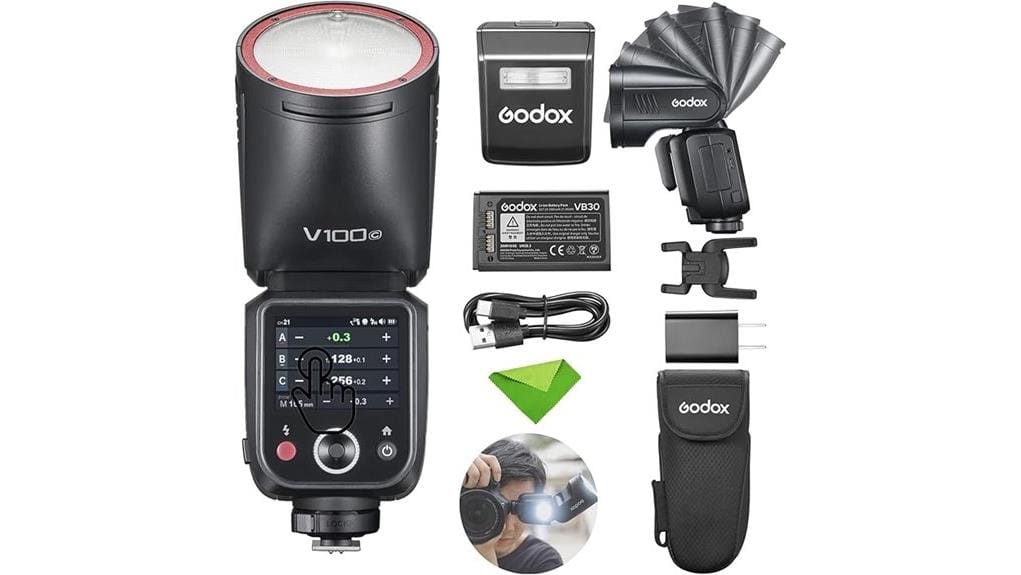

You’ll get a compact on‑camera 100Ws TTL strobe made for Canon shooters who want studio‑level output without a pack. It supports reliable TTL, HSS for freezing action, and fast ~1.7s recycle at full power, all from a removable USB‑C lithium cell rated ~400 full pops. The 2.3‑inch touchscreen and Godox 2.4G radio simplify multi‑flash setups, though there’s no full weather sealing and the proprietary battery needs care — keep going to see detailed pros, cons, and comparisons.
Some Key Takeaways
- Compact 100 Ws on‑camera strobe for Canon with reliable TTL and HSS performance suited to hybrid shooters.
- Removable proprietary USB‑C lithium battery claims ~400 full‑power flashes and supports rapid recycle (~1.7s at 1/1).
- Manual output reliable across 1/1–1/256 with consistent shot‑to‑shot stability and good thermal management.
- Built‑in Godox 2.4G radio enables quick pairing as master/receiver for multi‑flash setups and trigger compatibility.
- Touchscreen controls and SU‑1 detachable sub‑flash improve usability, though no full weather sealing and nonstandard battery care required.
What the Godox V100C Is and Who It’s For
As a compact yet powerful on-camera strobe, the Godox V100C gives Canon shooters a 100 Ws head with TTL and HSS in a pocketable package, so you get studio-level output without lugging a pack. You’ll find it’s aimed at hybrid shooters who prioritize portability and consistent results: event, run-and-gun portrait, and location work. Compared with larger pack systems, it balances output and size while offering reliable color fidelity for mixed-light scenes. Pay attention to battery safety with its nonstandard lithium cell—follow charging and transport rules. If you want compact power and accurate color, it’s a strong choice. For photographers seeking versatile lighting solutions, consider how LED panels complement strobes by providing continuous, adjustable light and helping to fine-tune exposure with consistent light quality.
Key Specs at a Glance: Power, Battery, and Connectivity
If you liked the V100C for its balance of power and portability, here’s what matters next: peak output, how long it runs, and how it talks to your camera and other flashes. You get 100 Ws peak (M) with a GN around 173, a broad 1/1–1/256 range, and advanced cooling that lets you dump 70–100 full-power pops consecutively. The included proprietary lithium cell claims 400 full-power flashes and five-year battery longevity; it’s removable and USB-C rechargeable. Built-in Godox 2.4G radio gives robust wireless compatibility, acting as master or receiver and pairing quickly with Godox triggers. This site also offers accessories and compatible external camera monitors to help you better frame and review your shots with the V100C external monitors.
Real-World Performance: TTL, HSS, Recycle Time, and Flash Output
When you press the shutter, the V100C delivers predictably accurate TTL exposures and quick manual control, letting you switch modes on the touchscreen without fumbling; its TTL is responsive on Canon bodies and balances ambient light well, while manual output tracks reliably across the 1/1–1/256 range. You’ll notice strong TTL consistency shot-to-shot, comparable to higher-end Godox units. HSS limits perform solidly for freezing action, though peak output drops noticeably in HSS compared with full sync. Recycle behavior is brisk (around 1.7s at full power), and Flash output is stable across cycles and battery levels. The compact design makes it a great match for on-camera use and portable setups.
Controls, Usability, and Build Quality: Touchscreen, SU-1 Sub‑Flash, and Workflow
Although small, the 2.3-inch touchscreen gives you direct, fast control over TTL/M switching, HSS activation, and one-tap pairing, and it’s noticeably quicker to navigate than Godox’s older button-heavy menus. You’ll appreciate the improved touch sensitivity and reduced menu latency compared with legacy units; taps register reliably and settings respond without the lag that slowed workflow before. The SU-1 detachable sub‑flash adds flexible lighting angles and simple mounting, speeding multi-flash setups. Build materials feel mostly robust—lightweight alloy and plastics—though Godox doesn’t claim full weather sealing, so you’ll avoid heavy rain or dusty environments. For photographers who shoot video or portraits, pairing the V100C with on-camera LED lights can create consistent fill and smoother skin tones when mixing light sources on-camera LED lights.
Buy or Skip? Use Cases, Pros/Cons, and How It Compares to Alternatives
Because it balances compact power with modern features, the V100C is a strong pick if you need a portable, rechargeable Canon-compatible flash that handles TTL, HSS, and multi-flash setups, yet it isn’t ideal if you prioritize full weather sealing or want the absolute lightest head for run-and-gun work. You should buy it if you value battery longevity, touchscreen control, and reliable Godox radio integration for location shoots and quick modifier swaps. Skip it if you need robust weatherproofing or ultra-small heads for mirrorless run-and-gun. Compared with bigger studio strobes, it trades absolute output and modifier flexibility for size and convenience. It’s also a useful option for photographers who use dedicated flash triggers to coordinate multi-unit setups on location.
Some Questions Answered
Is the V100C Compatible With Third‑Party Radio Triggers?
Yes — you can use third‑party triggers, but Radio compatibility is best with Godox 2.4G X‑system gear. You’ll get full TTL and HSS reliability only with native or X‑compatible triggers; generic triggers may work in manual mode. Expect possible trigger latency or missed pops with non‑compatible units, so performance is comparative: native triggers minimize latency and maximize features, while third‑party units can be cheaper but less consistent.
Can I Use the Flash While Charging via Usb‑C?
Yes — you can use the flash while charging via USB‑C, but with caveats. The V100C supports battery passthrough, so it’ll keep operating during charge; the Charging indicator shows status. Expect slightly different behavior versus removable battery use: recycle times may vary and continuous full‑power bursts can heat the unit. For reliability, monitor the Charging indicator and avoid heavy continuous firing while charging to prevent thermal throttling or reduced performance.
Does the Battery Have an Official Spare or Replacement Part Number?
Yes — the battery has an official partnumber listed by Godox (check the product page/manual for GD1548 bundle details). You can buy third‑party replacements, but compare capacity, voltage, and connector compatibility closely. Official batteries tend to offer better integration, firmware compatibility, and warranty support; third‑party options are often cheaper and plentiful but may vary in cycle life and safety. You’ll want identical specs to avoid performance issues.
Is the Unit Safe to Use in Extreme Hot or Cold Temperatures?
No — you shouldn’t expect full reliability in extreme hot or cold. The operating temperature range isn’t specified here, so compare to typical flashes: extreme heat can trigger thermal protection and reduce performance or shut the unit down; extreme cold shortens battery life and slows recycle. You’ll get best results in moderate conditions, avoid prolonged exposure, and keep spare batteries warm, monitor thermal protection warnings, and cool or warm the unit gradually.
Are Firmware Updates User‑Installable via Usb‑C?
Yes — you can install firmware updates via USB‑C. You’ll follow the firmware procedure using the included USB‑C cable and Godox updater software; it’s straightforward compared with older wired methods. You should still heed update risks: keep battery charged, avoid cable/connection loss, and don’t interrupt the process. If you prefer, use a stable computer connection or a Godox service to minimize bricking or compatibility issues.