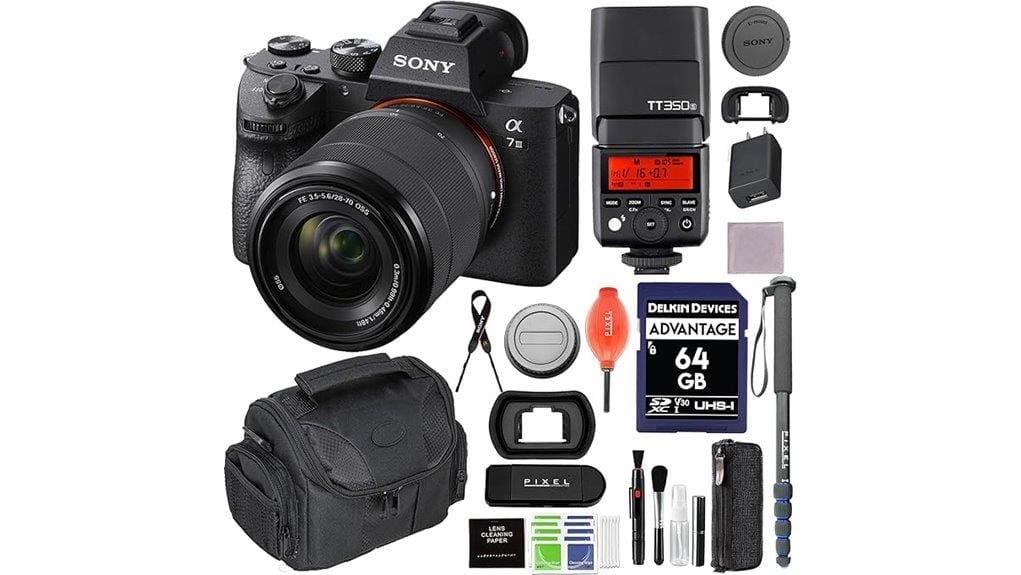

The Sony a7 III gives you a technically reliable, color-true full‑frame hybrid with a 24.2MP sensor, 14‑bit RAW, and excellent mid‑tone skin rendering. Its 693‑point phase‑detect AF and 10 fps bursts handle weddings, documentary and run‑and‑gun work reliably, while 5‑axis IBIS buys about 5 stops with compatible glass. You’ll get clean 14‑bit files to ISO 3200, usable tones to 6400, 4K capture with S‑Log, dual UHS‑II slots and long NP‑FZ100 endurance — more specifics follow.
Some Key Takeaways
- Excellent all-rounder: 24.2MP full-frame sensor, true-to-tone color, and strong dynamic range for portraits, events, and commercial work.
- Reliable autofocus and speed: 693-point phase-detect AF with AF-C tracking and 10 fps bursts for run-and-gun and action.
- Strong low-light performance: 5-axis IBIS plus clean 14-bit RAW up to ISO 3200 and usable results through ISO 6400.
- Solid video toolset: 4K/24–30p with S-Log2/3, HDMI output, and dual UHS-II slots, but watch for thermal limits in long takes.
- Practical ergonomics and workflow: deep grip, logical controls, NP-FZ100 battery life, and useful dual-slot recording options.
Who the Sony a7 III Is For and the Formats It Best Serves
Because it balances high-resolution full-frame imaging with fast, reliable AF and 4K capture, the Sony a7 III is ideal for professionals and advanced enthusiasts who shoot a mix of stills and video — wedding, event, portrait, documentary, and run-and-gun commercial work all benefit. You’ll appreciate its 24.2MP sensor’s clean mid-tones, 14-bit RAW latitude and accurate skin-tone rendering for portrait photographers. Hybrid shooters get dependable 693-point phase-detect AF, 10fps bursts and 5-axis IBIS for stabilized handheld video. Dual SD slots, UHS-II support and anti-flicker metering keep workflows steady. You’ll choose it for versatile, color-true, technical field work. It’s also well suited to mirrorless camera enthusiasts who need gear that complements their shooting style and accessories for mirrorless cameras.
Real-World Image and Autofocus Performance With the 24.2MP Sensor
Dive straight into the a7 III’s 24.2MP sensor and you’ll notice how it balances resolution with low-noise performance: photos deliver clean midtones, natural skin rendering and ample dynamic range for recoverable highlights and shadows, thanks to 14-bit RAW processing and a full-frame CMOS readout. You’ll appreciate accurate color fidelity and restrained noise reduction that preserves fine texture; microcontrast rendition is strong, so fabrics and foliage retain dimensionality. Autofocus combines 693-point phase detection and AF-C algorithms, giving predictable hits and subject tracking robustness across the frame. Files scale well for prints, and dynamic latitude aids shadow pull without color shifts. The camera pairs well with essential DSLR accessories like tripods and camera bags to enhance usability and protection, especially for photographers who enjoy carrying essential gear.
Low-Light, Stabilization, and ISO Results You Can Expect
Having seen how the a7 III’s sensor and AF preserve detail and latitude, you’ll notice those strengths carry into challenging low-light work: the 5-axis in-body image stabilization (up to ~5 stops with compatible lenses) lets you handhold at much slower shutter speeds while the fast hybrid AF maintains focus lock in dim scenes. You’ll get solid high iso performance: usable 14-bit RAW up to ISO 3200, clean tonality to 6400, and acceptable detail at 12800. In practical shooting, low light autofocus remains decisive on contrast edges, and Sony’s noise reduction balances grain versus microdetail retention without aggressive smearing. Perfect tripods can further improve results by allowing longer exposures and crisper images with slow shutter speeds sturdy support.
Video Capabilities: 4K Recording, Ports, and Vlogging Workflow
Tap into the a7 III’s strong video toolkit and you’ll find 4K capture that balances resolution with manageable file sizes and professional connectivity for monitoring and output. You’ll record 4K/24–30p with full-frame color fidelity, and S-Log2/3-compatible profiles let you retain highlight and shadow detail for grading. Use the HDMI video out to feed external recorders or monitors while the USB port handles file transfers. Mount an external microphone on the hotshoe for cleaner dialog. Dual UHS-II SD slots support sustained writes. Monitor operating times—heat management matters during extended 4K takes to avoid thermal throttling. Consider adding an external camera monitor to improve framing, focus, and exposure checks during shoots.
Lenses, Kit Bundle, and Practical Shooting Ranges (28–70mm Use Cases)
While the a7 III handles 4K capture and external monitoring, your choice of optics determines how you frame and render subjects—so let’s look at the bundled Sony FE 28–70mm F3.5–5.6 OSS and its practical shooting ranges. You’ll use 50–70mm for portrait range compression, pleasing skin tones and background separation, though limited by max aperture. At 28–50mm it’s an effective travel zoom: versatile, compact, stabilized for handheld low-light. For street framing you’ll favor wider angles for context and tighter mid-tele for candid isolation. As an everyday walkaround it balances size, color fidelity, and OSS-assisted sharpness across common scenarios. Many photographers also rely on backdrop clamps for stable, portable setups when shooting portraits or product work with studio backdrops and lights; see backdrop clamp tips for guidance.
Battery Life, Storage, Connectivity, and Shooting Ergonomics
Because the a7 III uses the larger-capacity NP-FZ100 battery, you’ll get noticeably longer shooting times than older Sony bodies, typically rated for several hundred stills per charge and comfortable multi-hour video sessions when you manage power settings. You’ll monitor battery management via menu sleep timers, viewfinder/off delays, and aircraft-mode-like wireless shutdown to stretch runtime. Dual UHS-II-compatible SD slots let you configure overflow, backup, or RAW/JPEG split—optimize a card workflow for uninterrupted 10 fps bursts and long 4K clips. Ergonomically, the deep grip, logical dial layout, textured shutter, and balanced 28–70 kit lens keep handheld stability and control tight. For photographers who frequently shoot away from power sources, carrying spare camera batteries is an easy way to ensure you keep shooting all day.
Strengths vs. Limitations: Should You Buy the Sony a7 III Today?
If you need a versatile, technically solid full-frame body that excels across stills and video, the a7 III still delivers — its 24.2 MP sensor, 5‑axis in-body stabilization, and fast hybrid AF with 693 phase-detect points give you reliable low‑light performance, sharp results at up to 10 fps, and smooth handheld 4K capture; however, you should weigh those strengths against more modern competitors that offer higher resolution, improved heat management for long 4K recording, and newer autofocus refinements. You’ll appreciate color accuracy, dynamic range, and battery stamina, and firmware updates keep features relevant. Consider future resale versus immediate needs. For photographers serious about consistent color in both stills and video, pairing the a7 III with a dedicated color calibration workflow helps ensure accurate, repeatable results.
Some Questions Answered
Does the Sony a7 III Have In-Body Focus Stacking or Focus Bracketing?
No — the Sony a7 III doesn’t offer in body stacking; it doesn’t provide built‑in focus bracketing either. You’ll need to shoot manual focus stacks yourself or use interval/continuous shutter with incremental focus changes via compatible lenses or third‑party controllers. For automated focus bracketing and reliable micro‑step focus shifts, consider external focus rails, firmware updates, or upgrading to a model that explicitly lists in‑camera focus bracketing and stacking features.
How Weather-Sealed Is the a7 III for Heavy Rain or Beach Use?
You’ll get moderate weather protection: the a7 III is weather-resistant with seals at joints and a sturdy magnesium alloy body, but it’s not fully waterproof for heavy rain or surf. You shouldn’t expose it to prolonged downpours or beach spray without extra protection. Salt corrosion is a real risk—rinse and dry gear immediately after seaside use, use protective covers, and avoid changing lenses in windy, sandy conditions to preserve seals and electronics.
Can the Camera Charge and Power Accessories via USB While Shooting?
Yes — you can charge the camera via USB and power some accessories while shooting, but there are limits. USB charging works with a compatible USB PD power bank or AC adapter to keep the battery topped up during use. Accessory power via the camera’s USB is limited: it can supply low-current devices (remote triggers, small microphones) but not high-draw accessories; use an external powered hub or dedicated battery for demanding gear.
Is There a Built-In Intervalometer for Time-Lapse Without External Apps?
Yes — the a7 III has a built in intervalometer for time lapse shooting. You’ll set interval and frame count, and you can lock manual exposure or use auto exposure smoothing via bulb ramping in-camera with compatible firmware. You’ll control exposure, ISO and shutter manually for consistent color and detail, or enable bulb ramping to smooth shifts. It’s technical, precise, and ideal when you need accurate time-lapse results.
What Third-Party Batteries and Grip Compatibility Are Recommended?
You can use Wasabi Power NP-FZ100 batteries and third-party grips like SonyGripPro-compatible vertical grips. You’ll get similar voltage and capacity to OEM cells (7.2V nominal, 2280–2285mAh typical), but check firmware compatibility and overheat protection. Choose grips that support dual NP-FZ100 slots, passthrough charging, and correct contact pin alignment. Verify USB-C charging, battery info reporting, and MCC/firmware notes to avoid power cutoff or inaccurate charge diagnostics.