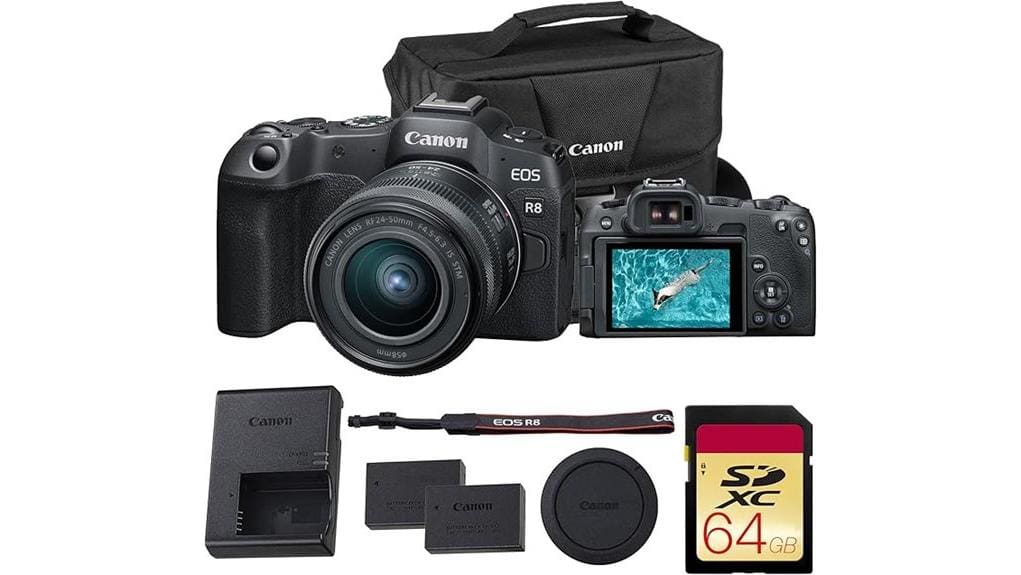

You get a compact full‑frame 24.2MP body with an RF 24–50mm stabilized zoom, LP‑E17 battery, charger, 64GB UHS‑II card, strap, covers and a shoulder bag, ready to shoot. Image quality delivers pleasing color, wide dynamic range and clean detail, while oversampled 4K60 from a 6K readout yields natural motion. Dual Pixel AF and combined stabilization make handheld capture reliable. Battery life and tele reach are modest, and more specifics follow below.
Some Key Takeaways
- Compact full-frame 24.2MP mirrorless kit with RF 24–50mm f/4.5–6.3 lens aimed at beginners and vloggers.
- Oversampled 4K60 from a 6K readout delivers clean, detailed video with natural motion; external monitor recommended for critical focus.
- Dual Pixel CMOS AF II provides fast, reliable subject and face/animal tracking, including in low light with minimal hunting.
- Balanced handling and in-body plus lens stabilization give steady handheld footage, though battery life (LP‑E17) is modest.
- Best value for hybrid shooters prioritizing video and autofocus; drawbacks include limited tele reach, non-weathersealed body, and modest stamina.
What the Canon EOS R8 Kit Includes and Who It’s For
While the Canon EOS R8 kit gives you a compact full-frame system ready for both stills and video, it’s also tailored to photographers and hybrid shooters who want capable performance without bulky gear. You get the R8 body, RF 24–50mm f/4.5–6.3 IS STM zoom, LP‑E17 battery and charger, 64GB UHS‑II SDXC card, strap, covers, lens caps and a shoulder bag—everything to start shooting. That bundle suits beginner photographers and travel vloggers who need lightweight versatility, stabilized optics, reliable autofocus, and immediate workflow support without buying extras before your first outing. The kit is especially convenient for enthusiasts who prefer mirrorless camera systems and want a compact, ready-to-go setup.
Image Quality and Video Performance: 24.2MP Stills and Oversampled 4K60 Tested
Now that you know what’s in the kit and who it’s aimed at, let’s look at how the R8 actually performs for stills and video. You’ll get 24.2MP stills with pleasing color depth and accurate skin tones straight from RAW or JPEG. Dynamic range is strong for a compact full-frame sensor, retaining highlight and shadow detail across typical exposures. Noise handling up to mid-high ISOs is controlled, preserving fine detail without aggressive smoothing. Oversampled 4K60 from a 6K readout yields clean, detailed footage with natural motion rendering and limited artifacts, provided you use good glass and proper exposure. Using an external monitor can help ensure critical focus and accurate exposure when recording oversampled 4K.
Autofocus, Stabilization, and Lens Performance in Real Shooting Scenarios
Because the R8 pairs Canon’s Dual Pixel CMOS AF II with lens-based stabilization, you’ll get fast, confident subject acquisition and steady handheld footage in most real-world scenarios. You’ll notice dual pixel responsiveness in stills and 4K60 video: subject tracking locks quickly on faces and animals and maintains composure during panning. The RF 24–50mm’s lens stabilization complements in-body algorithms to reduce shake across focal lengths. In low light the AF stays decisive with minimal focus hunting, though slow-moving, low-contrast targets can still prompt brief corrections. For run-and-gun work, this combo delivers reliable, repeatable results without constant manual intervention. Many photographers also use bi-color LED lighting to shape and balance light when shooting subjects handheld, improving color consistency and flexibility with bi-color video lights.
Handling, Battery Life, Connectivity, and Everyday Usability
Although compact, the R8 feels balanced in hand and lets you work comfortably for extended shoots thanks to its light mirrorless chassis and thoughtfully placed controls. You’ll notice an efficient button layout that reduces menu dives; custom buttons are reachable without changing your hold. Grip comfort is good for its size, though larger hands may prefer an added grip. Battery stamina with the LP-E17 is modest — plan spare cells for full-day sessions. Connectivity covers USB and HDMI Type A, and hotshoe connectivity supports flashes and accessories. Overall, everyday usability favors portability with sensible control ergonomics. For longer studio or tethered sessions consider using an AC adapter to provide continuous power with a camera AC adapter.
Value Judgment: Pros, Cons, and Which Shooter Should Buy the R8 Kit
When you weigh the R8 kit’s strengths against its compromises, it stands out as a compact, capable full-frame option that suits hybrid shooters who prioritize 4K60 video, fast Dual Pixel AF, and portability over ruggedness and long battery life. You’ll get excellent autofocus, oversampled 4K from a 6K readout, and a handy RF 24–50mm for everyday shooting. Pros: strong video, lightweight body, reliable subject/eye tracking. Cons: modest battery life, non-weathersealed build, limited tele reach and aperture. Buy it if you’re a hybrid creator, portrait enthusiasts wanting great AF, or budget shooters seeking full-frame value. For shooters who also work with continuous lighting, consider pairing the R8 with video light panels to maximize image quality in controlled environments.
Some Questions Answered
Does the Kit Include a Spare Battery or Vertical Grip?
No — the kit doesn’t include a spare battery or a vertical grip. You get one LP-E17 battery and charger in the package, so plan for additional battery accessories if you’ll shoot long sessions. For grip compatibility, the R8 accepts third-party and Canon vertical grips designed for its body, but you’ll buy those separately; check compatibility for LP-E17 connections and button layout before purchasing to guarantee full functionality.
Can the RF 24–50mm Be Used With Teleconverters?
No — you can’t reliably use teleconverters with the RF24–50 compatibility because Canon doesn’t list teleconverter support for that lens. Teleconverter limitations stem from the lens’s short zoom range, slower maximum apertures (f/4.5–6.3) and optical design, which reduce autofocus performance and image quality when coupled. If you need reach, you should choose an RF lens designed for teleconverter use or a longer focal length native zoom for consistent results.
Is In-Body Image Stabilization (IBIS) Available?
No, it doesn’t have IBIS; stabilization relies on the lens. You’ll need to account for IBIS limitations when shooting low‑light or handheld video, since the RF 24–50mm provides optical IS only. For a stabilization comparison, lens-based IS handles moderate shake well but won’t match body-plus-lens combos for aggressive movement or slower shutter speeds. Plan to use faster shutter speeds, a tripod, or gimbals for the best results.
What Warranty Length and Service Options Are Included?
You get a one-year warranty duration from Canon USA covering defects in materials and workmanship; you’ll want to register the camera to confirm coverage. You can buy extended service plans and protection options through Canon or authorized retailers for additional years, accidental-damage coverage, expedited repairs, and loaner cameras. Check plan terms for deductibles, repair turnaround, and international support. Keep receipts and serial numbers to streamline any service claims.
Can the Camera Shoot RAW Burst Over Long Sequences?
Yes — you can shoot RAW bursts, but you’ll hit limits. You’ll exhaust buffer depth sooner than with JPEGs, so long sequences will slow as the buffer clears. Heat management matters during extended 4K or high-frame captures and can throttle shooting. Card throughput (use fast UHS-II/V60) speeds buffer clearing. Expect notable battery drain during continuous RAW shooting; carry spares and prioritize short bursts for reliable, sustained performance.