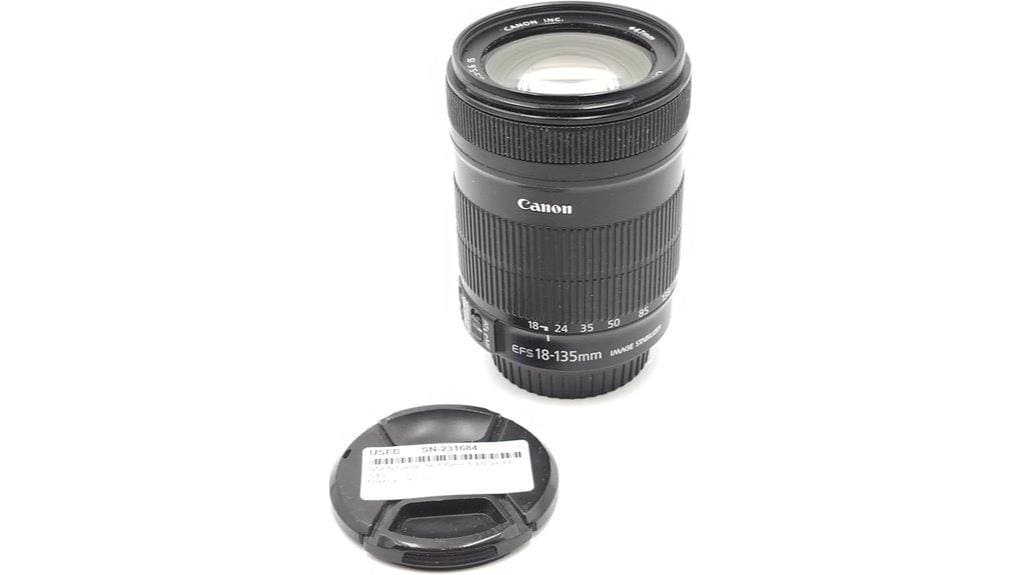

You’ll find the Canon EF‑S 18‑135mm f/3.5‑5.6 a compact, versatile walkaround zoom that suits most APS‑C shooters. It gives a useful 29–216mm equivalent range, a collapsible travel‑friendly design, built‑in stabilization, and a common 67mm filter thread. Center sharpness is solid in the midrange, corners fall off at wide and long ends, and AF is generally quick with occasional hunting. It’s a convenient, cost‑effective choice for travel and everyday use — keep going to see detailed strengths and tradeoffs.
Some Key Takeaways
- Versatile 18–135mm (29–216mm equiv.) zoom covers travel, portraits, and everyday scenes in a single compact lens.
- Variable f/3.5–5.6 aperture keeps size and cost down but limits low-light and shallow-depth performance.
- Good center sharpness overall with a sweet spot around 35–70mm; corners soften at wide and telephoto ends.
- Built-in image stabilization enables slower handheld shutter speeds for casual shooting and video.
- EF‑S mount fits Canon APS‑C bodies only; consider primes or third‑party alternatives for higher edge detail.
Why the Canon EF-S 18-135mm Fits Most APS‑C Shooters
Because it covers a wide focal range on APS-C bodies, the Canon EF-S 18-135mm f/3.5–5.6 works as an all-purpose walkaround lens for most shooters. You’ll appreciate its compact versatility: it collapses into a manageable package yet spans from short wide to medium telephoto, replacing multiple primes for everyday needs. You get travel convenience without hauling extra glass, and built-in stabilization helps keep shots steady in varied conditions. Designed for Canon APS‑C cameras and accepting 67mm filters, it suits photographers wanting one reliable, flexible optic. You’ll trade extreme speed for practicality, gaining adaptability and reduced kit weight. It’s a great choice for mirrorless camera enthusiasts looking for essential gear that balances versatility and portability.
Key Specs and What They Mean for Everyday Use
Now let’s look at the specs that shape real-world performance. You get a wide 18–135mm range (29–216mm equiv.) that delivers clear zoom versatility for travel, portraits and everyday scenes, so you’ll switch focal lengths instead of lenses. The variable f/3.5–5.6 max aperture balances size and cost, but expect aperture tradeoffs in low light and for shallow depth of field at longer focal lengths. Built with 16 elements in 12 groups and built-in stabilization, it’s optimized for handheld shooting on Canon APS‑C bodies. Compatibility with 67mm filters keeps accessories simple. It’s practical, compact, and economical for general use. This lens is a good fit for photographers who prioritize prime lens fundamentals when building a streamlined kit.
Real-World Performance: Sharpness, Autofocus, and Stabilization
When you shoot with the EF-S 18-135mm you’ll find center sharpness is solid across the zoom range, with the sweet spot around 35–70mm; corners soften noticeably at wide and tele ends, especially when stopped down only a little. You’ll see respectable edge contrast in the mid-range but reduced microdetail toward edges at extremes. Autofocus is generally reliable and quick on-body — occasional focus hunting appears in low light or low-contrast scenes, but locks recover promptly. The built-in stabilization shows confident VR behavior, allowing slower shutter speeds handheld with minimal drift. For casual work it balances performance and convenience well. For those assembling their kit, consider adding a sturdy tripod to improve long-exposure and low-light results with the lens, especially when prioritizing stability for photography.
Practical Handling: Size, Mounts, Filters (67mm), and Lens Compatibility
Alongside its optical and autofocus behavior, the EF-S 18-135mm’s physical traits shape how you’ll use it day to day. You’ll find it compact for an 18–135mm zoom on APS-C bodies, balanced on typical Canon DSLRs and easy to handhold. The EF-S mount limits use to Canon crop cameras, so check compatibility before buying; using it on full-frame bodies isn’t supported. A 67mm filter thread accepts common filters without stepping rings. Image stabilization reduces shake but can’t fix extreme light falloff at long focal lengths. Regular mounting and unmounting deserves care to minimize mount wear over time. Many enthusiasts pair lenses like this with essential lens gear to enhance versatility and protection.
Should You Buy It? Price, Use Cases, and Alternatives
If you’re weighing whether to buy the Canon EF-S 18-135mm f/3.5-5.6, focus on what you shoot and what you’ll pay for it: the lens covers a versatile 29–216mm equivalent range with usable stabilization and compact handling for APS-C bodies, making it a solid all-in-one for travel, everyday shooting, and casual video work. If you want convenience over peak sharpness, it’s cost-effective; note budget considerations against primes or pro zooms. Consider third party alternatives for lower cost or different optics, and use rental options to test handling and image quality before committing. Perfect Travel Tripods for travel photography can help stabilize shots and complement this lens on the go.
Some Questions Answered
Is This Lens Weather-Sealed for Shooting in Rain?
No — it isn’t weather-sealed, so you shouldn’t rely on it in heavy rain. You’ll want to add weather protection like a rain cover or protective sleeve to preserve seal quality at the mount and moving parts. With careful handling and external protection you can shoot in light drizzle, but don’t expect factory-grade weather resistance. Treat the lens as unsealed and avoid prolonged exposure to moisture to prevent damage and corrosion.
Does It Support Full-Time Manual Focus Override?
No — it doesn’t support full time manual override. You’ll need to use the camera’s AF/MF switch to change focusing modes because the focus lock isn’t designed for instant manual takeover. The mechanism details: this EF-S 18–135mm uses a motor-driven AF system without a clutch for seamless manual override, so you’ll feel resistance if you try to turn the focus ring during AF. For manual focus, switch to MF first.
Can It Be Used With Canon Mirrorless Bodies via Adapter?
Yes — you can use it on Canon mirrorless bodies via a lens adapter. You’ll need an EF-S/EF-to-RF or EF-to-EF-M mount adapter depending on your mirrorless mount; check mount compatibility before buying. Autofocus and image stabilization generally work through official adapters, though AF speed and coverage can vary on adapted APS-C lenses. You’ll retain focal length characteristics, but expect crop-sensor behavior and potential limitations with newer mirrorless features.
What Is the Minimum Focusing Distance for Close-Up Shots?
The minimum distance for close-up shots is 0.39 meters (39 cm) at the wide end, giving modest close up magnification that increases slightly when you zoom in. You’ll get roughly 0.28x maximum magnification at 135mm, so subjects won’t fill the frame like a macro lens would. You can get closer visually by cropping or using extension tubes or close-up filters to improve close up magnification for small subjects.
Does the Lens Exhibit Noticeable Focus Breathing During Video?
You’re unlikely to notice strong focus breathing with this lens; it shows mild focal shift when racking focus, but nothing dramatic for most run-and-gun video. You’ll want to avoid large zooms while refocusing, since variable aperture and aperture ramping can subtly alter exposure and perceived depth during pulls. Use careful pulls, lock exposure when possible, and consider autofocus shifts to minimize visible breathing and aperture-related shifts.