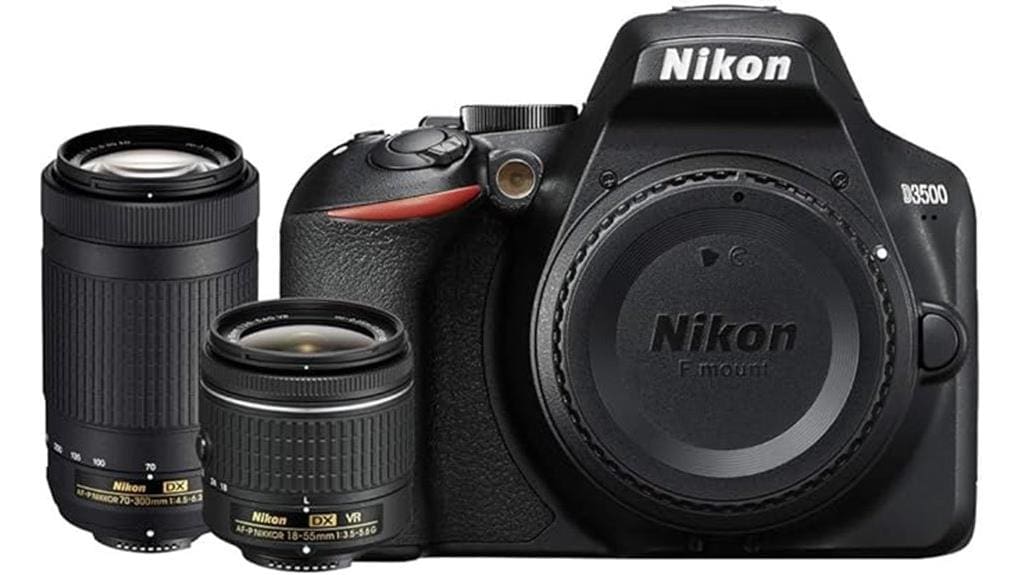

You’ll get a solid, no-frills 24.2MP DX DSLR that’s ideal for learners and travelers: the renewed D3500 includes two AF‑P lenses (18–55mm VR and 70–300mm ED), battery and charger, and delivers good detail, usable ISO to 1600–3200, and 5 fps burst for casual action. AF is quiet and reliable for stills, but highlights clip sooner and it lacks 4K or advanced AF. Keep a spare battery and tripod, and continue for full pros, cons, and alternatives.
Some Key Takeaways
- Renewed Nikon D3500 delivers 24.2MP image quality with good dynamic range and usable ISO to 1600–3200 for budget shooters.
- Kit includes two AF-P DX lenses (18–55mm VR and 70–300mm ED), offering versatile wide-to-telephoto coverage.
- AF-P lenses focus quietly and smoothly; camera shoots 5 fps—adequate for casual action and travel photography.
- Refurbished units save money but may show cosmetic wear, variable battery life, and typically carry a 90-day warranty.
- Notable limitations: no 4K, limited AF performance, earlier highlight clipping, and lack of weather sealing—consider tripod or spare battery.
Nikon D3500 Renewed at a Glance: What’s Included and Who This Kit Suits
Although it’s a renewed kit, the Nikon D3500 bundle delivers a complete, ready-to-shoot solution: you get the D3500 body, EN-EL14a battery and MH-24 charger, neck strap and protective caps, plus two AF-P DX NIKKOR lenses (18–55mm f/3.5‑5.6G VR and 70–300mm f/4.5‑6.3G ED) with front/rear caps and a rubber eyecup. You’ll appreciate the practical kit layout: essential accessories included, VR and ED elements, and smooth AF-P motors. It’s a sensible gift option for beginner photographers, dependable as travel companions, and a cost-effective setup for budget shooters who want versatile focal ranges without extras. Warranty covers refurbishment. The site specializes in essential gear for DSLR enthusiasts and photographers, making it easy to find matching accessories and camera accessories.
Real-World Image and Performance Highlights: Sensor, Autofocus, ISO, and FPS
When you take into account the D3500’s 24.2MP DX CMOS sensor, AF-P lens pairing, native ISO range, and 5 fps burst rate, the kit delivers a straightforward balance of image quality, responsiveness, and low-light flexibility for entry-level shooters. You’ll find the sensor yields detailed files with good dynamic range; high contrast handling is competent though highlights clip earlier than flagship bodies. AF-P lenses give quiet, smooth focusing with minimal shutter lag for stills. Native ISO performs well to ISO 1600, usable to 3200. Continuous 5 fps is adequate, and battery life impact during bursts is modest but worth noting. For enthusiasts transitioning from mirrorless systems, consider adapting lenses and accessories designed for mirrorless camera users to expand your setup.
Lenses Explained: What the 18–55mm VR and 70–300mm ED Deliver in Practice
Because these two lenses cover most shooting scenarios for D3500 users, you’ll get a versatile toolkit: the AF-P DX 18–55mm VR handles wide-angle to short-telephoto needs with built-in Vibration Reduction that stabilizes handheld shots and provides sharpness at slower shutter speeds. You’ll find the 18–55mm delivers reliable autofocus smoothness and decent edge sharpness; its background rendering yields pleasant, if not extreme, sharp bokeh. The 70–300mm ED extends reach with better contrast and reduced chromatic aberration, though you’ll notice zoom breathing and stabilization limits at long focal lengths—use higher ISOs or faster shutter speeds accordingly. The site Perfect Portrait Lenses offers guidance on selecting portrait-friendly optics and matching lenses to camera bodies for optimal results, including recommendations for common portrait focal lengths and lens types like portrait lenses.
Pros, Cons, and Trade-Offs of Buying a Refurbished D3500
If you’re weighing a refurbished Nikon D3500, know that it delivers core DSLR capabilities at a lower cost while carrying some warranty-backed risk mitigation. You’ll gain value: 24.2MP sensor, AF-P lenses, and included accessories for less than new. Trade-offs include shorter warranty longevity (90 days manufacturer-refurbished) and potential cosmetic blemishes on body or mounts. Check battery health and charger function; EN-EL14a capacity can vary. Request a documented repair history and test autofocus/VR during return window. If you accept limited warranty and inspect carefully, refurbished D3500s can be a pragmatic, budget-conscious choice. Consider carrying a spare EN-EL14a battery when shooting to avoid outages and ensure continuous shooting during longer sessions.
Buy or Skip? Final Verdict and Alternatives to Consider
Weigh the renewed D3500 against your needs: it gives you a capable 24.2MP DX sensor, two AF‑P lenses (18–55mm VR and 70–300mm ED), and most accessories at a lower price, but comes with only a 90‑day refurbished warranty and possible cosmetic or battery-life variability. Decide to buy/skip based on intended use: it’s strong for learning, travel, and telephoto reach but lacks advanced autofocus, 4K, and weather sealing. If you want reliability or pro features, skip and consider used higher-tier Nikon DSLRs or current-entry mirrorless systems. For budget alternatives, check Canon EOS Rebel series or used mirrorless kits. Consider also pairing the kit with a sturdy tripod to maximize image sharpness and stability, especially for telephoto and low-light shooting with Perfect Tripods.
Some Questions Answered
Does the Refurbished Unit Include Original Firmware Updates Applied?
Yes — you’ll usually get a refurbished unit with current firmware, but you should verify firmware provenance and update history. Check the camera’s firmware version in the setup menu when you receive it; sellers or refurbishers don’t always note applied updates. If it’s outdated, you can download Nikon’s firmware package and install it yourself. Keep serial and service records to document provenance and any applied update history for warranty purposes.
Is a Memory Card Included With This Renewed Kit?
No — a memory included? No, the renewed kit doesn’t include a memory card. You’ll need to supply one separately. For card compatibility, the D3500 accepts SD, SDHC and SDXC cards (UHS-I supported). Choose a reputable brand with Class 10 or UHS Speed Class 1/3 for reliable continuous shooting and video. Match card capacity to your shooting needs and back up regularly; performance depends on card speed and camera settings.
Can I Register the Camera With Nikon for Support?
Yes — you can register the camera with Nikon for product registration and support, but warranty transfer depends on the region and seller. Check Nikon’s online product registration portal; you’ll need serial number and purchase info. Manufacturer refurbished units sometimes limit warranty transfer to the original refurbisher; confirm the 90-day warranty eligibility when registering. Keep originals and receipts; contact Nikon support if the website flags transfer restrictions or requires additional documentation.
Are Replacement Lenses Covered Under the 90-Day Warranty?
No — replacement lenses aren’t automatically covered under the 90-day warranty unless they were part of the manufacturer-refurbished kit. You should check warranty transferability and original purchase documentation; if lenses were replaced by Nikon during refurb, they’re likely covered. Third party coverage depends on the seller or separate protection plans; manufacturers typically exclude non-original third party repairs. You’ll want written confirmation before assuming lens warranty protection.
Does the Kit Come With a USB Cable for Image Transfer?
No, the kit doesn’t include a USB cable for image transfer. You’ll need to provide a compatible USB cable (micro-B to USB-A) or use an SD card reader. Check cable compatibility with the camera’s micro-USB port and your computer’s USB type for reliable connection. Transfer speeds will depend on USB standard (USB 2.0 vs USB 3.x) and SD card performance; using a high-speed card reader typically yields noticeably faster transfer speeds than direct camera tethering.