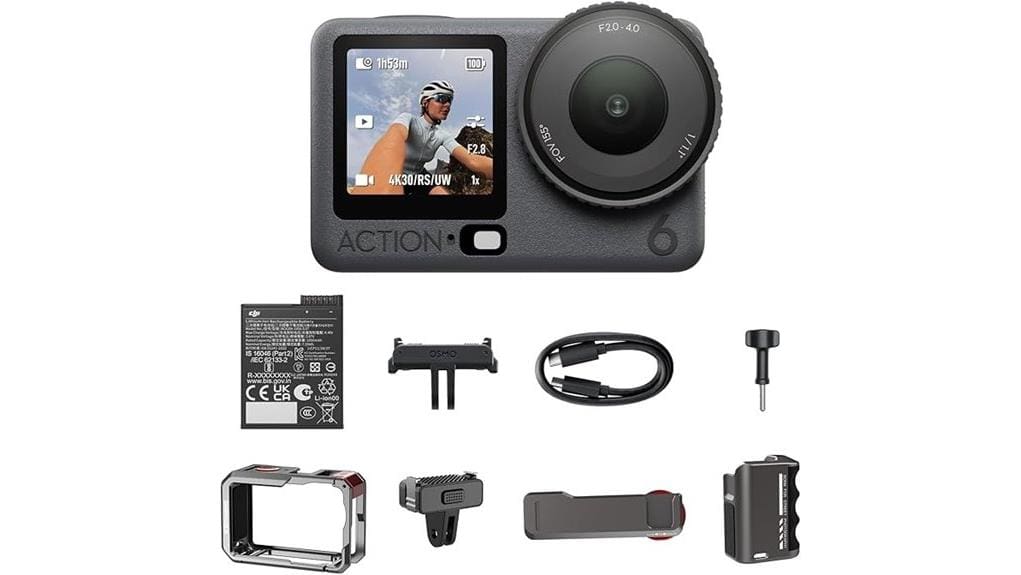

You’ll get sensational 8K footage and crisp 38MP stills from a 1/1.1″ CMOS sensor, with RockSteady 3.0 and HorizonSteady delivering locked, low‑artifact stabilization for action shots. SuperNight helps in low light but daylight yields better dynamic range and detail. The rugged, waterproof body, dual displays, 50GB internal storage and dual mic support make it travel‑ready; battery life is modest so pack spares. Keep going to see detailed test results and practical comparisons.
Some Key Takeaways
- 8K-capable 1/1.1″ CMOS sensor delivers 38MP stills and retains fine detail for aggressive crops.
- RockSteady 3.0 and HorizonSteady provide strong stabilization with minimal crop up to 4K/60.
- SuperNight boosts low-light exposure and reduces noise but lags daylight in dynamic range.
- Rugged waterproof build to 20 m, dual displays, and balanced controls suit travel and adventure use.
- Dual DJI mic support, 50 GB internal plus microSD, and USB-C PD enable flexible audio, storage, and charging.
Real-World 8K and Photo Performance: How the Osmo Action 6 Handles Video and 38MP Stills
Put the Osmo Action 6 in your hands and its 1/1.1″ square CMOS sensor immediately shows ambition: 8K capture (7,680-pixel) video and 38MP stills give you lots of resolution to work with, and the wide 8–20mm lens (variable f/2.0–f/4.0) delivers a broad field of view with a modest 2x optical and 2x digital zoom. You’ll evaluate sharpness, noise, and color rendition across ISO range; 8K retains fine detail for heavy reframing while 38MP stills resolve texture. Dynamic framing benefits from high resolution, letting you crop aggressively without obvious degradation. Consider pairing the Osmo Action 6 with an external monitor for improved framing and exposure control, especially when shooting high-resolution video.
Stabilization, HorizonSteady, and Low-Light Modes: Testing RockSteady 3.0 and SuperNight
Detail and resolution are only useful if your footage stays steady and readable in low light, so next you’ll judge how RockSteady 3.0 and HorizonSteady handle real-world motion and night scenes. You’ll find RockSteady 3.0 delivers firm rolling stabilization with minimal crop at 4K/60; motion artifacts are suppressed and micro‑vibrations are neutralized. HorizonSteady keeps the roll axis locked through abrupt pans, though it’s limited above 4K/60. SuperNight’s Low light processing boosts exposure and reduces noise while preserving edges, but dynamic range and fine detail lag behind daylight captures. Overall, stabilization is class‑leading; night mode is competent, not miraculous. This camera also pairs well with underwater camera accessories and housings for diving and snorkeling use.
Build, Waterproofing, Battery Life, and Durability: Practical Reliability for Travel and Adventure
Ruggedized and compact, the Osmo Action 6 feels purpose-built for travel and adventure: its polycarbonate-and-metal chassis gives a solid, reassuring snap at every mount point, and the dual 2.5‑inch displays sit flush with minimal protrusion so it won’t snag in a pocket or on gear. You’ll appreciate targeted weather sealing—rated waterproof to 20 m and cold-resistant—for real-world reliability. Battery life reaches up to four hours in normal conditions; the single 1,950 mAh pack is replaceable but you’ll want a spare for extended trips. Travel ergonomics are thoughtful: balanced weight, intuitive controls, and secure mounts reduce handling fatigue. For those shooting in wet environments, consider investing in a dedicated waterproof housing to protect your gear and expand underwater capability.
Connectivity, Audio, and Accessories: Dual-Audio, Built-In 50 GB, Street Photography Handle Kit, and Mic Support
Several connectivity options and accessory integrations make the Osmo Action 6 a flexible capture hub: it pairs via Bluetooth, supports wireless cloud upload, and includes built-in 50 GB for on-the-go storage while accepting high-speed microSD cards (V60/U3/V60) for heavier 8K workflows. You’ll appreciate reliable dual audio capability: the camera directly supports two DJI mic transmitters for independent channels, simplifying two-person capture without external mixers. The included Street Photography Handle Kit adds ergonomic control and cold-shoe mounting for accessories. USB-C PD speeds transfers and charges the 1,950 mAh battery. Overall, connectivity and accessories are practical, well-integrated, and production-ready. Helmet camera mounts are a popular accessory for adventure photographers, offering stable POV shots for action-packed shoots and easy integration with compact units like the Osmo Action 6 helmet camera mounts.
Who Should Buy the Osmo Action 6 and When to Choose Alternatives (Value Vs Competitors)
If you need an action camera that prioritizes image quality, robust stabilization, and flexible audio for two-person shoots, the Osmo Action 6 is a strong choice—its 1/1.1″ sensor, 8K capture, RockSteady 3.0 plus HorizonSteady, and dual-direct mic support make it especially valuable for prosumers, travel vloggers, and content creators who want near-professional footage without bulky rigs. You should buy it when you value high-resolution capture, waterproof durability, and simplified dual-audio capture that streamlines your editing workflow. Choose affordable alternatives if you need lower cost, smaller files, longer battery redundancy, or raw budget models from rivals. For accessory needs like mounts and stabilization, consider compatible tripod options to get the most from your setup.
Some Questions Answered
Can the Osmo Action 6 Live-Stream Directly to Social Platforms?
Yes — you can live-stream from the Osmo Action 6, but expect Live streaming limitations and Platform authentication challenges. You’ll stream via the DJI app using Wi‑Fi/Bluetooth; built‑in 50 GB and strong battery help, yet some platforms require manual RTMP setup or OAuth in the app, which can be finicky. You’ll want a stable connection, correct RTMP credentials, and to confirm app support for your target platform before relying on live broadcasts.
Is External RAW Video Recording Supported or Only Jpeg/Mp4?
No — the camera only records JPEG stills and MP4 video internally; it doesn’t provide RAW output for video. You can capture high-bitrate 8K MP4 and use an External recorder only if you route via supported outputs, but native RAW video capture isn’t available. For stills, RAW photo support isn’t listed either, so expect JPEG. If you need camera-origin RAW video, you’ll have to use a different camera with dedicated RAW/ProRes output.
How Well Does the Touchscreen Work Underwater With Gloves?
You won’t get full glove usability—touchscreen responsiveness drops noticeably with gloves underwater. The capacitive panel still reacts to large, deliberate presses and some glove materials, so waterproof responsiveness is usable for basic framing and start/stop, but fine adjustments are unreliable. For precise control you’ll want tactile buttons, a compatible handle kit, or voice/gesture commands. Test your glove type beforehand; thicker or insulated gloves usually fail more often.
Are Firmware Updates Delivered Over-The-Air via Wi‑Fi?
Yes — you’ll get OTA updates via Wi‑Fi. The camera supports OTA updates delivered over-the-air; you connect to Wi‑Fi and the firmware downloads and installs. That process is straightforward, shows progress, and preserves settings. It’s technical and reliable, though you should guarantee battery >50% and stable Wi‑Fi. For large firmware files use a fast connection or update via DJI software on a computer as an alternative.
Can It Charge and Record Simultaneously From Usb‑C PD?
Yes — you can record while charging via USB‑C PD. You’ll need USB‑PD compatibility for reliable power delivery; the camera accepts PD charging and supports battery passthrough so recording won’t stop when external power’s connected. Expect heat and reduced thermal limits during high‑res recording (8K), which may trigger time or thermal cutouts. Use a V60/UHS‑rated power source and keep ventilation in mind for sustained sessions.