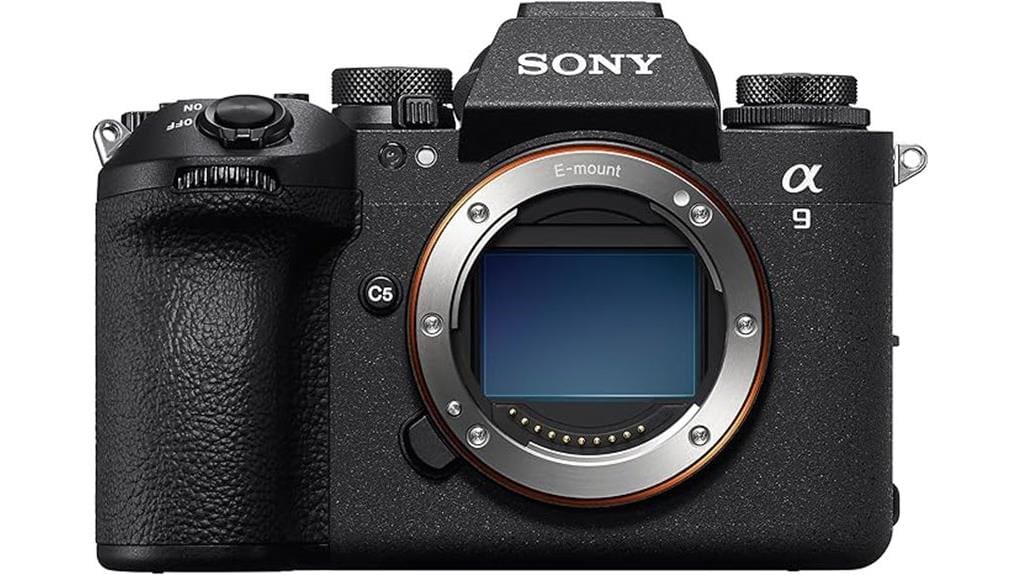

You’ll get a pro-grade, blackout-free action tool with a 24.6MP stacked Exmor RS global‑shutter sensor that delivers distortion‑free frames and 120 fps full AF/AE for decisive moments. The 14‑bit output and CFexpress support preserve tonal fidelity and sustain long bursts, while 759‑point AF and AI subject recognition keep focus on erratic subjects. IBIS up to 8 stops and uncropped 4K120 expand creative control, with battery, heat and card choices shaping real-world workflows—more specifics follow.
Some Key Takeaways
- Exceptionally fast 24.6MP stacked full-frame sensor with global-shutter readout delivers distortion-free, high-fidelity 120 fps blackout-free shooting.
- Advanced 759-point AF and AI subject recognition provide reliable eye/subject tracking for humans, animals, birds, insects, and vehicles.
- Up to 8 stops IBIS plus coordinated lens stabilization improves handheld sharpness for sports, wildlife, and low-light work.
- Uncropped 4K/120p 10-bit output and clean HDMI support enable professional slow-motion video and external recording workflows.
- Requires CFexpress Type A/V60 UHS cards, heat management, and ample storage; battery and ergonomics suit extended pro use.
Sony Alpha 9 III at a Glance : Headline Specs and Who It’s For
Think-performance packed, the Sony Alpha 9 III gives you a pro-level toolset: a 24.6MP full-frame stacked Exmor RS sensor with global-shutter full-pixel readout, blackout-free shooting to 120 fps with full AF/AE, and AI-driven subject recognition across humans, animals, birds, insects and vehicles. You’ll get pro grip ergonomics, robust weather sealing, and streamlined menu ergonomics that speed setup. In-body stabilization, dual CFexpress/UHS slots and high-rate connectivity suit sports and wildlife pros. Battery life supports long shifts with spare cells. Expect premium price positioning reflecting rare capability and workflow efficiency; it’s aimed squarely at professionals needing relentless, reliable speed. Essential gear for mirrorless camera enthusiasts includes accessories like grips, cases, and lenses to maximize the camera’s potential and workflow efficiency, as sold on our site mirrorless accessories.
Why the Stacked 24.6MP Sensor and Global Shutter Matter for Action
Put the stacked 24.6MP Exmor RS sensor and its global-shutter full-pixel readout to work and you get distortion-free, high-resolution captures of the fastest action. You’ll benefit from full-frame 24.6MP detail with a stacked design that embeds memory and speeds A/D throughput, reducing rolling artifacts and readout lag. Global-shutter full-pixel readout delivers true motion immunity across the frame, so fast panning or subject sprinting won’t skew geometry. This shutter innovation pairs with 14-bit output and robust file formats to preserve tonal fidelity. In practice, you get precise frames for tracking, analysis, and critical sports or wildlife shoots. Proper color calibration with a calibration device ensures those high-resolution, motion-free images reproduce accurate hues and tones.
Speed and Burst Workflows : 120 FPS, Pre‑Capture and Storage Needs
When you exploit the α9 III’s 120 fps blackout‑free burst and Pre‑Capture together, you can reliably nail decisive moments—but only if your workflow and cards keep pace. You’ll design workflows to minimize workflow bottlenecks: preformat sessions, prioritize CFexpress Type A or V60/U3 UHS cards, and route files to fast editors. Manage buffer management by selecting appropriate file formats and burst windows; shorter Pre‑Capture reduces throughput. Monitor card throughput and swap before saturation. Implement heat mitigation—limit continuous bursts, use Cooling breaks or external fans, and enable Speed Boost sparingly—to maintain sustained performance and avoid dropped frames. For photographers shooting high-volume sessions, choosing the best memory cards for large capacity and sustained write speeds is essential, so invest in large capacity memory cards that match your shooting demands.
Autofocus and AI Recognition in Real Shooting Scenarios
Having your cards and buffer sorted for 120 fps bursts pays off only if the AF system can consistently lock and follow subjects at those frame rates, so here we assess how the α9 III’s AI-assisted autofocus performs in real shooting conditions. You’ll notice rapid, reliable acquisition across 759 points; real-time AF keeps pace with high-speed sequences. AI classification improves subject prioritization between human, animal and vehicle profiles, and refined eye tracking holds focus on eyes during erratic motion. Edge cases—small insects or densely packed birds—still challenge the system, but overall tracking is class-leading and predictably durable. For those calibrating their setups, using dedicated lens calibration tools can help ensure peak AF accuracy across lenses.
Stabilization, Lenses and Low‑Light Stills Performance
Because the α9 III pairs up to 8.0 stops of in-body stabilization with improved lens-camera communication, you’ll get markedly sharper handheld stills in low light and at long focal lengths. You can rely on coordinated lens stabilization and IBIS to suppress motion blur when shooting slower shutter speeds or using longer primes. That tighter coupling reduces reliance on faster shutter speeds, letting you exploit the 24.6MP stacked sensor for cleaner detail. High ISO performance remains excellent thanks to BSI design and processing, yielding usable files with restrained noise. Paired fast lenses capitalize on AF accuracy, maximizing keep rates in challenging light. For photographers who shoot high-frame-action or need fast write speeds, consider using CFexpress cards to keep up with sustained burst capture and rapid buffer clearing.
Video Capabilities : Uncropped 4K120, Monitoring and Outputs
Although the α9 III targets stills pros, its uncropped 4K/120p capability makes it a serious video tool, letting you capture high-frame-rate slow motion without changing focal length or field of view. You’ll get full-frame 4K 120p with consistent angle of view versus 24p, enabling clean slow-motion workflows and uncropped playback to preserve composition. The camera outputs clean 10‑bit via HDMI and supports external recorders; HDMI monitoring gives you real-time, latency‑minimized monitoring and waveform/false‑color via compatible monitors. Network and USB/ethernet options aid tethered capture. Overall, it’s a compact, pro‑grade video platform with precise monitoring and output. For shooters wanting even more control and confidence over exposure and focus, consider pairing the camera with an external monitor for enhanced real-time monitoring and color tools.
Real‑World Tradeoffs: Battery, Ergonomics, Compatibility, and Value
Dig in and you’ll find the α9 III delivers pro-level speed and ergonomics, but not without practical compromises you should weigh. You’ll get blackout-free 120 fps, robust IBIS and refined controls, yet battery longevity varies with burst use and 4K120 recording — plan spares or external power. Grip comfort is excellent for extended handheld work, but the ~1.6 lb body plus pro lenses adds fatigue. Dual CFexpress/UHS slots and E-mount compatibility suit pros, though ecosystem costs mount. Overall value depends on workflow: if speed and AF trump budget, it’s justified; otherwise assess ongoing media and lens investment. If you rely on long shoots, consider buying spare camera batteries to avoid interruptions.
Some Questions Answered
How Long Does the Battery Actually Last Shooting 120 Fps Bursts?
You’ll get roughly 30–45 minutes of continuous shooting at 120 fps before battery exhaustion, though real-world battery endurance depends on temperature, EVF usage, stabilization, and card write speed. Burst longevity per charge translates to several thousand frames — often 1000–2000+ frames in high-efficiency modes. Keep CFexpress Type A and power-saving settings to maximize sessions; turning off IBIS or EVF and using external power will extend battery endurance markedly.
Can I Use Older A-Mount Lenses With an Adapter and Retain AF?
Yes — you can use A mount adapters and retain AF compatibility in most cases. You’ll need a compatible Sony LA-EA or third-party adapter that supports electronic lens communication; AF performance varies by adapter, lens model and shooting mode. Expect slower or less reliable AF-C tracking versus native E-mount lenses, especially for fast action or eye/animal recognition. Test your specific lens+adapter combo before critical shoots to verify performance.
Is the Global Shutter Completely Silent in Mechanical Terms?
No — the global shutter removes rolling-read distortion but doesn’t make the camera mechanically silent. You’ll still hear mechanical noise from mirrorless actuators, aperture blades and accessory mechanisms, though the sensor readout itself is free of mechanical shutter travel. That said, using a global shutter reduces mechanical wear on a traditional shutter curtain, which can improve shutter longevity versus frequent mechanical actuation in burst-heavy shooting.
What Heat Management Exists for Extended 4K120 Recording?
You’ll get active thermal management to minimize thermal throttling during extended 4K120 recording: the body uses heat-dissipating construction plus dedicated airflow vents and internal heat paths to move heat away from sensor and processor. Firmware manages processing load and frame rates to avoid overheating, and the camera will throttle encoding if temperatures rise. Use CFexpress Type A media and external HDMI output options to reduce internal strain during long high‑bitrate shoots.
Does the Camera Support In-Camera Focus Stacking or Pixel Shift?
No — it doesn’t offer in-camera focus stacking or pixel shift. You’ll need to capture focus-bracketed or multi-frame pixel-shift sequences manually and combine them in post using software. Use the stacked sensor’s blackout-free burst and precise IBIS/lens communication to minimize motion between frames; shoot on a stable platform and use CFexpress Type A or fast UHS cards for reliable write speeds when capturing high-frame, multi-image sequences for stacking or shifting.