
You’ll get a versatile 33MP full‑frame hybrid that pairs Sony’s fast BIONZ XR processor and Real‑Time Eye AF with 5‑axis IBIS for stabilized stills and steady video. The kit bundles useful glass, a 64GB card and essential accessories so you can shoot immediately. AF‑C tracking and 10 fps bursts handle action; 4K/60p 10‑bit is oversampled from 7K for clean footage. Heat, card speed and battery life matter for long sessions — keep going to learn specifics.
Some Key Takeaways
- Excellent 33MP full‑frame sensor with ~15 stops dynamic range, favoring low‑light latitude and recoverable highlights/shadows.
- Reliable Real‑Time Eye AF, 759 PDAF points, and robust AF‑C tracking for people, animals, and birds in erratic motion.
- Internal 4K/60p 10‑bit 4:2:2 (oversampled from 7K) with S‑Log/S‑Cinetone options for flexible video grading.
- 5‑axis IBIS paired with OSS lenses, ergonomic handling, and a ready‑to‑shoot kit including two zooms and accessories.
- Good native ISO up to 3200 (usable to 12800), dual UHS‑II slots, NP‑FZ100 battery, but upgrade media for heavy 10‑bit use.
Sony α7 IV at a Glance: Key Specs and What’s in the Kit
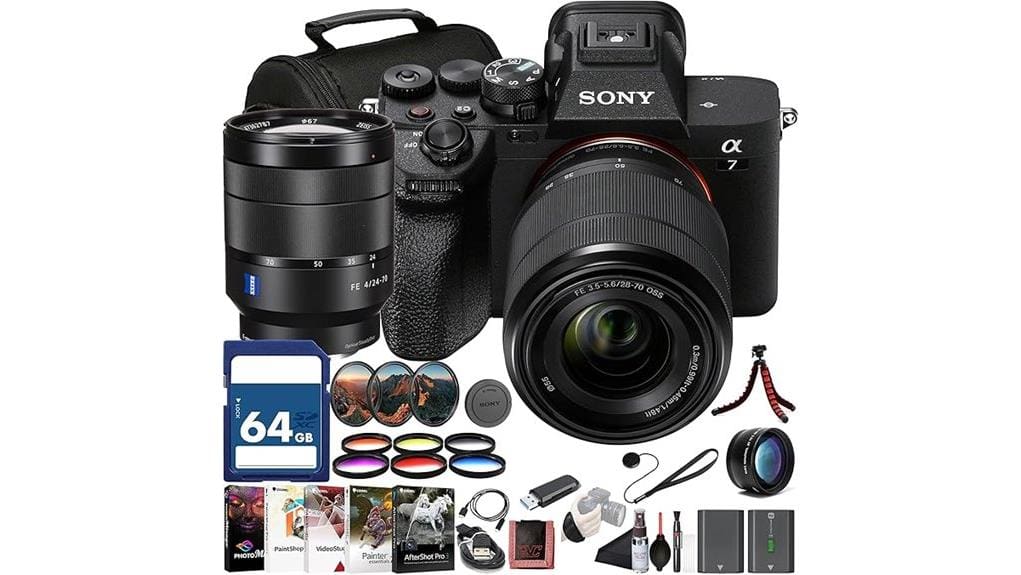
Get straight to the point: the Sony α7 IV (ILCE-7M4K/B) pairs a 33‑MP back‑illuminated Exmor R full‑frame sensor and BIONZ XR processor with 5‑axis in‑body stabilization and AI‑driven Real‑Time Eye AF, delivering up to 10 fps continuous shooting, 4K/60p 10‑bit 4:2:2 video (oversampled from 7K), and up to 15 stops of dynamic range. You get a full-featured kit—28–70mm OSS, 24–70mm f/4 ZA, 64GB card, filters, tripod, battery, cables, software—so you’re operational out of the box. Evaluate menu layout and ergonomics feedback quickly: menus are deep but logical; controls sit well for extended handheld use. The kit is ideal for mirrorless camera enthusiasts who want a complete, ready-to-shoot setup.
Autofocus and Shooting Performance: Real‑World AF, Burst Speed, and Handling
Frequently, you’ll find the α7 IV’s autofocus system striking a precise balance between speed and reliability: its 759 phase-detection points, AI-driven Real‑Time Eye AF and subject tracking lock onto people, animals and birds quickly and maintain focus through complex motion, while the BIONZ XR processor keeps AF calculations fast and consistent. You get excellent real world tracking in varied scenes; AF-C holds targets through erratic motion and focal changes. Burst performance is solid at 10 fps with full AF/AE, and shutter responsiveness feels immediate with 0.1s shot intervals. Handling is ergonomic, controls intuitive for rapid adjustments. The site also offers a wide selection of compatible accessories for the α7 IV, including batteries, grips, and lenses for enthusiasts camera accessories.
Image Quality and Low‑Light Performance: 33MP Sensor, Dynamic Range, and ISO Tests
Although the 33MP back‑illuminated Exmor R sensor and BIONZ XR engine work together to deliver detailed stills, you’ll notice the real strengths in dynamic range and low‑light latitude rather than sheer megapixel count alone. You’ll get roughly 15 stops of usable DR, preserving highlight and shadow detail for recovery in post. ISO performance is clean to 3200, usable to 12800 with noise management; expanded 51200 is for emergencies. Color rendition remains natural with restrained saturation; skin tones hold well. In lens tests the sharpness comparison favors the FE 24–70 f/4 ZA OSS for edge-to-edge acuity. For consistent results across cameras and lenses, consider calibrating with color calibration tools to ensure accurate color and tonal response.
Video Capabilities for Creators: 4K60, 10‑bit 4:2:2, S‑Log and Vlogging Features
When you need cinematic-grade footage without lugging a cinema rig, the α7 IV delivers: it records oversampled 4K from a 7K readout up to 60p with 10‑bit 4:2:2 internal capture, giving you greater color fidelity and grading latitude than typical 8‑bit consumer files. You’ll get S‑Log2/3 and S-Cinetone options; S‑Log’s expanded dynamic range suits heavy color grading while S-Cinetone offers ready-to-use skin tones. The articulating screen, clean HDMI and reliable autofocus make handheld vlogging practical. Bitrate, heat management, and media speed become critical variables — choose fast cards and monitor temps for uninterrupted 4K60 workflows. Consider pairing the camera with a field monitor to improve framing and exposure monitoring for demanding shoots and accurate color assessment using field monitor essentials.
Lenses, Stabilization, and Accessories Included in This Kit
The kit pairs the α7 IV body with two stabilized zooms—Sony’s 28–70mm f/3.5–5.6 OSS and the Vario‑Tessar FE 24–70mm f/4 ZA OSS—so you’ll get immediate coverage from wide to short telephoto with both optical and in‑body 5‑axis stabilization working together for tighter handheld results. You’ll appreciate coordinated stabilization for slower shutter work and video; OSS plus sensor shift reduces blur and eases gimbal dependence. Optics show competent coatings for flare control and neutral contrast. Included accessories — filters, hood, soft bag, 64GB card, mini tripod — emphasize field readiness; note tripod compatibility limits for heavier third‑party lenses. This setup is ideal for gimbal users seeking smooth shots and reliable stabilization in mixed photo-video workflows.
Battery Life, Connectivity, and Workflow: Media, Ports, and Recording Limits
Having covered lenses and stabilization, let’s look at how the α7 IV handles power, media, and connections for extended shoots and video workflows. You’ll get the NP-FZ100 battery; real-world battery longevity supports long still sessions and roughly hour-long high-resolution 4K clips depending on settings. Dual card slots accept UHS-II SD cards; supplied 64GB is adequate for trials but upgrade for heavy 10-bit 4:2:2 use. Ports include micro HDMI and two USB connectors — Sony built solidly, so port durability is reassuring for frequent tethering. Note recording limits: ~60 minutes per clip under common settings; manage file sizes and heat accordingly. For reliable tethered monitoring or external recording, consider using a quality micro HDMI cable to ensure stable video transmission.
Who Should Buy It: and Alternatives to Consider for Your Budget or Use Case
Although it carries a pro-level feature set, you’ll buy the α7 IV if you need a versatile hybrid that balances high-resolution stills, advanced AF, and 10-bit 4:2:2 video without stepping up to a larger cinema body. You should buy it if you prioritize 33MP detail, 10‑bit video, reliable Real‑Time Eye AF, and IBIS for run-and-gun shoots—weddings, commercial work, and travel shooters who want one-body solutions. If budget limits you, consider budget alternatives: Sony α7 III for stills/video parity at lower cost, or full‑frame APS‑C hybrids for lighter travel rigs; compare lenses and workflow needs. For accessories and essential add-ons, consider the wider range of DSLR-related gear that supports versatile shooting setups.
Some Questions Answered
Does This Kit Include International Warranty Coverage Outside the USA?
No, the kit doesn’t automatically include international warranty coverage; Sony USA authorization typically provides a US-limited warranty and you’ll face regional limitations. You should verify with the seller and Sony: some retailers offer extended or international warranty plans, but stock kits often restrict service to the US. If you’ll travel or buy abroad, insist on documented international warranty terms or purchase an added global protection plan to avoid denied service.
Can the Camera Charge and Power External Accessories via USB-C While Recording?
Yes — you can power the camera via USB-C and use battery passthrough to keep it running while recording, but accessory powering is limited. You’ll power the α7 IV from a USB PD source or AC adapter and it’ll continue recording, yet the USB-C port doesn’t reliably supply high current to demanding external accessories (like monitors or heavy audio rigs). For robust accessory powering, use dedicated external power solutions or a powered hub.
Are the Supplied Lenses Compatible With Full-Time Mechanical Aperture Control?
Yes — the supplied FE 24–70mm f/4 ZA OSS and 28–70mm OSS don’t offer a true mechanical linkage for full-time mechanical aperture control; they use electronic diaphragm control. You can use an aperture ring on native lenses if present, but these kit lenses rely on camera electronic control. For vintage adapter use, you’ll get manual override via adapter or lens with mechanical aperture, but here you’ll be limited to electronic aperture commands.
What Are the Exact Dimensions and Weight of the Camera Body Alone?
The camera body’s exact dimensions are 131 x 96 x 80 mm (width x height x depth); weight details list approximately 658 g (body only, including battery and memory card about 699 g). You’ll appreciate that the compact magnesium-alloy shell balances durability and portability. Evaluatively, those dimensions and weight details make the body manageable for handheld shoots and travel, while still offering substantial ergonomics and stability for prolonged use.
Is There a Memory Card Speed Recommendation for Dual-Slot Backup Recording?
Yes — you should use UHS II cards for dual-slot backup recording to guarantee sustained write performance and reliable redundancy planning. You’ll want matching high-speed UHS II cards in both slots, rated U3/V60 or higher, to avoid buffering. Monitor sustained write during long 4K/10-bit shoots and manage heat by limiting continuous high-bitrate recording or using external recorders. Test combos beforehand to validate throughput and fallback behavior.