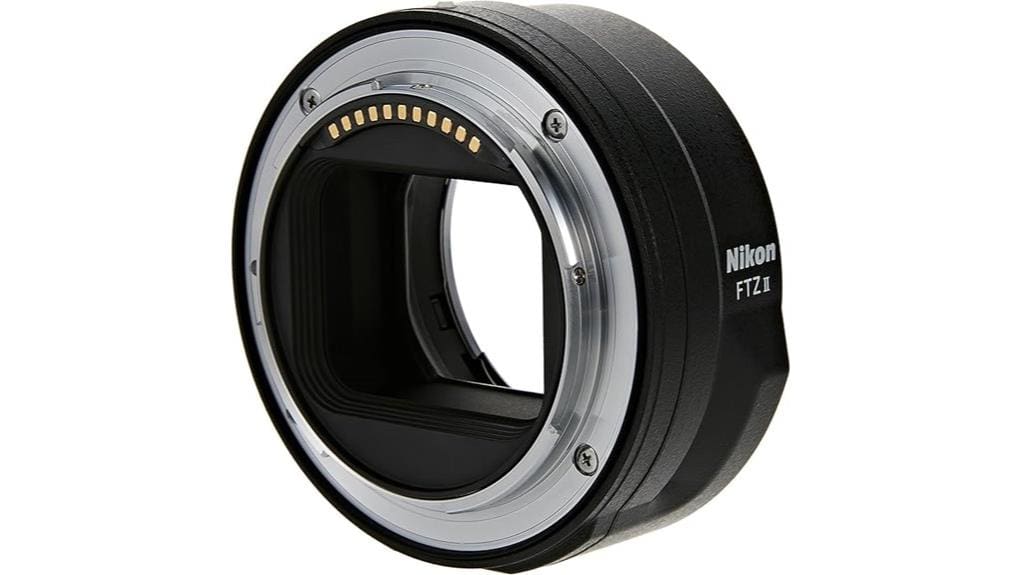

You’ll get near‑native AF and AE with most AF‑S, AF‑P and AF‑I F‑mount lenses on Z bodies, preserving automation and teleconverter support while adding about 250 g. It’s compact, metal‑mounted, weather‑sealed and reliable for field use, though some legacy AI glass loses automation and there’s no in‑adapter stabilization. Expect tiny AF or exposure quirks in low light or with older D‑type lenses. If you want to keep your F glass, this is a practical bridge — more specifics follow.
Some Key Takeaways
- Preserves full AF and AE functionality for most AF‑S, AF‑P, and AF‑I F‑mount lenses with near‑native autofocus speed.
- Works with AF‑S/AF‑I teleconverters and retains automation, but some legacy AI lenses lose automation.
- Reliable exposure metering and fast AE lock, with occasional hunting or minor delays in very low light.
- Solid, compact metal build with weather sealing; adds ~250 g and maintains good balance on Z bodies.
- No in‑adapter stabilization; use body IBIS or optically stabilized lenses and test critical glass before shoots.
What the FTZ II Does and Which Nikon Lenses It Supports
While the FTZ II acts as a simple mechanical adapter, it does more than just mount F-mount glass on Z bodies—you’ll keep full AF and AE functionality with a wide range of Nikon lenses, including FX and DX AF‑S Type G/D/E, AF‑P Type G/E, AF‑I Type D, and AF‑S/AF‑I teleconverters. You get reliable mount conversion that preserves optical performance and weather sealing, so your pro glass stays usable on Z bodies. Lens compatibility is extensive but not universal: manual-focus AI lenses and some legacy teleconverters lose automation. Expect straightforward operation, minimal bulk, and transparent integration with supported modern Nikkor optics. It’s a popular choice for photographers looking to preserve lens investment while transitioning to Nikon Z.
Real-World Autofocus and Exposure Performance With Fx/Dx AF-S, AF-P, AF-I Lenses
Experience shows the FTZ II delivers near-native autofocus speed and reliable exposure metering with supported FX/DX AF‑S, AF‑P, and AF‑I lenses on Z bodies, so you won’t lose responsiveness on most modern Nikkors. You’ll notice minimal autofocus latency in good light; tracking remains firm for stills and moderate action, though ultra-fast AF-I glass can reveal tiny delays compared with native Z optics. Exposure consistency is strong: AE locks quickly and meters accurately across apertures and focal lengths. In challenging low light or with older D-type lenses, expect occasional hunting and slight exposure variance, but overall performance is impressively dependable. This adapter is ideal for photographers who want to expand creative options with legacy and modern glass and understand the benefits of lens mount adapters.
Handling, Build Quality, and Weather Sealing: Is It Rugged Enough?
Because the FTZ II keeps the balance and feel of whatever F-mount glass you attach, you’ll find it comfortable to use on Z bodies even with heavier telephotos. You’ll notice rugged ergonomics in its compact, well-machined body and predictable weight distribution; it won’t feel like a weak link when changing lenses in the field. The metal mount and firm locking mechanism inspire confidence, though the adapter adds 250 g to your rig. Nikon’s weather sealing preserves the mounted lens’ protection, and seal longevity looks solid for routine use. Still, treat it like a precision part and avoid unnecessary shocks. If you need durable transport and storage for adapters and lenses, consider Pelican cases for secure protection.
Limitations: Stabilization, Unsupported Lenses, and Practical Workarounds
You’ll appreciate the FTZ II’s solid build, but it does introduce a few practical limits you should plan for—most prominently the lack of in-adapter image stabilization and incomplete support for some legacy F-mount glass. Expect no stabilization from the adapter itself; rely on body IBIS or optically stabilized lenses. Some unsupported lenses won’t communicate EXIF or AF reliably, so test critical glass before shoots. A manual workaround is often needed: use focus confirmation, stop down metering, or live-view magnification for precise focus. Keep an eye on firmware updates from Nikon—they can improve compatibility but won’t add stabilization. Consider pairing the FTZ II with a compatible L-bracket to improve handling and stability in the field.
Should You Buy It? Use Cases, Value, and Warranty/Return Details
If you own Nikon Z bodies and already have quality F‑mount glass, the FTZ II is a sensible bridge that keeps autofocus, exposure automation, and weather sealing intact for most modern Nikon lenses. You should buy it if you want extended compatibility without replacing lenses — particularly AF-S/AF-P/AF-I glass and teleconverters. Its cost effectiveness is strong when you amortize existing optics versus new Z lenses. Don’t expect in‑body stabilization gains from the adapter itself. Warranty is Nikon’s 1‑year manufacturer coverage plus many sellers offer a voluntary 30‑day return guarantee, so risk is limited. The site also stocks a range of essential accessories for mirrorless users, like cases, filters, and mount adapters, that complement the FTZ II.
Some Questions Answered
Does the FTZ II Add Any Crop Factor on Z Cameras?
No — the FTZ II adds no crop on Z cameras; it preserves full frame sensor coverage and the native field of your F‑mount lenses when mounted on Z full‑frame bodies. You’ll maintain the lens’s original field of view and focal length characteristics, so there’s no crop factor introduced. Be aware that using the adapter on Z APS‑C bodies will still result in an expected crop from the smaller sensor, not the adapter.
Can I Use F-Mount Manual-Focus Lenses With Electronic Aperture Control?
Yes — you can use F‑mount manual‑focus lenses with electronic aperture control, but there are limits. The adapter lacks mechanical coupling for fully mechanical aperture actuation, so lenses that rely on aperture indexing or a mechanical lever won’t work as intended. Electronic‑controlled lenses that communicate aperture electronically will retain AE and aperture control via the camera. Check each lens: if it needs mechanical coupling or aperture indexing, it won’t fully function.
Is There Any Delay When Switching Lenses on the Adapter?
You won’t notice any delay when switching lenses on the adapter — mounting speed is quick and smooth. You’ll attach and release lenses without lag, and the adapter hands control to the camera almost instantly. Focus confirmation works reliably with supported AF lenses, so autofocus and exposure engage promptly. Be critical: with some legacy manual lenses you might lack instant electronic feedback, but for AF-S/AF-P optics performance is immediate.
Does the Adapter Support In-Camera Lens Corrections for All Lenses?
Yes — you’ll get in-camera lens corrections for many supported F-mount lenses, but not absolutely all. Lens profiles are applied when the camera recognizes the lens type (AF-S/AF-I/G/D/E and compatible AF-P/teleconverters). You should check compatibility lists and keep both camera and adapter firmware updates current, because Nikon adds profile support over time. If a specific lens isn’t recognized, corrections may be limited or unavailable.
How Much Does the FTZ II Weigh Compared to Typical Lenses?
The FTZ II weighs about 250 grams, so you’ll notice it’s much lighter than most full-frame lenses. For a size comparison, it’s roughly the weight of a small prime, not a heavy zoom, so handling stays balanced on most Z bodies. Handling tips: mount it firmly, support heavier F-mount lenses at the barrel, and keep it weather-sealed in wet conditions to retain lens sealing and reliable autofocus performance.