
You’ll get an extreme 185° fisheye view on full‑frame Canon RF bodies with the manual‑focus 7artisans 10mm F2.8 II, trading autofocus and weather sealing for dramatic, enveloping compositions and strong center sharpness at F2.8. Edges soften until you stop down to f/5.6–f/8, and star work shows elongation toward the periphery with decent coma control near center. It’s compact and budget‑friendly for creative panoramas and night scenes — keep reading to see performance, corrections, and alternatives.
Some Key Takeaways
- Ultra-wide 10mm F2.8 delivers a dramatic 185° full-frame fisheye perspective ideal for landscapes, architecture, and creative panoramas.
- Manual-focus only with smooth focus throw; use magnified live view or focus peaking for precise results.
- Strong center sharpness at F2.8; stop down to f/5.6–f/8 to improve edge resolution.
- Noticeable barrel distortion and edge stretching—keep distortion for creative effects or correct in RAW with cropping and softening.
- Good low-light and star performance with respectable coma control near center, but expect star elongation and potential flare at edges.
Quick Verdict: Who This 7artisans 10mm F2.8 II Fisheye Is Best For
If you want an extreme, immersive perspective for landscapes, architecture, night sky or creative wide-angle effects, the 7artisans 10mm F2.8 II delivers a compact, manual-focus fisheye that’s tuned for full-frame Canon RF bodies. You’ll find it best if you prioritize dramatic, enveloping compositions over conventional rectilinear rendering. Use it for creative panoramas, exaggerated interiors, or immersive portraits where distortion becomes a feature. It’s ideal for shooters who’ll correct geometry in post, manually focus precisely, and exploit F2.8 for low-light work. It’s less suitable if you need autofocus, weather sealing, or undistorted, traditional wide-angle imagery. The lens is a good fit for photographers exploring specialized portrait optics and portrait camera lenses that emphasize creative distortion and character.
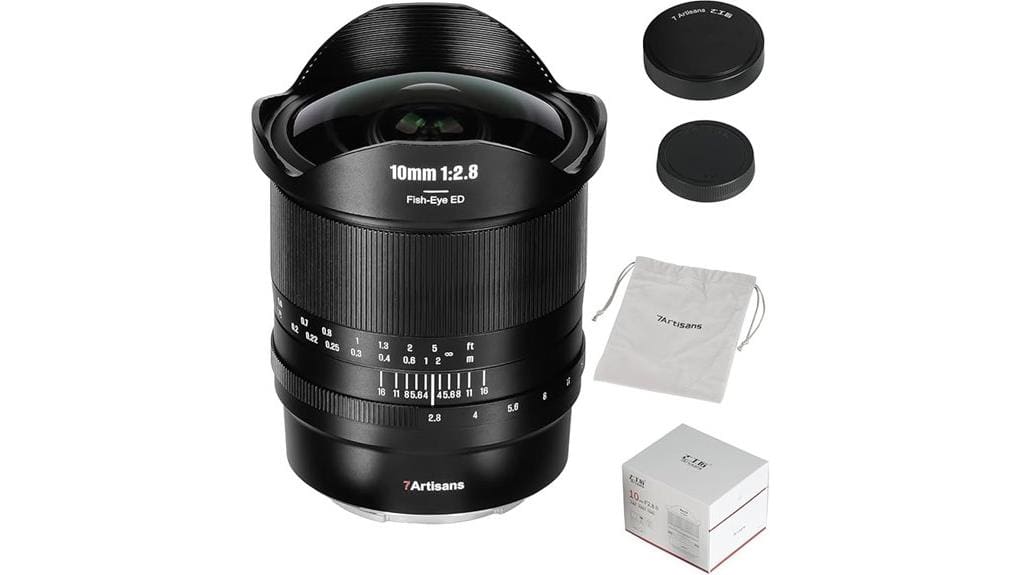
What’s in the Box and Key Specs (10mm, F2.8, 185° Angle)
While compact and straightforward in delivery, the 7artisans 10mm F2.8 II ships with the essentials you need to start shooting: the lens itself with its Canon RF mount, front and rear caps, a soft carrying pouch, and basic documentation including warranty and a user leaflet. The box contents list also notes a Rear cap and Front cap, User manual and Warranty card; a Mount adapter isn’t included but third-party adapters can be used if needed. There’s no dedicated Lens hood in the package, so you’ll rely on the lens’ built-in profile or add an aftermarket hood. Specs: 10mm, F2.8, 185°. Perfect Tripods recommends choosing compatible gear to maximize stability with ultra-wide lenses like this one, especially when shooting long exposures with solid support.
Real-World Performance: Sharpness, Autofocus Behavior, Bokeh, and Low-Light/Star Shooting
Having covered what’s in the box and the basic specs, let’s look at how the lens performs in real shooting conditions. You’ll find center sharpness strong wide open; edge sharpness drops toward the extreme periphery, improving stopped down to f/5.6–8. Manual focus means you rely on a deliberate focus throw and careful magnified review; the ring is smooth with predictable spacing. Coma control is respectable for stars near the center but shows elongation at edges. Bokeh is busy by design—busy as expected from a fisheye. Flare resistance is decent; bright sources can still produce streaks, so watch angles for night and star shooting. Gold reflectors can help subtly warm and balance skin tones in portrait lighting when used carefully gold photo reflectors.
Fisheye Distortion, Correction Workflow, and When to Keep vs. Correct the Effect
Because the 10mm F2.8 II projects a full-frame 185° fisheye field, you’ll get dramatic barrel curvature and pronounced stretching at the edges that define the lens’s creative identity, but also demand deliberate choices about correction. You should evaluate intent: keep creative distortion for surreal panoramas, close foreground emphasis, or dynamic skies. Correct when subjects require architectural preservation, straight lines, or realistic perspective. Workflow: shoot RAW, use lens profile or manual mapping to linearize, refine in local adjustments, and check edge resolution after correction. Accept trade-offs—correction crops and softening—before committing to a look. Mastering composition and placement is key when working with extreme wide angles and fisheye perspective.
How It Stacks Up: Alternatives, Compatibility With Canon RF Bodies, Price and Buying Recommendation
Deciding whether to correct the fisheye’s extreme geometry or embrace it leads naturally into comparing this 7artisans 10mm F2.8 II with other options and evaluating how it pairs with Canon RF bodies. You’ll find useful lens comparisons against native Canon and Samyang fisheyes: the 7artisans trades autofocus and weather sealing for a lower-cost, compact design. It’s fully compatible with listed RF cameras (R1, R3, R5 II, R5, R6 II, R6, R8, R, RP, R7, R10, R50) and supports correction profiles. Consider price tiers—budget alternative, midrange native, premium pro—then buy if you prioritize extreme angle, manual control, and value. Many photographers who use adapters and third-party glass value the 7artisans for its compactness and affordability when pairing with mirrorless systems and lens mount adapters.
Some Questions Answered
Does It Accept Front Filters or Require Rear Gel Filters?
It requires rear gel filters; you can’t use standard front protection or screw-on creative attachments. The extreme 185° fisheye front element protrudes and prevents front filters, so you’ll mount thin gel or specialty rear holders at the lens mount or use in-camera/correction-file workflows. For front protection, use a dedicated removable lens hood cap or carry a protective pouch; for creative attachments, rely on rear gels, external holders, or digital/post-processing techniques.
What Is the Lens’s Minimum Focusing Distance?
The minimum focusing distance is 0.2 meters (20 cm). You’ll use close range composition deliberately, keeping your subject near that 20 cm plane to maximize the fisheye distortion. For focusing techniques, rely on manual focus with live view magnification, focus peaking, and test shots to confirm sharpness across the frame. Move the camera rather than the lens for framing, and stop down slightly to increase depth of field for critical close-ups.
Is the Lens Weather-Sealed for Outdoor Use?
No — it’s not weather-sealed for outdoor use. You shouldn’t rely on weather resistance or assume it passed any seal testing. The lens is specified as not water resistant and lacks official environmental sealing, so you’ll need to protect it from rain, dust, and moisture with covers or a weatherproof camera body. If you require robust protection, choose a lens with manufacturer-rated seal testing and IP-style ingress protection.
Can It Be Adapted to Other Mounts With an Adapter?
Yes — you can adapt the lens to other mounts using a mount adapter, but you’ll lose autofocus and electronic communication. You’ll manually focus and set exposure on the camera or lens. Most adapters won’t provide electronic contacts for this manual optic, so features like aperture reporting and in-camera corrections may be unavailable unless the adapter specifically passes contacts. Confirm flange distance compatibility and choose a quality adapter to maintain alignment and image performance.
What Tripod/Foot Compatibility or Mounting Options Exist?
You can mount this lens using an Arca compatible foot if you add a third‑party tripod adapter; it doesn’t include an Arca compatible foot out of the box. A detachable tripod collar isn’t standard either, so you’ll need a clamp or custom collar designed for its barrel profile. Use low-profile clamps to avoid vignetting and guarantee secure balance on wide-angle shots. Check compatibility with your camera’s RF mount and adapter before buying.