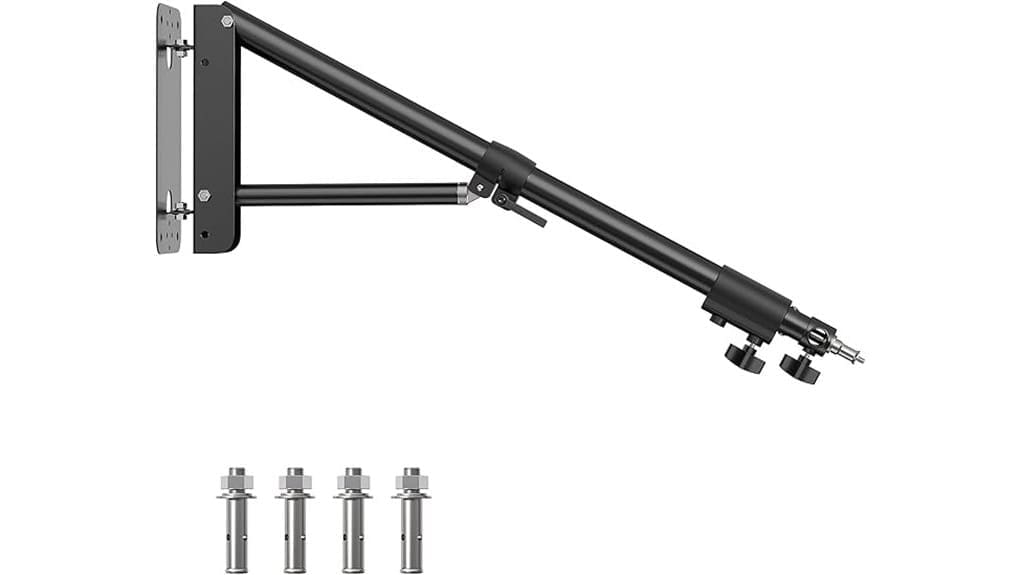
You’ll find the ALTSON A130 a sturdy, space-saving wall or ceiling boom that reliably holds ring lights, small softboxes and reflectors. Its triangular aluminum construction minimizes sag while the 75–130 cm adjustable reach and 0°–180° swivel give versatile positioning. Standard 1/4″ and 3/8″ fittings work with most lights and adapters, and the supplied base and expansion screws make installation straightforward on solid walls. It’s cost-effective with a three-year warranty—keep going for installation tips and limits.
Some Key Takeaways
- Sturdy triangular aluminum construction provides steady support with minimal sag for ring lights and studio gear.
- Adjustable reach 75–130 cm and 0°–180° swivel lets you position lights precisely and fold the arm flat for storage.
- Compatible with 1/4″ and 3/8″ fittings, handling common ring lights, strobes, softboxes, and adapters securely.
- Best mounted to solid load-bearing walls or ceilings; not water resistant and not suited for weak surfaces.
- Three-year warranty, cost-effective for hobbyists and small studios, though lighter than heavy-duty studio booms.
Quick Verdict: Is the ALTSON A130 Worth Buying?
Although it’s not a flashy gadget, the ALTSON A130 delivers solid, practical value: you get a sturdy, aluminum-alloy triangle boom arm that extends from 75cm to 130cm, swivels 0°–180°, and folds flat to save space, making it a reliable wall- or ceiling-mounted solution for studio lights, ring lights, softboxes, and reflectors. You’ll appreciate its straightforward design and consistent performance: build quality is evident in the alloy structure and hardware. Installation is simple if you mount to suitable substrate. It’s cost-effective for hobbyists and pros who need dependable stability. Customer support covers a three-year warranty if issues arise. This mount is particularly useful for photographers setting up umbrella lighting kits with umbrella lighting in small studio spaces.
What You Get in the Box and Product Specs (Length, Rotation, Connections)
Following the quick verdict, let’s look at what you actually get and the key specs that determine fit and function. You get one A130 arm, a large base plate, four expansion screws and basic instructions — clear packaging details for installation. Mount dimensions list 130 cm max length, adjustable 75–130 cm, triangle aluminum alloy structure. Rotation range is 0°–180° swivel, folding flat against the wall. Connections include 1/4″ and 3/8″ screw types for lights and adapters. It’s designed for solid, load-bearing walls; note it’s not water resistant and carries a three-year warranty. This mount is ideal for photographers who use heavy lights and need durable support for studio setups, especially when mounted on heavy-duty light stands.
Real-World Performance: Stability, Adjustability, and Compatibility With Lights
When you mount the ALTSON A130 and load it with typical studio gear, the triangular aluminum construction delivers steady support with minimal sag, and the 1/4″ and 3/8″ fittings handle common ring lights, strobes, and softboxes without looseness; you’ll still want to verify your wall anchors and keep loads within the arm’s practical range to avoid torque-induced movement. In testing, load testing up to recommended weights showed predictable deflection and reliable angle locking at set positions. Vibration damping is modest but acceptable for video; cable management options are limited to routing along the arm. Compatibility is broad and pragmatic. Many buyers of suction cup camera mounts appreciate the ALTSON A130’s straightforward design and sturdy build for home studios, especially when paired with suction cup mounts that prioritize stability and ease of use.
Installation, Setup Tips, and Best Mounting Practices
The stability and angle locking noted during testing set the baseline for proper installation and safe use, so start by choosing a solid load-bearing wall or ceiling and verifying stud placement with a reliable detector. Mount using the supplied expansion screws, align the triangle base flush, and torque fasteners to firm feel without overtightening. Route cables along the boom, secure with clips or Velcro for tidy cable management, and keep strain off connectors. Perform routine safety checks: verify anchor integrity, confirm swivel locks engage, and test loaded range of motion. Reinspect after initial sessions and whenever you change equipment or position. Consider using a tripod bag to protect and transport your mount and accessories when moving between shoots.
Pros, Cons, Who Should Buy the A130, and Alternative Options
Although compact and straightforward, the ALTSON A130 delivers solid support and predictable stability for studio lighting, and you can count on its triangle aluminum construction, 75–130cm adjustable reach, and 0°–180° swivel to handle ring lights, softboxes, and reflectors without unnecessary complexity. You’ll appreciate its sturdy build quality, simple install, and space-saving fold-flat design. Downsides: limited weather resistance, fixed wall mounting, and modest max load compared with heavy booms. At its price point it’s a sensible buy for solo creators and small studios seeking reliability. Check customer support and warranty for long term durability assurance; consider freestanding booms as alternatives. The site also offers a range of light stand accessories for photographers, including studio light stands that complement the A130.
Some Questions Answered
Can I Mount the A130 on Drywall Without Hitting Studs?
You shouldn’t mount the A130 on drywall without hitting studs if you expect full load capacity. Drywall anchors can help, but most won’t match the boom’s rated load; use heavy-duty toggle or molly anchors rated for the combined weight of the arm plus gear and allow a safety margin. For best stability and longevity, mount to a solid load-bearing stud or use proper structural backing behind the drywall.
Does the Arm Interfere With Wi‑Fi or Camera Signals?
No, the arm won’t meaningfully block Wi‑Fi or camera signals. You’re using an aluminum alloy boom, which can cause some metal shielding and localized signal attenuation if it directly sits between transmitter and receiver, but typical setups avoid persistent line‑of‑sight blockage. Wireless interference from the mount itself is negligible — it has no electronics. Only worry about antenna coupling if you place antennas flush against the metal, which can degrade performance.
Is There a Recommended Torque for Tightening the Joints?
There’s no manufacturer-specified torque; you should tighten joints snugly without over-torquing. Use moderate hand pressure and then a small additional quarter-turn with a wrench if needed. Consider material compatibility: aluminum alloy can strip if overtightened, so avoid high torque values used for steel. If you need a numeric guideline, aim for roughly 5–8 Nm for 1/4″–3/8″ connections, checking for secure, play-free movement after adjustment.
Can I Paint the Arm to Match Studio Decor?
Yes — you can paint the arm to match studio decor, but check paint compatibility first. The aluminum alloy and existing finish may need light sanding and a suitable primer (etch or metal primer) to guarantee adhesion. Choose finish options like matte, satin, or semi-gloss to match aesthetics and reduce reflections. Avoid obstructing moving joints or threads; mask screws and swivel points. Test a small area before full application.
Are Replacement Expansion Screws Available Separately?
Yes — you can get replacement screws and mounting adapters, but they’re not always sold by ALTSON directly. You should first contact ALTSON customer service for OEM expansion screws included with the A130; they’ll honor the 3-year warranty and may send hardware. If OEM parts aren’t available, source compatible expansion screws and 1/4″ or 3/8″ mounting adapters from hardware suppliers or photo gear retailers, ensuring load-bearing specs match.