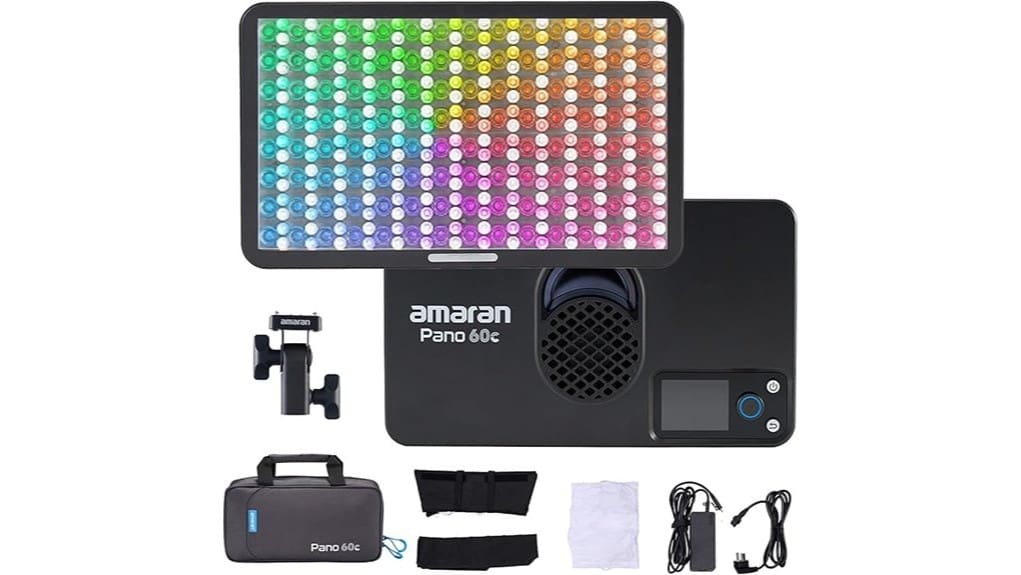
The amaran Pano 60C Kit gives you a compact, travel-friendly LED panel with measured peak output to 22,220 lux at 0.5 m, stepless 0–100% dimming, and professional color fidelity (CRI 96, TLCI 97) across 2,300–10,000K. You’ll get green–magenta correction, deterministic HSI/RGB control, magnetic modifiers, and USB‑C PD for cable-free operation with compatible banks. It suits studio and location work where accurate skin tones and repeatable effects matter, and you can learn more about performance and tradeoffs.
Some Key Takeaways
- High color fidelity (CRI 96, TLCI 97) and green–magenta correction deliver accurate skin tones for professional video and portrait work.
- Compact, ultra-slim 610 g tablet with magnetic modifiers and included softbox, grid, diffuser, and case suits travel and tight setups.
- Peak measured output up to 22,220 lux at 0.5 m (6,500K) but 60W limits long-throw performance and heavy diffusion cuts usable lux.
- USB‑C PD support enables cable-free operation with PD power banks (battery sold separately), enhancing on‑location flexibility.
- Stepless 0–100% dimming, HSI/RGB modes, and deterministic color control via app provide predictable, repeatable creative effects.
How the Pano 60C Kit Performs: Output, Color Accuracy, and Effects
Curious how the Pano 60C holds up in real-use scenarios? You’ll measure steady output: up to 22,220 lux at 0.5 m (6,500K), with stepless 0–100% control letting you dial intensity precisely. You’ll confirm color fidelity—CRI 96, TLCI 97—across 2,300–10,000K, plus green–magenta shifts for accurate skin tones. HSI and RGB modes give deterministic color selection; the display and app report exact values. Built-in creative effects are predictable and repeatable for motion work. In short, highlights summary: high output, excellent accuracy, granular control, and reliable creative effects for studio and location workflows. These strengths make the Pano 60C a compelling choice for photographers seeking video light panels that balance portability and professional features.
Design and Power: Size, Mounting, USB‑C PD, and Kit Accessories
Although it’s compact enough to fit in a messenger bag, the Pano 60C‘s design prioritizes mounting versatility and mobile power, making it practical for both studio rigs and run-and-gun shoots. You get a compact footprint—610 g, ultra-slim tablet form—that installs via an amaran Ace E-Lock quick-release or standard light-stand adapter. USB-C PD lets you run the panel from PD power banks or chargers; Peak1 compatibility enables cable-free operation (battery sold separately). The kit includes a softbox, light-control grid, diffuser, power adapter, cable, and protected case. Magnetic modifiers attach quickly, preserving alignment and repeatability for precise setups. The product is aimed at photographers and videographers who use external camera monitors and related gear, offering accessories and support for external camera monitors.
Real‑World Tests: Studio, On‑Location, and Travel Use Cases
When you move the Pano 60C from the bench to real shoots, you’ll notice its combination of high output, wide color range, and compact form factor makes it adaptable across studio, on‑location, and travel workflows. You’ll deploy it in studio setups for controlled key and rim work, relying on stable CCT range and high CRI/TLCI for accurate skin rendering. On location, its lightweight body and USB‑C PD allow tethered or battery operation, simplifying location lighting rigs. For travel, travel ergonomics matter: the slim profile, case, and accessory kit reduce packing volume while maintaining modifier control and mounting precision. Perfect LED lighting tips help you get the most out of continuous lights in each shooting situation.
What Photographers and Videographers Should Know: Strengths and Limitations
Because the Pano 60C packs a high-output, full‑color panel into a slim, travel-friendly chassis, you’ll get professional-grade color fidelity and flexible mounting options without hauling bulky fixtures. You’ll appreciate accurate skin tones via green–magenta correction and high CRI/TLCI numbers for critical color work. The 22,220 lux peak suits key and fill duties at short distances, while HSI/RGB modes enable creative control. Limitations: 60W output constrains long-throw uses and heavy diffusion reduces usable lux. USB-C PD support helps portability but battery life depends on bank capacity (battery not included). Controls are precise; app scaling is reliable. The kit also benefits hobbyists and pros alike who want LED panel basics in a compact package.
Should You Buy the Amaran Pano 60C Kit? Pricing, Alternatives, and Final Recommendation
You’ve seen where the Pano 60C excels and where it’s constrained, so now weigh its value against price and alternatives to decide if it fits your workflow. You’ll assess price comparison data: kit cost versus single-panel and competitor RGBWW panels, factoring included softbox, grid, and case. Buying considerations: portability, USB-C PD power, measured output, and color accuracy matter more than extras if you travel or shoot tight spaces. Choose the Pano 60C if you need high CRI/TLCI, compact form, app control, and effects; pick stronger-output or modular fixtures if studio brightness or battery inclusion is priority. If you often shoot on location, prioritize a kit’s portability and power when comparing light kit options.
Some Questions Answered
Does It Support AC Mains Operation Without the Included Adapter?
Yes — you can run it from AC mains using the included AC adapter. You’re not offered a documented mains bypass; the light expects external PD via USB-C or the supplied AC adapter. If you want true mains bypass (direct internal wiring to mains), you’d need to modify hardware, which voids warranty and poses safety risks. For portable mains-free use, use compatible PD power banks or the amaran Peak1 battery solution.
Can Multiple Pano 60C Units Be Daisy‑Chained for Synchronized Power?
No — you can’t daisy chain Pano 60c units for synchronized power. Power syncing via direct daisy chaining isn’t supported; each unit requires its own USB‑C PD source or the included AC adapter. For synchronized operation, you’ll power each light individually and use the amaran app or wireless controls to sync settings and effects. This method guarantees stable voltage per unit and prevents overloads or unpredictable behavior from attempting power daisy chaining.
Is the Softbox Compatible With Third‑Party Light Modifiers?
Yes — the included softbox offers broad softbox compatibility with third‑party light modifiers, but you’ll need to check mounting adapters and fabric thickness. You can attach most lightweight grids, diffusers, and small barn doors designed for tablet‑sized panels; heavier modifiers may stress the Ace Lock. Measure adapter ring diameters, verify secure lock engagement, and match fabric thickness to avoid vignetting or heat buildup. Test physically before extended use.
What Is the Fan Noise Level During Extended High‑Output Use?
You’ll hear low fan acoustics under extended high‑output use—audible but not intrusive, roughly comparable to a quiet desk fan at close range. The unit actively cools to prevent thermal throttling, so output may step down slightly only under extreme, sustained loads. You’ll notice a steady hum during long sessions; it’s consistent and predictable, allowing you to plan placement and sound isolation if you need completely silent recording conditions.
Are Replacement Batteries or Internal Battery Options Available?
No — there’s no internal pack; you won’t find a built‑in battery. You can perform a battery swap only by attaching compatible USB‑C PD power banks or the amaran Peak1 power bank (sold separately) for cable‑free operation. Replaceable internal cells aren’t supported, so plan for external power. Use PD power banks that meet required voltage/current specs and the Ace E‑Lock mount to secure the battery for reliable, continuous field operation.