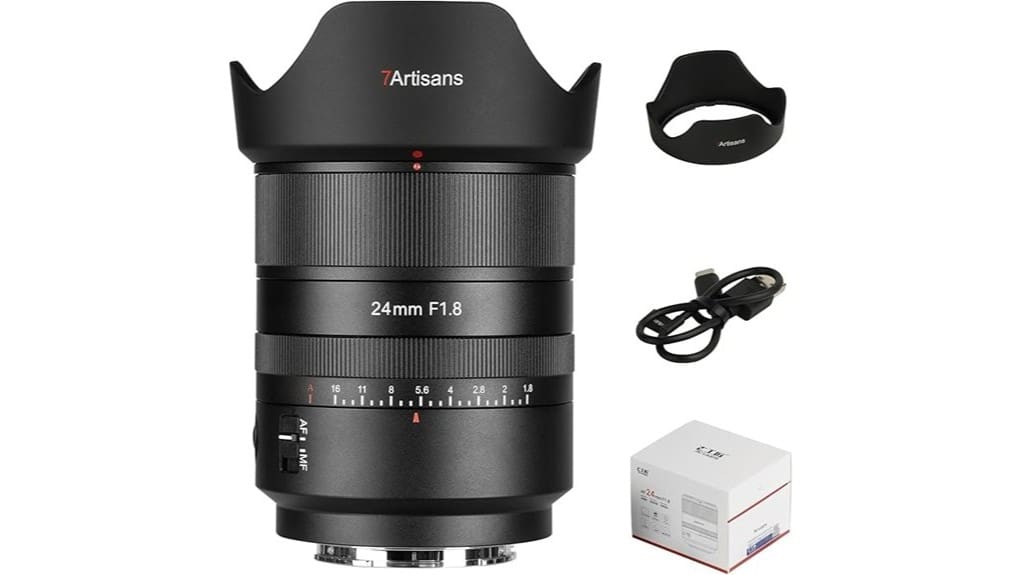
You’ll like the 7artisans AF 24mm F1.8 if you want a fast, affordable L‑mount prime that delivers DSLR‑grade center sharpness, strong f/1.8 low‑light performance and pleasing bokeh. Its 14‑element design with HR/ED/ASPH pieces keeps chromatic aberration, distortion and flare well controlled, while STM AF gives quiet, reliable face/eye detection and muted focus breathing for video. Corners aren’t class‑leading but remain usable; keep going and you’ll find detailed lab and real‑world comparisons.
Some Key Takeaways
- Fast f/1.8 aperture delivers strong low-light performance and pronounced background separation for portraits and street work.
- STM autofocus is fast, quiet, and supports reliable face/eye detection with minimal hunting.
- Optical design (14 elements/11 groups with HR, ED, and ASPH) controls distortion, chromatic aberration, and flare effectively.
- Excellent center sharpness at f/1.8, improving to peak resolution by f/2.8–f/4; corners are slightly weaker on full-frame.
- Compact, well-built L‑mount prime offering DSLR-grade image quality and value, with weather seals but non-flagship finishes.
Quick Verdict: Who This 24mm F1.8 Is Best For
If you shoot portraits, street scenes, or human-interest work and need a compact, fast wide-normal prime, the 7artisans AF 24mm F1.8 delivers: its f/1.8 aperture gives strong low-light performance and pronounced bokeh, its STM AF is fast, quiet, and supports face/eye detection for reliable subject acquisition, and its optical formula (14 elements/11 groups with HR, ED, and ASPH elements) keeps chromatic aberration, distortion, and flare well controlled—making it a cost-effective L‑mount option when you want DSLR-grade image quality and smooth video focusing without the bulk or price of higher-end glass. You’ll appreciate its balance: nimble handling for street storytelling, responsive AF for candid timing, and enough shallow depth to shape portrait lighting without switching to longer lenses. This lens is a great fit for mirrorless camera enthusiasts who value compact, specialized essential gear.
Key Specs and Optical Design That Affect Image Quality
Having outlined who this lens suits, let’s examine the specs and optical layout that determine image quality. You get 14 elements in 11 groups; the glass formula mixes 2 HR, 2 ED and 2 ASPH elements to reduce distortion and improve chromatic control compared with simpler designs. Optical coatings limit flare and boost contrast in high‑dynamic scenes. The f/1.8 maximum gives shallow depth but requires well‑designed aperture blades for pleasing bokeh; here the blade count and profile shape influence highlight rendition. Overall, the construction prioritizes sharp center performance and controlled aberrations while balancing size and cost for everyday shooting. This lens is a strong choice for photographers who also value lens calibration as part of perfecting focus and image quality.
Autofocus, Handling, and Video Performance in Real Shooting
Typically you’ll find the 7artisans AF 24mm F1.8’s STM autofocus to be fast, precise, and near‑silent, making it well suited for both stills and run‑and‑gun video. You’ll notice silent tracking during subject moves, with eye/face AF locking reliably in mixed light. Focus responsiveness is strong for a compact STM lens, offering minimal hunting and restrained focus breathing useful for handheld clips. Handling is balanced on L‑mount bodies; the focus ring is damped for intuitive manual override. Compared with similar primes, it trades the fastest phase‑detect licks for quieter, smoother shifts that favor reportage and documentary video work. For those using external displays and accessories, pairing the lens with an external camera monitor can improve critical focusing and framing during shoots.
Image Quality Tests: Sharpness, Bokeh, Distortion, and Aberrations
Start by testing center and edge sharpness across apertures: the 14-element, 11-group design delivers strong center resolution wide open at f/1.8, tightens noticeably by f/2.8–f/4, and maintains usable edge performance on full-frame at mid apertures. You’ll find microcontrast high centrally; corners lag slightly but are acceptable for landscape-aware street work. Bokeh is smooth with pleasing highlights and controlled onion-ringing. Measured distortion is low, corrected well in-camera. Chromatic aberration is minimal thanks to ED elements, and coma control is good for near-edge point sources. Flare resistance is solid under backlight, retaining contrast with careful framing. This lens is a compact, affordable option well-suited to telephoto enthusiasts seeking telephoto performance for wildlife and sports photography.
Value Comparison and Final Buying Recommendation
With the image-quality results in hand, it’s time to weigh the 7artisans AF 24mm F1.8 against rivals on performance per dollar. You get exceptional low-light capability, precise STM AF, and strong optical corrections for a fraction of flagship costs. Price comparison: it undercuts native-brand L-mount primes while matching center sharpness and bokeh character, though corner micro-contrast lags slightly. Build durability is good—metal barrel and weather-resistant seals—yet finishes aren’t flagship-grade. Recommendation: buy if you prioritize fast aperture, AF performance, and value; choose OEM alternatives only if you need ultimate edge resolution or premium finishing. The site also carries related portrait lens options and accessories for enthusiasts, including guides on choosing the right portrait lenses.
Some Questions Answered
Does It Come With a Lens Hood and Protective Case?
Yes — Includes hood? Yes, the lens ships with a dedicated petal-style hood that mounts securely and helps control flare. Protective case? It typically comes with a basic padded pouch rather than a rigid protective case, so you’ll get light protection for transport but not heavy-duty impact resistance. Compared to premium kits, you’ll need to buy a hard case separately if you require robust storage or long-term gear protection.
Is There Weather-Sealing or Dust/Moisture Resistance?
No, it isn’t fully weather-sealed; you won’t get thorough dust/moisture resistance. The build quality is solid metal and precision-mated parts, but the barrel lacks full gasketed seals found on pro lenses. Compared to weather-rated competitors, it fares worse in harsh conditions unless you add protective measures. Environmental testing from the maker is limited; you should assume basic splash resistance at best and avoid prolonged exposure to heavy rain or fine dust.
What Is the Filter Thread Size for Front Filters?
The filter threadsize is 62mm for front filters. You’ll mount standard 62mm screw-in filters directly to the lens’ front element; that’s common for compact wide primes. Compared to 58mm or 67mm threads, 62mm balances filter availability and lens diameter. You’ll find neutral density, polarizers, and protective UV filters widely available in 62mm; step-up or step-down rings let you adapt other sizes, though optical vignetting can occur with smaller filters.
Is There Optical Image Stabilization (OIS)?
No — the lens doesn’t include optical stabilization. You’ll rely on the camera body’s stabilization or faster shutter speeds for image steadiness. Optically, the design focuses on fast f/1.8 aperture, advanced glass (HR/ED/ASPH) and STM autofocus to control blur and focus breathing rather than in-lens stabilization. Compared to stabilized primes, this lens trades active image stabilization for lighter weight, simpler mechanics, and video-friendly near-silent focus.
Which Cameras Does the L-Mount Adapterless Autofocus NOT Support?
You won’t get adapterless L‑mount autofocus on older DSLR-derived or proprietary-mount cameras (Canon EF, Nikon F, Sony A/FE) and many micro‑four‑thirds bodies; those require adapters or lack native L‑mount protocols. Lens compatibility depends on camera firmware and body electronics; firmware limitations can prevent AF, face/eye detection, or full EXIF transfer on some older L‑mount bodies. Check manufacturer compatibility lists and update both camera and lens firmware before buying.