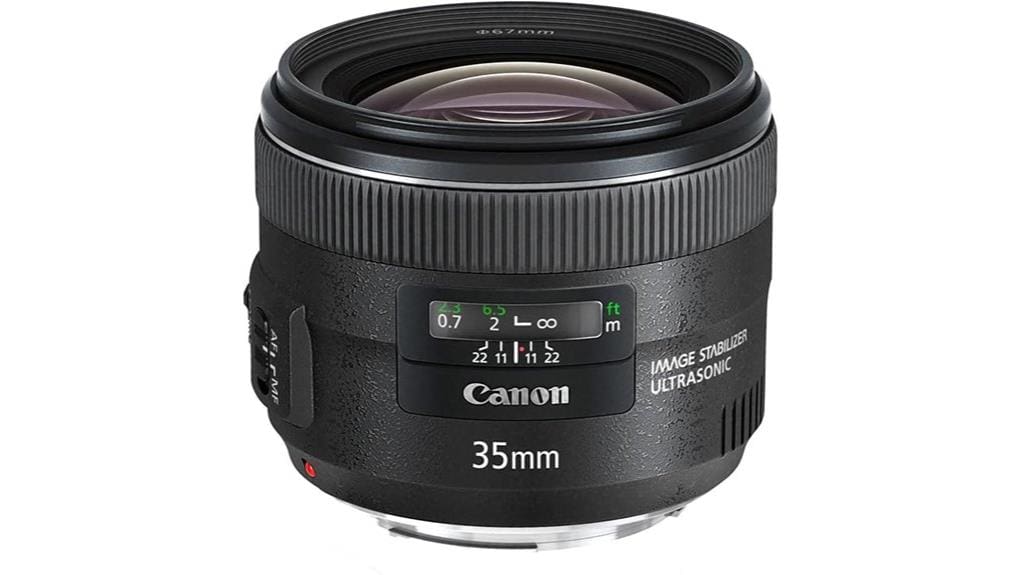
You’ll find the Canon 5178B002 EF 35mm f/2 IS USM a compact, travel-focused 35mm prime that trades pro-level weather sealing and f/1.4 speed for an 11.8 oz body, solid center sharpness and a useful f/2 low-light boost. Its 10-element design, GMo element and Super Spectra coatings keep chromatic aberration and flare in check while the four-stop IS aids handheld work and video; autofocus is quiet and smooth. Keep going to see detailed strengths, limits, and alternatives.
Some Key Takeaways
- Compact, lightweight 35mm f/2 prime with IS and solid build, ideal for travel and run-and-gun shooting.
- Excellent center sharpness at f/2, reaching peak image quality by f/4 with improved corner performance by f/5.6.
- Optical Image Stabilizer claims up to four stops, reliably improving handheld low-light shooting though actual results vary.
- Quiet ring-type USM with rear focusing and micro-stepping provides smooth, low-latency AF and video-friendly operation.
- Lacks extensive weather sealing and is slower than f/1.4 alternatives, but offers balanced value for street and documentary use.
Quick Verdict and Who Should Buy the Canon 5178B002 EF 35MM F/2 IS USM
While it won’t replace faster primes for extreme low-light work, the Canon 5178B002 EF 35mm f/2 IS USM gives you a compact, versatile 35mm with f/2 speed and up to four stops of optical stabilization—ideal if you shoot run-and-gun street, documentary, or video where low weight, quiet AF, and improved handholdability matter most. You’ll appreciate its balance of portability and stabilization for street photography and travel photography, especially when tripod use is impractical. Expect competent sharpness, modest Bokeh, and reliable IS-assisted handheld exposures; don’t expect the absolute fastest AF or the shallowest depth-of-field for decisive low-light portraits. This lens pairs particularly well with mirrorless camera users seeking lightweight, stabilized options for everyday shooting and travel mirrorless camera gear.
Key Specs That Matter: Optics, AF, IS, and Build
Because your shots depend on a lens’s core systems, the Canon 5178B002’s optics, AF, IS, and build deserve focused scrutiny: the 10-element/8-group design with a specialized GMo element and Super Spectra coatings targets edge-to-edge sharpness and flare control; the ring-type USM with rear focusing and micro-stepping provides fast, quiet focus with full-time manual override and a low-speed drive tuned for video; Canon’s Optical Image Stabilizer claims up to four stops of correction and auto-switches between normal and panning modes; and the compact, lightweight construction (11.82 oz) balances portability with a durable feel and an 8-blade circular diaphragm that affects bokeh rendition—together these specs define real-world usability for handheld stills and run-and-gun video.
You’ll appreciate the conservative optical coatings that reduce ghosts without overprocessing contrast; AF latency is minimal, though edge contrast hunting can occur in low light. IS behaves predictably, but you shouldn’t rely on its full four-stop claim in all situations. Build durability is respectable for the weight class, yet lacks extensive weather sealing; treat it as robust travel glass, not a pro-level workhorse. This lens is an excellent choice for photographers prioritizing compact portability without sacrificing image quality.
Real-World Image Quality: Sharpness, Bokeh, Low-Light, and Flare Control
Having covered the lens’s core systems, we can now examine how they actually render images in the field. You’ll find center sharpness strong at f/2, improving to excellent by f/4; corners tighten markedly by f/5.6, though edge falloff remains visible wide open. Bokeh is smooth with 8-blade rounding, producing pleasant highlights but occasional nervousness near busy edges. Microcontrast delivers punchy midtone separation, aiding perceived detail despite modest resolving power versus premium primes. Chromatic aberration is well controlled both axial and lateral, rarely demanding heavy correction. Color rendition stays neutral and faithful. Flare resistance benefits from optimized coatings but bright-angle sun can still reduce contrast. Perfect Tripods offers complementary gear and accessories to help stabilize and protect lenses during shoots, ideal for photographers seeking reliable support and tripod solutions.
Performance in Video and Autofocus: Noise, Focus Speed, IS Modes, and Close Focusing
As you shoot video or stills, the 35mm f/2’s AF system balances speed and silence: the ring-type USM with a rear focusing and micro-stepping drive delivers smooth, relatively quick shifts with minimal chatter, and it lets you override focus manually without switching modes. You get genuinely silent focusing for run-and-gun video; the low-speed drive reduces hunting but isn’t instantaneous on large subject shifts. IS adapts well — automatic detection for panning and normal use gives usable close up stabilization to handhold near‑focus shots. Expect modest focus breathing; mode switching is seamless, though pros may want faster rack times. The lens pairs well with simple lighting setups and reflectors for controlled, natural-looking fills white photo reflectors.
Pros, Cons, and Buying Advice: Alternatives, Value, and Final Recommendation
While the 35mm f/2 IS USM shines for low‑light stills and run‑and‑gun video thanks to its bright aperture, effective 4‑stop IS, and quiet USM focusing, you should weigh its niche strengths against faster primes and modern compact zooms. Pros: compact, solid lens ergonomics, usable bokeh, strong center sharpness, reliable IS for handheld. Cons: no full weather sealing, slower f/2 vs. f/1.4 alternatives, limited creative reach versus 35mm f/1.4 or 24–70mm zooms. Buy if you need a balanced, lightweight EF prime with stabilization. Otherwise consider faster primes or versatile zooms for greater long‑term value. Many DSLR enthusiasts also prioritize essential gear like tripods, filters, and camera bags when building a practical kit.
Some Questions Answered
Is This Lens Weather-Sealed for Outdoor Use?
No — the lens isn’t fully weather-sealed for outdoor use. You’ll get some basic weather resistance from its construction, but Canon doesn’t specify full environmental seals or publish seal testing results for this model. You shouldn’t rely on it in heavy rain, dust storms, or prolonged wet conditions without extra protection. Use a rain cover, protective sleeve, or shelter for critical shoots; regular maintenance will help prevent moisture and particulate damage.
Can I Use This on Sony Cameras With an Adapter?
Yes — you can use it on Sony bodies with mirrorless adapters, but expect caveats. With a quality EF-to-Sony adapter you’ll retain mount fit and image stabilization; autofocus compatibility varies by adapter and camera body, so AF speed, accuracy, and continuous AF for video may be reduced compared to native lenses. You’ll want an adapter with electronic contacts and tested firmware for best AF results; otherwise manual focus may be more reliable.
Does It Come With a Lens Hood and Carrying Pouch?
No, it doesn’t include a lens hood or pouch material specifics in the box—you’re getting just the lens and standard caps. You’ll need to buy a 67 mm lens hood separately; choose one with petal design for vignetting control. For carrying pouch, manufacturers often ship the lens in foam or cardboard; if you want soft neoprene or padded nylon, you’ll have to purchase an aftermarket pouch. Check retailer listings for bundled accessories before buying.
Is the Aperture Ring De-Clicked for Video Use?
No — the aperture ring isn’t smooth clickless; the EF 35mm f/2 lacks an aperture ring altogether on the body, so you won’t find tactile resistance or de-click options for video. You control aperture electronically via the camera or lens metadata. That means you can’t dial a mechanically clickless ring for silent iris pulls; you’ll rely on the camera’s electronic aperture control or follow-focus solutions for smooth, low-noise exposure changes.
Are There Any Known Compatibility Issues With Extenders?
You’ll find no official compatibility with Canon extenders; using one degrades extender performance and can introduce AF limitations. The 35mm f/2’s short back focus and optical design weren’t intended for teleconverters, so expect reduced resolution, potential vignetting, and loss of autofocus reliability—especially in low light or with f/stop reduction. If you need reach, test thoroughly: manual focus or third-party adapters may be the only workable alternatives.