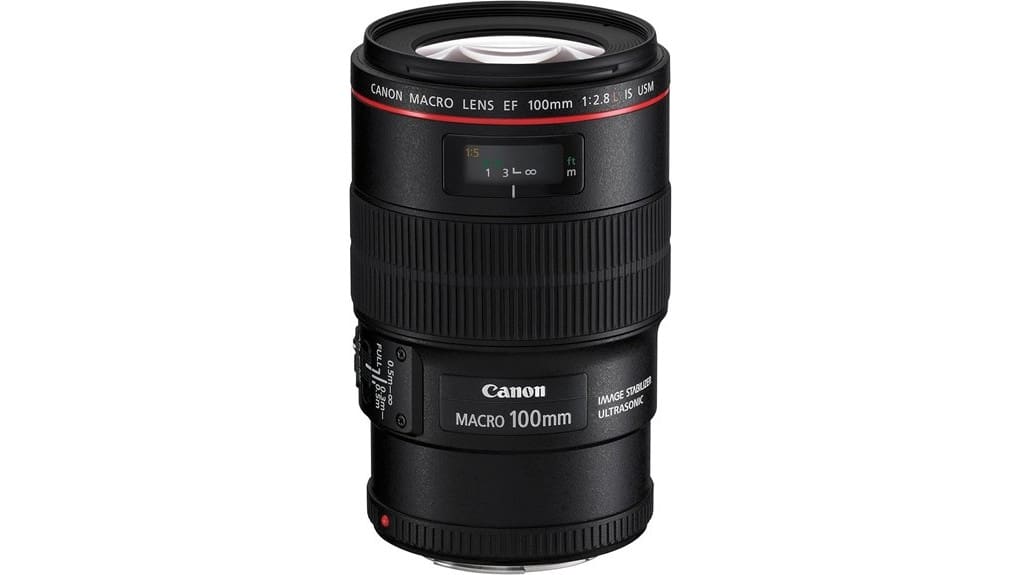
You’ll find the Canon EF 100mm f/2.8L IS USM Macro is a robust, weather‑sealed L‑series optic offering true 1:1 magnification, razor‑sharp center detail wide open and improved edges by f/5.6–f/8. Its hybrid IS yields about four stops of stabilization for handheld close work, while near‑silent USM with full‑time manual override gives precise focus control. Working distance and ergonomics suit studio and field use, and practical alternatives exist — keep going to understand performance tradeoffs and shooting tips.
Some Key Takeaways
- Exceptional center sharpness at f/2.8, peaking between f/4–f/8 for critically sharp images.
- True 1:1 macro with 0.3 m minimum focus distance and comfortable working distance for lighting.
- Hybrid IS provides roughly four stops of stabilization, reducing angular and shift blur for handheld close work.
- Fast, near‑silent USM autofocus with full‑time manual override; low‑light tracking can slow in low contrast.
- Robust L‑series build, weather‑tolerant seals, firm focus ring, and ergonomic balance for professional field use.
How the EF 100MM F/2.8l IS USM Macro Performs at a Glance
Although it’s a specialty optic, the Canon EF 100mm f/2.8L IS USM Macro delivers reliable, professional-grade results across close-up and short-telephoto work. You’ll notice dependable handling from robust build quality, with weather-tolerant seals and a firm focus ring that resist field wear. Hybrid IS stabilizes angular and shift shake, letting you shoot handheld near 1:1 magnification with fewer rejects. USM-driven AF is fast and quiet, and full-time manual override gives precise control. At wider apertures, bokeh performance is smooth and controlled, aiding subject isolation without distracting highlights. Overall, it’s a purpose-built, predictable tool for critical shooting. This lens is ideal for photographers who want to master close-up techniques with macro lenses.
Optical Quality and Sharpness: Close‑Up, Portrait, and Edge Tests
When you put the Canon EF 100mm f/2.8L IS USM Macro on a test bench, its optical pedigree shows clearly: center sharpness reaches excellent levels at f/2.8, tightening further by f/4–f/8, while edge and corner resolution lag slightly at the widest aperture and improve substantially by f/5.6–f/8. In close‑up mode you’ll see exceptional micro contrast and fine detail rendering at 1:1, with minimal color fringing. For portraits the lens resolves skin texture cleanly and delivers pleasing bokeh rendition with smooth highlights. Edge tests reveal controlled astigmatism and only modest field curvature that vanishes stopped down. This performance makes it a standout choice for photographers who value optical quality in macro and portrait work.
Stabilization, Autofocus, and Handling in Real Shooting Situations
Having established the lens’s strong optical performance, it’s important to assess how its stabilization, autofocus, and ergonomics affect real-world shooting. You get Hybrid IS delivering about four stops of shake compensation, noticeably reducing blur from angular and shift movement during handheld close work. The USM-driven inner focus is near-silent, fast, and allows full-time manual override; low light tracking is competent though contrast-limited scenes can slow acquisition. Ergonomic balance on a DSLR is good—weight distribution feels centered and controls are intuitive—helping steadier handheld framing. Overall, stabilization and AF systems combine to make field use efficient and predictable. For photographers looking to fine-tune focus performance, dedicated lens calibration tools can help ensure consistently sharp results.
Macro Capability and Working Distance: Real 1:1 Close‑Up Examples
Offering true 1:1 magnification, the Canon EF 100mm f/2.8L IS USM lets you capture life‑size detail without adapters, and its 0.3 m (0.99 ft) minimum focus distance defines the working distance from sensor to subject rather than front element to subject. You’ll frame small subjects accurately and maintain comfortable clearance for lighting or diffusers. The lens delivers sharp corner‑to‑corner performance at macro distances, preserving contrast and resolving fine texture. Subject isolation benefits from the 100mm focal length and f/2.8 aperture, letting you separate background elements while keeping critical detail at life‑size magnification for scientific or commercial work. For controlled lighting in close‑up work, many photographers pair macro lenses with ring lights to ensure even illumination and reduce harsh shadows.
Who Should Buy It and Alternatives to Consider
The lens’s true 1:1 capability and comfortable working distance make it a strong choice if you need life‑size detail with reliable stabilization and fast, quiet AF; now consider whether its size, cost, and feature set match your shooting priorities. If you’re focused on macrophotography, product, or portraits on Canon EF bodies, you’ll appreciate Hybrid IS, 0.3 m close focus, and durable L‑series build — a solid beginners’ choice for serious amateurs. If you need lighter weight, cheaper glass, or longer reach, evaluate 100mm third‑party macros, 85mm primes, or pro alternatives like the Canon RF or Sigma Art series on adapted mounts. The company also offers accessories and shooting advice for working with white photo reflectors to improve macro and product images with controlled light white photo reflectors.
Some Questions Answered
Is This Lens Weather-Sealed or Splash-Resistant?
No — it’s not weather-sealed or splash-resistant. You shouldn’t expect moisture or dust protection from the Canon EF 100mm f/2.8L IS USM Macro; the product details state it’s not water resistant. You’ll need to avoid wet or dusty environments or use external protection (rain covers, sealed bags). For professional outdoor work, plan for contingencies since the lens lacks dedicated weather sealing, which limits rugged-field reliability.
Can I Use Canon Extenders With This Lens?
No — you can’t use Canon extenders with this lens; EF1.4X II and EF2X II are incompatible. For teleconverter compatibility, the lens lacks proper coupling and performance support, so mounting teleconverters isn’t recommended. Even if adapted, focal multiplier effects (1.4x or 2x) would change effective focal length and aperture, degrading sharpness, AF reliability, and macro 1:1 magnification. Rely on native optics or longer prime alternatives for reach.
What Filter Size Does the Lens Accept?
The lens accepts a 67mm filter. You’ll mount 67mm filter threads on the front element; use the included E-67 II cap for protection. Note compatibility notes: some texts mistakenly list 58mm, but the correct size is 67mm. Choose quality multi-coated 67mm filters to avoid degrading image quality, and make sure stack thickness won’t interfere with macro focus or the ET-73 hood. Remember extenders aren’t compatible with this lens.
Does the Lens Include a Lens Hood and Carrying Case?
Yes — the lens includes a lens hood and a carrying case. You’ll get the ET-73 lens hood plus the LP1219 soft lens case as part of the lens accessories package. These storage options protect the optical assembly and accessories during transport and reduce stray light when shooting. The soft case offers padded, lightweight protection; the hood mounts to control flare and physical impact, improving handling and long-term optical performance.
Is Image Stabilization Effective for Handheld Macro Video?
Yes — Hybrid IS is effective for handheld macro video, reducing both angular and shift shake so you’ll get steadier close-up footage. You’ll still need careful framing and slow movements because focus breathing and shallow depth of field remain limiting factors. Use focus peaking on your camera or monitor to confirm critical focus during movement, and combine IS with steady technique or a monopod for best results in life-size 1:1 shooting.