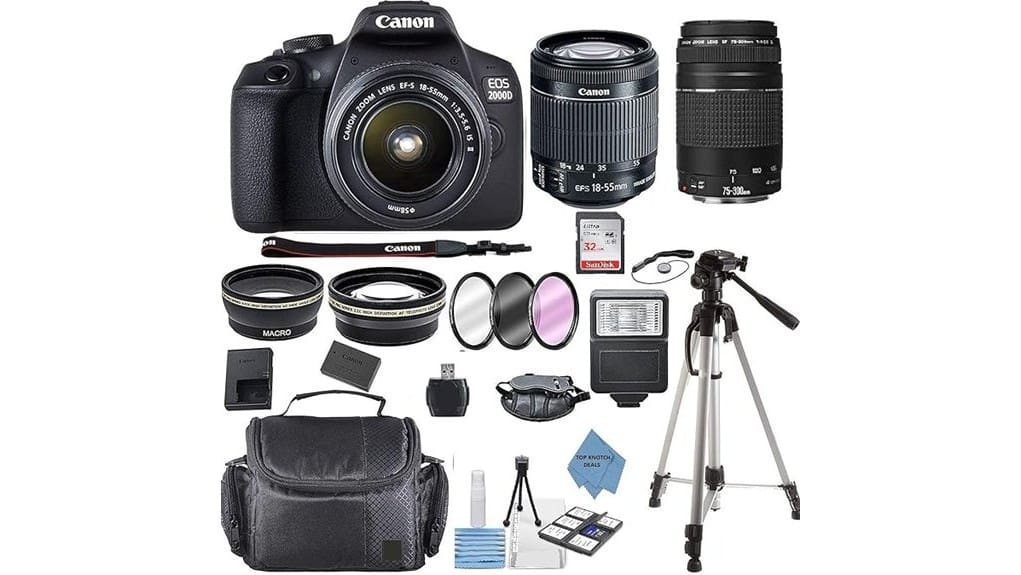
You’ll get a 24.1MP APS‑C DSLR (DIGIC 4+) with Wi‑Fi/NFC, 1080/30p video and an 18–55/75–300 kit that covers 18–300mm equiv. It delivers good daylight detail and neutral color, usable RAW latitude to ISO 1600–3200, but noise rises past 3200. AF is basic (9‑point) and continuous shooting is 3 fps, so action is constrained. Lenses lack stabilization; battery isn’t included. Keep reading for full tests, lens notes and buying alternatives.
Some Key Takeaways
- 24.1MP APS‑C sensor delivers good daylight stills with usable RAW latitude; best up to ISO 1600–3200 for detail.
- Kit includes 18–55mm and 75–300mm lenses, covering wide-to-tele but lacking image stabilization and fast autofocus.
- DIGIC 4+ processor, 3 fps continuous shooting, and 9‑point AF limit action and low‑light performance.
- Records Full HD 1080/30p video with basic autofocus; no 4K or in‑body stabilization.
- Renewed bundle is budget‑friendly but check cosmetic condition, missing battery, and 90‑day limited warranty.
Quick Verdict: Is the Canon EOS 2000D (Rebel T7) Kit Worth Buying?
While it lacks the latest processor and high-speed burst capabilities found in modern midrange bodies, the Canon EOS 2000D (Rebel T7) kit still delivers a solid, affordable entry-point for photographers who need a reliable 24.1MP APS-C DSLR with a broad focal-range lens set. You’ll find its 24.1MP sensor, DIGIC 4+ processing, and native ISO 100–6400 sufficient for controlled daylight, travel, and budget travel projects. Autofocus and 3 fps limits constrain action work, but stabilized lenses mitigate shake. For beginner astrophotography you’ll need tripod, manual control, and post-processing to offset noise and limited long-exposure support. This kit is a good match for DSLR enthusiasts seeking essential gear for everyday photography.
What You Get in the Renewed 2000D Bundle (Body, 18–55 & 75–300 Lenses, Accessories, Warranty)
The renewed Canon EOS 2000D bundle packages a complete, ready-to-shoot DSLR kit: a 2000D body (model 2000D, UPC 656942097372) with a 24.1MP APS-C CMOS sensor and DIGIC 4+ processor, an EF‑S 18–55mm f/3.5–5.6 III standard zoom and an EF 75–300mm f/4–5.6 III telephoto zoom (together covering 18–300mm equivalent), plus an accessory set—camera bag, lens filters, cleaning kit and a TopKnotch Deals cloth—and a 90‑day limited warranty from Ultimate Deals; the package supports EF/EF‑S mounts, records JPEG and 14‑bit RAW, outputs Full HD 1080/30p video in MP4, and includes built‑in Wi‑Fi/NFC, though a battery is not included.
You’ll receive renewed grading details with the listing; inspect photos for lens wear and body blemishes, verify accessory authenticity and filter sizes, and confirm warranty transferability before purchase. Accessories are basic but functional; lenses use EF/EF‑S mounts and lack image stabilization, so expect optical performance to depend on condition and handling. For carrying and protecting your gear during shoots, consider choosing a camera bag that fits the kit and offers padding and organization.
Real-World Performance: Image Quality, Autofocus, Low‑Light and Video Tests
Although aimed at entry-level users, the 2000D delivers predictable, technically honest results across image quality, autofocus, low-light, and video tasks that let you evaluate trade-offs quickly. You’ll get 24.1MP files with respectable dynamic range for JPEGs and usable RAW latitude, while color rendering is neutral and responds well to custom white balance. The 9-point AF and simple focus tracking are reliable for static subjects but struggle with erratic motion. Noise performance holds to ISO 1600; usable detail to 3200, then aggressive luminance loss. Video is limited to 1080/30p with decent exposure stability but basic autofocus and no stabilization. This camera is a solid choice for enthusiast photographers looking for an affordable entry into interchangeable-lens systems.
How the 18–55 and 75–300 Lenses Perform and Who Each Suits Best
Building on what you learned about the camera’s image characteristics and autofocus limits, let’s examine how the bundled 18–55mm and 75–300mm lenses shape real-world results and which shooting scenarios each handles best. You’ll find the 18–55mm delivers balanced sharpness centrally, modest edge falloff, controlled chromatic aberration at mid-range, and pleasant, albeit restrained, bokeh character from its 6-blade diaphragm. Its micro motor focus speed is adequate for casual use but not fast for action. The 75–300mm favors reach over finesse: softer edges, more visible chromatic aberration at long end, lighter build quality, and slower focus speed—best for static distant subjects. For those exploring different focal lengths, understanding zoom lens behavior can help choose the right lens for common shooting situations.
Should You Buy It? Alternatives, Upgrade Paths, and Final Buying Recommendations
If you’re weighing this renewed Canon EOS 2000D Rebel T7 kit against other entry-level options, focus on whether its 24.1 MP APS‑C sensor, DIGIC 4+ processing, and included 18–55mm and 75–300mm lenses meet your real-world needs for image quality, autofocus speed, and reach. You’ll get competent stills and Full HD video, but 3 fps and a basic 9‑point AF limit action work. Consider battery life (spare battery advisable), accessory compatibility with EF/EF‑S glass, and limited future proofing versus newer AF systems and 4K. Buy if cost-conscious; otherwise consider newer EOS M/entry mirrorless for better resale value and longevity. This is a good fit for buyers who primarily shoot stills and want a straightforward kit with essential gear for mirrorless camera enthusiasts.
Some Questions Answered
Does the Renewed Kit Include a Battery and Memory Card?
No — the renewed kit doesn’t include a battery; you’ll need to supply a compatible Lithium‑ion pack. The listing also doesn’t state an internal memory card, but the camera supports SD, SDHC and SDXC cards, so you’ll want to buy a card separately. For clarity: battery included is false; memory compatibility covers SD/SDHC/SDXC formats. Check the seller for optional accessory bundles or warranty details before purchase.
Is the Camera Compatible With Third-Party EF-S Lenses and Adapters?
Yes — you can use third party EF‑S lenses and many mount adapters with the 2000D. You’ll get reliable autofocus with EF‑S/designated lenses; third party performance varies, so run lens testing to confirm AF accuracy and image quality. For non‑native mounts, check adapter compatibility for electronic contacts, aperture control, and focus confirmation. Mechanical adapters may work for manual focus only; smart mount adapters can preserve EXIF and AF depending on the lens.
Can the 2000D Connect Wirelessly to Smartphones for Remote Shooting?
Yes — you can connect the 2000D to a smartphone and perform remote shooting using its built‑in Wi‑Fi and NFC. You’ll pair the camera with Canon’s Camera Connect app, establish a wireless shutter link, preview live view, adjust basic settings and trigger the wireless shutter remotely. Operation is app‑driven, supports JPEG/RAW transfer, and relies on Wi‑Fi range; latency and limited advanced controls reflect the camera’s entry‑level DIGIC 4+ design.
Are Firmware Updates Available and How Are They Installed?
Yes — firmware updates are released occasionally; check Canon’s support site for firmware release cycles and version notes. You’ll download the correct firmware file, copy it to a formatted SD card, insert it, power the camera with a charged battery, then run the update from the menu. Follow installation precautions: use the exact model firmware, make certain battery won’t die, don’t remove the card or power during flashing, and verify final version afterward.
What Accessories Are Covered by the 90-Day Warranty?
The 90-day warranty covers the included accessories that are part of the renewed bundle: camera bag, filters, cleaning kit, and TopKnotch Deals cloth, plus the two lenses and camera body as specified. You’ll get accessory coverage for defects in materials and workmanship; warranty exclusions apply to cosmetic wear, accidental damage, consumables (batteries, memory cards), and damage from misuse or unauthorized repair. Follow claim procedures to validate coverage.