You’ll get a reliable 24.1MP DSLR that’s easy to use and comes as a generous kit — body, EF‑S 18–55mm lens, battery, charger, 64GB card and extras — making it great for budget shooters who want solid stills and an optical viewfinder. Autofocus and high‑ISO performance lag behind newer APS‑C mirrorless models, and video tops out at 1080/30p, so pros will want faster AF and better low‑light ability; keep going to see full test notes and alternatives.
Some Key Takeaways
- 24.1MP APS‑C sensor delivers sharp stills at base ISO, good for web and prints but noise rises past ISO 1600.
- 9‑point phase‑detect AF is reliable for portraits and daylight but basic for continuous tracking and action.
- EF‑S 18–55mm kit lens is decent in the center, with softer corners and limited focal reach.
- Video limited to 1080/30p with no advanced stabilization or AF tracking, suitable only for casual clips.
- Renewed bundles with battery, charger, 64GB card, and accessories offer great out‑of‑box value; consider mirrorless for better AF/video.
What the Canon EOS 2000D / Rebel T7 Kit Includes and Why It Matters
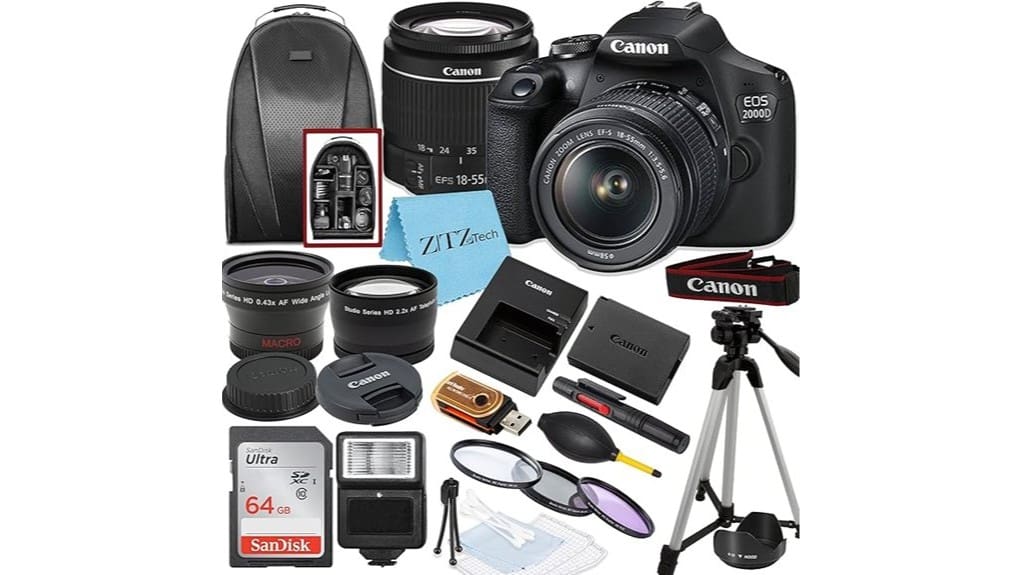
The Rebel T7 kit ships as a ready-to-shoot package, so you won’t need to buy basic accessories separately: it pairs the 24.1 MP EOS 2000D body with an EF‑S 18–55mm f/3.5–5.6 zoom, a genuine LP‑E10 battery and LC‑E10 charger, a 64 GB SanDisk Class 10 SD card, and essential extras like lens/body caps, neck strap and a carrying backpack. You’ll get complete kit contents—filters, tripod, flash, cleaning tools—so you can compare value against body-only purchases. As a renewed unit, it’s professionally inspected and includes 90-day warranty coverage under Amazon Renewed, which reduces risk versus private sales. This package is particularly useful for photographers who value having compatible camera body caps and accessories ready to use right away.
Key Specs That Affect Real-World Shooting (Sensor, AF, Lens, Video)
Because you’ll be using the 2000D for everything from travel shots to casual portraits, its 24.1 MP APS‑C sensor, 9‑point phase‑detect AF and bundled 18–55mm kit lens combine into a practical but limited toolkit you should understand before shooting. You’ll get good resolution and usable dynamic range for web and prints, but highlight recovery lags behind newer sensors. AF speed is adequate for static subjects; continuous tracking is basic. In low light noise rises quickly past ISO 1600. The kit lens delivers decent lens sharpness center‑frame but soft corners and limited reach. Video is capped at 1080/30p, straightforward but modest. This site also offers curated accessories for mirrorless and DSLR users like you, including essential gear to complement the 2000D.
How the 2000D Performs in Photos and Video : Real-World Tests
When you push the 2000D into real-world shooting it delivers reliable stills and straightforward video, but its limitations show up quickly under challenging conditions. You’ll get clean 24MP JPEGs and usable RAW at base ISOs, with autofocus that’s competent for portraits and daylight walking shots. In low light performance noise rises noticeably past ISO 1600, detail softens, and autofocus hunts compared with newer models. Skin tone rendering is pleasant and natural straight from camera, requiring minimal correction. Video is serviceable 1080/30p for casual clips but lacks stabilization and advanced AF tracking, so expect simpler results. For extended shooting sessions and high-capacity needs consider using large capacity memory cards to avoid frequent card changes and workflow interruptions.
Bundle Accessories, Battery Life, and Connectivity : Practical Value
Often you’ll find the 2000D’s bundled accessories and connectivity make it a practical starter kit for casual shooters, even if some items reflect its budget positioning. You get a full accessory set—battery, charger, 64GB SD, tripod, flash and cleaning kit—that beats bare-body purchases for out‑of‑box shooting, though accessory durability varies: tripod and flash are adequate but feel lightweight compared with prosumer gear. Battery life with the LP‑E10 is modest but typical for entry DSLRs; carry a spare for long shoots. Built‑in Wi‑Fi and NFC simplify transfers, but wireless reliability can be hit‑or‑miss compared with modern systems. Many buyers prefer to include a spare camera battery in bundles to ensure uninterrupted shooting during longer sessions.
Final Verdict: Who Should Buy the 2000D / Rebel T7 and Alternatives to Consider
Having covered the kit’s practical strengths and limits, let’s examine who will get the most from the 2000D / Rebel T7 and which alternatives might be better fits. You’ll appreciate this bundle if you’re a budget shooter prioritizing solid stills, reliable ergonomics, and bundled accessories; the 24.1MP sensor, EF-S 18‑55 kit, and optical viewfinder deliver straightforward results. If you crave faster autofocus, higher ISO performance, or video flexibility, consider newer APS-C mirrorless options or Canon’s own EOS M/ R line amid mirrorless migration. Also weigh used higher-tier DSLRs for more speed and advanced AF systems. Many DSLR buyers also look for essential accessories like tripods and bags to complete their kits.
Some Questions Answered
Can the 2000D Use Canon EF Glass Without Cropping Issues?
Yes — you can use Canon EF glass on the 2000D, but there’s an EF compatibility caveat: the camera’s APS-C sensor applies a 1.6× crop factor, so full-frame EF lenses will have a narrower effective field of view compared with full-frame bodies. You’ll keep full resolution and autofocus support where lenses allow, yet focal length behaves like a telephoto compared to FF. Comparatively, EF-S lenses avoid that crop penalty on this body.
Is the Camera Compatible With External Microphones for Better Audio?
No — you don’t get a dedicated external microphone jack, so external microphone use is limited. Compared to bodies with mic inputs, you’ll rely on wireless lavalier or shotgun compatibility via external audio adapters or recorders. That adds complexity but often improves quality because the camera’s internal preamp is basic. Objectively, using an adapter or separate recorder gives better control and cleaner sound than the built-in mic alone.
Does the Shutter Sound Vary Across Different Shooting Modes?
Yes — you’ll notice shutter sound differences across modes: mechanical variation is audible in standard mechanical shutter shooting and continuous drive, sounding firmer and quicker. In Live View and some silent-like modes the camera relies more on electronic simulation, producing quieter, flatter tones. Objectively, mechanical modes offer consistent tactile feedback and slight cadence changes with burst rate; electronic simulation reduces noise but may alter perceived timing and shutter character.
Can the 2000D Be Used for Timelapse Without Additional Accessories?
Yes—you can create basic timelapses without extra gear, but with limits. The 2000D lacks a dedicated intervalometer menu, so you’ll rely on third‑party remotes or the app for intervalometer functionality; in‑camera stacking isn’t available for long intervals or exposures. Compared to newer models, you’ll get straightforward frame capture (1080p/30p) and decent results, but you’ll miss built‑in interval features and advanced in‑camera stacking conveniences.
Is Focus Peaking or Histogram Available During Live View Shooting?
No — you won’t get focus peaking, and live histogram support is limited. The camera’s Live View lacks focus peaking overlays, so manual focusing relies on magnified view and the 9-point AF system; that’s less precise than modern mirrorless hybrids. You do get a basic live histogram option in Live View for exposure checking, but it’s rudimentary compared with real-time waveform or advanced histograms on newer models.