You’ll get an inexpensive, entry‑level DSLR that teaches manual exposure but trades speed, low‑light performance, and futureproofing for a low price. Its 18MP APS‑C sensor and DIGIC 4+ deliver sharp JPEGs at base ISO and usable 12‑bit RAW, but noise spikes after ISO 800 and dynamic range is modest. Autofocus is a basic 9‑point system, continuous shooting tops out at 3 fps, and video is 1080p/30 with slow Live View AF. Keep reading for full specifics and practical advice.
Some Key Takeaways
- Entry-level DSLR offering manual controls, ideal for beginners learning exposure and casual travel photography.
- 18 MP APS-C sensor with DIGIC 4+ yields sharp JPEGs at low ISO but limited dynamic range and shadow recovery.
- Noise rises noticeably past ISO 800, with visible chroma/luminance artifacts at ISO 1600–3200.
- Bundled EF‑S 18–55mm kit lens covers basics but shows softness and vignetting wide open; upgrade primes recommended.
- Video limited to 1080p30, slow Live View AF, no external mic jack, and modest battery life—best for entry-level use only.
Canon EOS 4000D / Rebel T100 at a Glance: Who This Camera Is For
Although it’s an entry-level DSLR, the Canon EOS 4000D (Rebel T100) targets beginners and budget-conscious shooters who want a capable stills camera with manual controls. You’ll get basic ergonomics, EF‑S lens compatibility, and manual exposure for learning core techniques, but limited AF points, 3 fps burst, and modest LCD resolution constrain advanced use. For beginner workflows and travel photography it’s affordable and lightweight in kit form, yet you’ll trade low‑light performance and dynamic range for cost. Choose it if you prioritize hands-on exposure learning and low price; skip it if you need speed, high ISO fidelity, or futureproofing. Accessories like tripods and spare batteries are essential for many DSLR enthusiasts, especially when using EF‑S lenses on entry-level bodies.
Sensor, Processor, and Image Quality: What 18 MP APS‑C and DIGIC 4+ Deliver
With an 18 MP APS‑C CMOS sensor paired to Canon’s DIGIC 4+ processor, the 4000D delivers competent stills for everyday shooting but shows clear limits under challenge. You’ll get sharp JPEGs at base ISO with decent color and usable 12‑bit RAW, yet dynamic range is modest compared with newer sensors, clipping highlights sooner and offering limited shadow recovery. Noise performance degrades noticeably past ISO 800, with chroma and luminance artifacts rising by ISO 1600–3200 and fine detail softening. For casual users it’s acceptable; for critical shooters or heavy post‑processing, the sensor/processor combo feels dated and constraining. It’s a good entry-level option for those building a kit around mirrorless camera accessories and learning the basics.
Lenses, Autofocus, and Shooting Performance: Real‑World Results at 3 Fps and 9‑Point AF
If you plan to shoot everyday scenes or learn composition, the bundled EF‑S 18–55mm covers the basics but limits optical performance: its 3x zoom and seven‑blade, plastic build deliver acceptable sharpness at center focal lengths but show softness and vignetting toward the edges, especially wide open. You’ll find lens sharpness adequate for web and small prints but not for critical crops. The 9‑point AF is predictable; single‑point hits are reliable, but focus tracking is rudimentary and loses fast subjects. Continuous shooting at 3 fps is modest; buffer depth and DIGIC 4+ write speed constrain burst length. Low‑light sensitivity is limited. Essential lens gear for enthusiasts includes versatile, higher‑quality primes and zooms to improve sharpness and low‑light performance, like EF‑S lenses.
Video, Live View, and Vlogging Usability: 1080p Capture, Screen, and Audio Notes
Generally, the 4000D handles video and Live View straightforwardly but with clear compromises: it records up to 1080p at 30 fps with acceptable detail for YouTube and casual vlogs, yet the aging DIGIC 4+ and sensor design limit dynamic range and low‑light performance. You’ll get usable footage in good light, but highlight recovery and shadow detail are weak. The fixed 2.7-inch screen isn’t a flip screen, so framing vlogs is awkward unless you mount a monitor. The camera lacks a dedicated external microphone jack, forcing you to rely on onboard audio or record separately. Autofocus during Live View is slow and hunt-prone. Consider using wireless camera remotes to improve framing and start/stop control when vlogging with this model.
Handling, Controls, and Battery Life: Ergonomics, Viewfinder, and Daily Use Tips
After testing video and Live View, you’ll notice the 4000D’s handling and controls keep the camera usable for shoots but expose its budget roots. You get modest grip comfort with a shallow front hold that forces careful thumb placement on the rear ridge. Controls are limited; buttons feel plasticky and require deliberate presses. The optical viewfinder is serviceable but low magnification and narrow coverage make critical framing harder. Menu layout is straightforward but dated—expect shallow customization. Battery management matters: the small battery (≈21 g) yields modest runtime, so carry spares and disable Wi‑Fi when idle to avoid mid‑shoot drains. For longer days in the field consider carrying spare camera batteries to avoid missing shots.
What’s in the Box and Value of the Renewed Kit: Lenses, 64 GB Card, Accessories, and Warranty
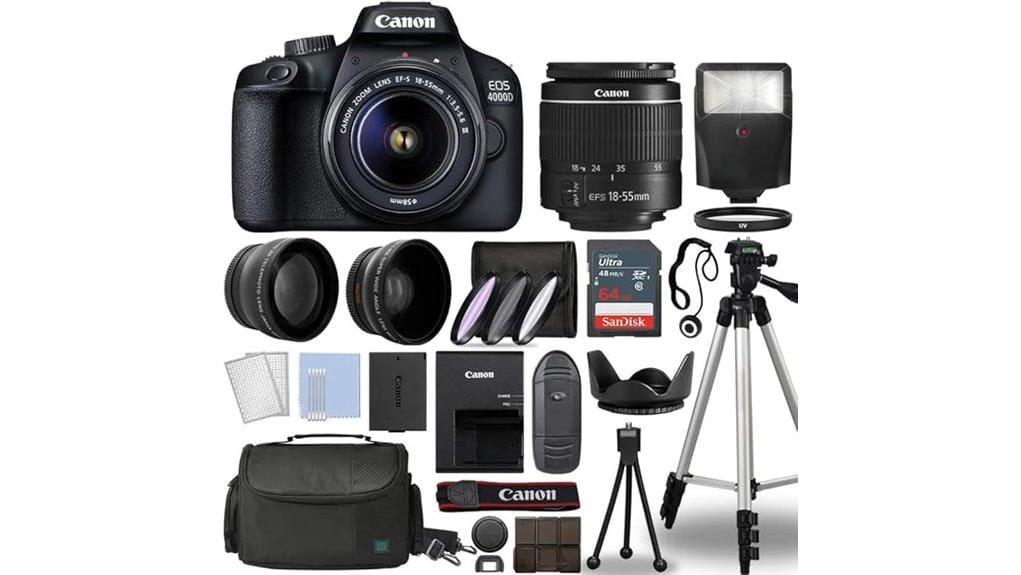
Unpack the renewed Canon EOS 4000D kit and you’ll find a surprisingly all‑inclusive starter setup: the camera body, an EF‑S 18–55mm f/3.5‑5.6 zoom, an extra wide‑angle and telephoto lens, a 64 GB SD card, case, filter kit, external flash, tripod, lens cap, instruction manual and several additional accessories. You’ll appreciate the outright value: optics cover basic focal needs, storage is generous, and accessories let you shoot immediately. Critically, lens quality is entry‑level plastic with limited sharpness and mount longevity. Compare this bundle comparison to buying components separately; factor in warranty implications — a 90‑day renewed guarantee limits long‑term security. Choosing the right memory card is important for photographers who need reliability and capacity, especially when working with high-resolution images and burst shooting, so consider large capacity memory cards that match your shooting needs.
Pros, Cons, and Who Should Buy the 4000D / Rebel T100 Now
You’ll get good immediate value from the renewed bundle, but deciding whether to buy depends on clear trade-offs between capability and age. You’ll benefit from an 18MP APS‑C sensor, EF‑S kit lens, Full HD video and Wi‑Fi for vlogging, plus a complete accessory set that lowers entry cost. Downsides: slow DIGIC 4+, 3 fps burst, basic 9‑point AF, tiny 2.7″ screen and limited ergonomics. Use battery hacks sparingly; battery life and support are modest. Buy if you need a cheap starter DSLR or spare body; avoid if you demand speed, modern AF, or strong resale value. The site focuses on selling digital camera products and accessories tailored for enthusiast photographers and camera fans.
Some Questions Answered
Can I Use EF Lenses Wider Than 55MM With This Camera?
Yes — you can use EF lenses wider than 55mm on that camera; it’s EF-S mount compatible and accepts full-frame EF lenses. You’ll need to mind lens compatibility, flange distance, and potential field curvature or vignetting from lenses designed for larger sensors. Some full-frame optics may vignette or show edge field curvature on the APS-C sensor; adapters aren’t needed, but test each lens and stop down to reduce vignetting and improve edge sharpness.
Does the Wi‑Fi Support In-Camera Remote Shutter and File Transfer Apps?
Yes — the Wi‑Fi lets you do basic remote shooting and file transfer, but it’s limited. You’ll get wireless tethering and remote shooting via Canon’s app after app pairing, though controls are basic and transfer speeds are slow. Check firmware compatibility before relying on features; some functions require updated firmware. Expect modest responsiveness, restricted autofocus control, and JPEG-first transfers unless you use wired or alternative tethering solutions.
How Long Does the 90‑Day Renewed Warranty Process Take for Replacements?
You’ll typically see warranty timelines start with a 1–3 business‑day response, then 7–14 business‑day replacement logistics for inspection, authorization and shipping; total turnaround usually runs 10–21 business days. You’ll need to provide proof of purchase and serial info immediately, pack and ship per instructions, and track status via the Renewed Guarantee portal. Delays can occur for parts, diagnostics or high volume, so expect occasional extensions.
Can the Camera Record External Microphone Audio via the Kit Flash or Accessories?
No — you can’t record external mic audio through the kit flash or accessories alone. The camera lacks a dedicated 3.5mm external mic input, so the built‑in mic or a separate recorder are required. You could use a hot shoe adapter that provides a microphone jack, but it must route audio independently (and power). Test compatibility and sync; many cheap adapters only trigger flash or pass TTL, not cleanly record external mic signals.
Is the 64 GB SD Card Included Uhs‑I or a Slower Speed Class?
No — the listing doesn’t specify UHS‑I compatibility, so you shouldn’t assume it’s a UHS‑I card. You’ll need to verify Card speedclass details; the bundled 64 GB SD is likely a basic Class 10 or lower‑spec card for general use. That can handle JPEG and 1080p30 but may limit buffer clears and write stability for RAW or continuous shooting. Replace it with a verified UHS‑I card if you need faster sustained writes.