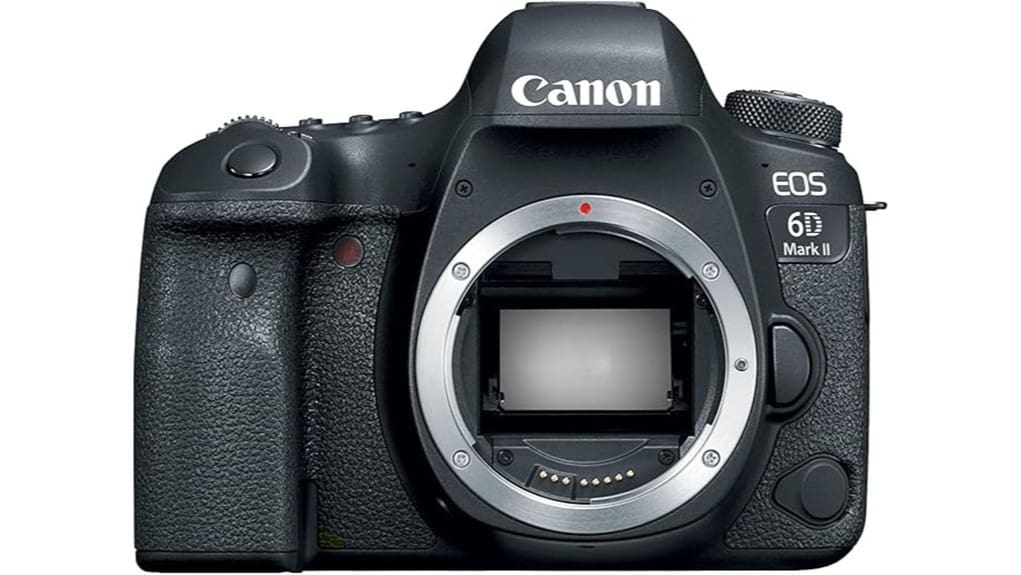
You’ll find the Canon EOS 6D Mark II a pragmatic full‑frame DSLR that delivers clean 26.2MP files with DIGIC 7 processing and usable high‑ISO performance. Dual Pixel CMOS AF gives reliable Live View and smooth Full HD 60p video, while the 45‑point viewfinder array handles most stills work. The body is compact, the vari‑angle touchscreen speeds operation, and EF‑lens compatibility keeps options broad. It isn’t a flagship for tracking or 4K video, and more detail follows below.
Some Key Takeaways
- 26.2MP full-frame sensor with DIGIC 7 delivers clean detail and usable high-ISO performance for most shooting conditions.
- Dual Pixel CMOS AF and 45-point cross-type AF provide reliable, fast focusing in Live View, portraits, and Full HD video up to 60p.
- Vari-angle touchscreen, solid ergonomics, and broad EF-lens compatibility make it versatile for travel and portrait work.
- Video is limited to 1080p/60 with basic bitrate/options, so not ideal for 4K or advanced videography needs.
- Good value for serious hobbyists and travel photographers; consider certified used bodies to reduce cost and check shutter count.
Quick Verdict: Is the Canon EOS 6D Mark II Worth Buying?
Although it’s not a flagship, the Canon EOS 6D Mark II delivers a compelling balance of image quality, autofocus capability, and connectivity that makes it a strong choice for enthusiast full-frame shooters. You’ll appreciate its 26.2MP sensor and DIGIC 7 processing for clean detail and usable high ISO. The Dual Pixel AF and 45-point cross-type array give reliable subject acquisition, though not class-leading burst speed. The vari-angle touch LCD and intuitive user interface speed operation. Battery life is moderate with LP‑E6 series cells, so plan spares for extended shoots. Overall, it’s a pragmatic, well-rounded option for serious hobbyists. Don’t forget to outfit your kit with essential accessories like mirrorless camera gear to get the most from your shooting sessions.
What the 6D Mark II Does Best: Core Features and Real-World Performance
Having established its strengths as a balanced, practical full‑frame option, let’s look at what the 6D Mark II does best in everyday use: reliable image quality, fast and forgiving AF in live view and video, and broad lens compatibility for creative work. You get a 26.2MP sensor with DIGIC 7 delivering clean files and usable dynamic range, especially when pushing exposure in Low light performance. Dual Pixel CMOS AF makes focusing smooth for stills and 60p Full HD clips. Compatibility with Canon EF glass lets you adapt focal priorities. Battery longevity with LP‑E6 series cells supports extended shoots without frequent swaps. Consider pairing the camera with an external monitor to improve composition and focus confirmation with external camera monitors.
Where the 6D Mark II Falls Short: Autofocus, Video and Lens Limitations
While the 6D Mark II delivers solid stills and approachable handling, it reveals clear limitations in autofocus, video capabilities, and lens options that affect advanced shooters. You’ll notice autofocus reliability varies: Dual Pixel CMOS AF is great in Live View but the 45-point phase-detect AF and viewfinder system lags in tracking fast subjects and low light. Video limitations are evident — Full HD up to 60p, no 4K, limited bitrate controls and rudimentary autofocus during recording. Lens-wise, compatibility with only EF optics excludes compact EF-M glass and forces reliance on existing EF glass, restricting portability and specialized options. Our Gear Guide covers related accessories and lenses to help photographers make the most of their Canon gear, including recommendations for digital cameras and compatible lenses.
Who Should Buy It and Which Photographers Benefit Most
If you need a full-frame DSLR that balances image quality, ergonomics, and connectivity without breaking the bank, the 6D Mark II is worth considering. You’ll appreciate the 26.2MP sensor, DIGIC 7 processing and Dual Pixel AF for reliable stills and brisk live‑view focusing. Travel photographers benefit from its compact full‑frame body, vari‑angle touchscreen and integrated GPS/Wi‑Fi/Bluetooth for location tagging and quick sharing. Portrait shooters will value tonal rendition, dynamic range and compatibility with Canon EF portrait lenses. If you prioritize low weight, robust video specs, or cutting‑edge AF tracking, you might look elsewhere. This is a pragmatic tool for image-focused users. Consider pairing it with a camera backpack designed for photographers to keep your gear protected and ready for any shoot.
How It Compares to Alternatives and What to Pay (Models, Lenses, and Price Tips)
Although Canon’s 6D Mark II doesn’t push the envelope on resolution or AF sophistication, it offers a pragmatic balance of full‑frame image quality, ergonomics, and connectivity at a price point that undercuts many higher‑end bodies. You’ll find it compares favorably to entry full‑frame rivals for portraits and travel; sports shooters will want faster AF. Buy a lightly used copy or certified used copies to save; expect EF 24‑70 and 50mm primes to pair well. Consider third party glass to reduce cost, but vet AF performance. Factor body condition, shutter count, and bundled lenses when setting your offer. Pelican cases are a popular choice for photographers who need durable, protective equipment storage when transporting gear.
Some Questions Answered
Does the 6D Mark II Have In-Body Image Stabilization?
No, it doesn’t: you won’t find in body stabilization in the 6D Mark II. You rely on lens-based stabilization or faster shutter speeds because the sensor lacks built-in motion compensation. That means the camera doesn’t counteract sensor vibration internally, so stabilization depends on IS-equipped EF lenses or external support. You’ll still get good low-light performance from the 26.2MP sensor and Dual Pixel AF, but for shake reduction you need stabilized glass or a tripod.
Can I Use LP-E6 Batteries From Older Canon Models?
Yes — you can use LP‑E6 and LP‑E6N batteries from older Canon models; they offer proper battery compatibility and fit the 6D Mark II. You should prefer genuine LP‑E6N for best performance and full charge reporting. Third party batteries can work and may save money, but verify capacity, voltage, and firmware compatibility, and buy from reputable makers to avoid reliability, overheating, or inaccurate charge indicators that could disrupt shoots.
Is There a Silent Electronic Shutter Option?
No — the camera doesn’t offer an electronic shutter; it uses a mechanical focal-plane shutter, so you’ll still get shutter noise. You can enable silent mode to reduce operational sounds from menus and some controls, but image capture relies on the mechanical shutter, so rolling shutter effects aren’t avoided as they would be with a true electronic shutter. For truly silent captures and minimal rolling shutter, you’ll need a model with a full electronic shutter.
What Weather-Sealing Level Does the Body Offer?
The body offers modest weather-sealing: it’s not fully waterproof but it uses gasket protection around doors and joints to provide moisture resistance for typical outdoor use. You’ll get protection against light rain, dust and splashes, but you shouldn’t expose the camera to heavy downpours, submersion or prolonged harsh conditions. For professional wet-weather work, you’ll want additional protection like a rain cover or sealed housing to guarantee reliability.
Does It Support Tethered Shooting Over USB?
Yes — you can tether over USB, though Canon’s support is limited compared with some pro models. USB tethering works for image transfer and remote control using Canon EOS Utility; connection is stable for studio use but can be slower than Ethernet. You can also use Wireless tethering via Wi‑Fi, NFC or Bluetooth for untethered control and file transfer, but expect reduced speed, occasional drops, and more latency versus wired USB tethering.