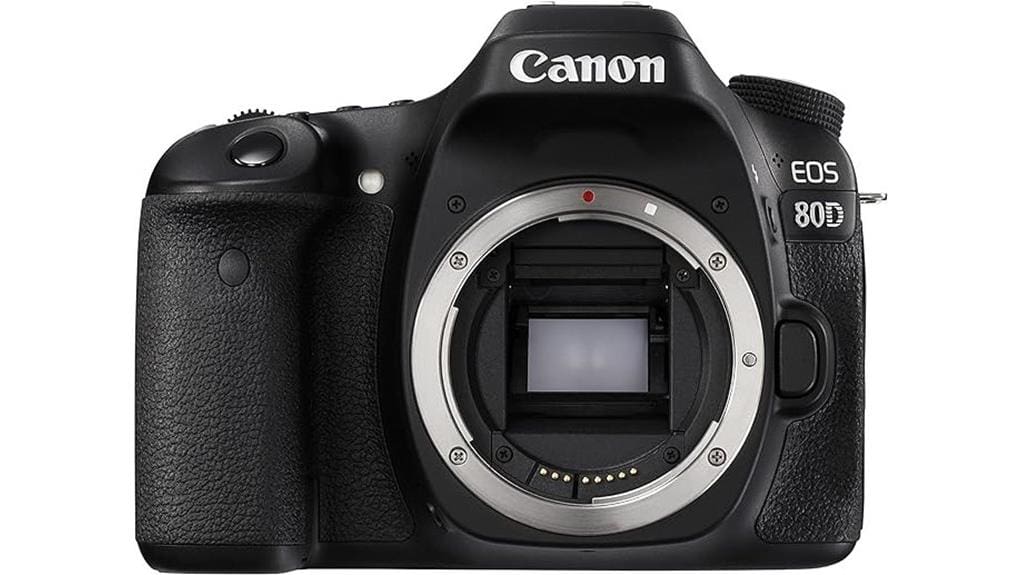

You’ll get a rugged APS‑C DSLR that still delivers 24.2MP image quality, reliable tonal range, and a 45‑point all cross‑type AF system with Dual Pixel CMOS AF for smooth Live View and video focusing. It shoots 7 fps bursts, offers solid battery life, and supports Wi‑Fi/HDMI/USB workflows. Renewed units trade lower price for variable cosmetic/ shutter condition and seller warranties, so inspect firmware and AF function — continue for details on use cases and alternatives.
Some Key Takeaways
- Renewed Canon EOS 80D offers 24.2MP APS‑C image quality with good tonal range and usable high‑ISO performance.
- Reliable 45‑point all cross‑type AF plus Dual Pixel CMOS AF ensures fast, accurate stills and smooth Live View/video focusing.
- 7 fps continuous shooting and responsive AF‑C subject tracking suit moderate action and portrait sequences.
- Durable DSLR ergonomics, clear optical viewfinder, solid battery life, and connectivity (Wi‑Fi/HDMI/USB) support real‑world workflows.
- Renewed units deliver value but check cosmetic grade, shutter count, firmware, Dual Pixel function, and warranty before purchase.
Why the Canon EOS 80D (Renewed) Still Matters in 2026
Although mirrorless systems have surged, the Canon EOS 80D (Renewed) still matters in 2026 because it delivers a robust combination of APS-C 24.2 MP image quality, a 45-point all cross-type phase-detection AF system, and dependable ergonomics at a lower cost. You’ll find its legacy ergonomics retain tactile controls, substantial grip, and a clear optical viewfinder that speed operator workflows in varied shoots. Technically, the 80D balances sensor resolution, Dual Pixel AF for live view/video, and durable build against contemporary needs, offering measurable budget compatibility without sacrificing core performance metrics useful for enthusiasts and pros prioritizing cost-effective reliability. It also pairs well with a wide range of mirrorless-adjacent accessories commonly sought by mirrorless camera enthusiasts.
What the EOS 80D Delivers: Key Specs and Real‑World Performance
When you put the Canon EOS 80D to work, it delivers a concise blend of measurable specs and practical performance: the 24.2MP APS‑C sensor yields high‑resolution stills with good detail and tonal range, the 45‑point all cross‑type phase‑detect AF plus Dual Pixel CMOS AF provides fast, reliable subject acquisition in both viewfinder and live‑view/video modes, and a 7 fps burst rate supports moderate action shooting. You’ll find solid connectivity (Wi‑Fi, HDMI, USB), versatile exposure control, and Full HD video. Ergonomics grip is well balanced for extended use, and battery life meets typical shooting days without frequent swaps. It also pairs well with a wide range of DSLR accessories available for enthusiasts.
Autofocus, Speed, and Image Quality: How the 80D Performs for Photos and Video
Building on its balanced ergonomics and reliable connectivity, the 80D pairs a 45-point all cross-type phase-detection AF with Canon’s Dual Pixel CMOS AF to deliver fast, accurate focusing for both stills and video. You’ll get responsive AF performance for single-shot and AF-C sequences, supporting up to 7 fps with consistent subject tracking. Dual Pixel provides smooth, low-hunt continuous AF in Live View and movie modes, improving framing workflow. Image quality from the 24.2MP APS-C sensor shows good detail and tonality to ISO 1600, with usable Low light performance to higher ISO when noise reduction is applied. For those using external displays to better judge focus and composition, an external camera monitor can streamline critical focusing and framing with Live View feeds from the 80D external camera monitors.
Renewed Unit Considerations: Warranty, Condition, and Value vs. New
Because a renewed EOS 80D is sold after inspection and repair, you should treat its purchase as a value-driven tradeoff between lower cost and potentially limited support compared with a new unit. You’ll evaluate warranty transferability carefully: many renewed listings include a 90-day limited warranty tied to the original seller, not Canon, which affects resale and repairs. Inspect cosmetic grading, serial matching, shutter count, and accessory completeness to quantify condition. Factor firmware state, sensor cleanliness, and verified AF/dual-pixel function into expected lifespan. Compare total cost including potential repair risk against buying new with full manufacturer coverage. Consider how protective storage and transport in Pelican cases can preserve condition and reduce damage risk during resale.
Who Should Buy the EOS 80D (Renewed)? : Use Cases and Alternatives
If you need a versatile APS-C DSLR that balances strong autofocus performance, solid ergonomics, and 24MP image quality at a reduced price, the renewed EOS 80D is a pragmatic choice. You’ll benefit if you prioritize budget portraiture with interchangeable EF lenses, reliable 45-point AF, and good low‑light ISO flexibility. It’s also suited for travel photography where battery life, robust viewfinder, and weather-resilient handling matter more than mirrorless size. Alternatives include used Canon EOS M6 Mark II for compactness or newer APS-C mirrorless bodies for faster AF and EVF. Choose the 80D when tactile controls and cost-efficiency dominate requirements. The site also offers a wide selection of digital camera accessories and related products for enthusiasts.
Some Questions Answered
Does the 80D Support External Microphones for Video Recording?
Yes — you can attach an external mic to the 80D for video. You’ll use the dedicated 3.5mm external mic input to capture higher-quality audio than the built‑in microphone. You’ll still monitor and adjust audio levels via the camera’s menu and on-screen meters, though there’s no headphone jack for real‑time monitoring. This setup improves signal-to-noise and directional pickup, but you’ll need external monitoring solutions for precise level control during shoots.
Can I Use Canon EF-S Lenses on the EOS 80D?
Yes — you can use EF-S lenses on the EOS 80D. The camera natively supports Canon EF-S compatibility for APS-C lenses via its EF mount, so autofocus and metering work normally without a mount adapter. If you need to fit non-native formats or rare third‑party optics, you’d use a mount adapter, which may limit AF performance or metadata. Evaluate lens communication and crop factor when planning focal length and image circle coverage.
Is the Battery Compatible With Newer Canon DSLR Batteries?
Yes — the battery compatibility is limited: the 80D uses the LP-E6N/LP-E6 series, which is compatible with many newer Canon DSLRs that accept LP-E6-type packs. You’ll need to confirm specific model support since some recent bodies shifted to LP-E6NH or different chemistries. Charging options include Canon’s dedicated external chargers and in-camera USB charging only with approved batteries; third-party chargers work but verify voltage and charge protection for safety.
Does the Camera Have Built-In GPS or Require External Tagging?
No built in GPS; external required for geotagging. You’ll attach a GPS receiver or use a smartphone app via Wi‑Fi/NFC to record coordinates, then sync or embed location data. Expect GPS accuracy to depend on the external unit and satellite reception (typically a few meters under clear sky). Consider location privacy: you should manage metadata embedding and delete or disable geotags if you don’t want images to reveal shooting coordinates.
Can I Tether the 80D to a Laptop for Studio Shoots?
Yes — you can tether the 80D to a laptop for studio shoots. You’ll use Canon’s EOS Utility or third‑party tethering software (Capture One, Lightroom) over USB; some laptops may need usb adapters (USB‑C to USB‑A) to connect. Expect live view, remote capture, and file transfer, with Dual Pixel AF for video/live focusing. Performance depends on cable quality, adapter bandwidth, and tethering software settings for capture, transfer, and camera control.