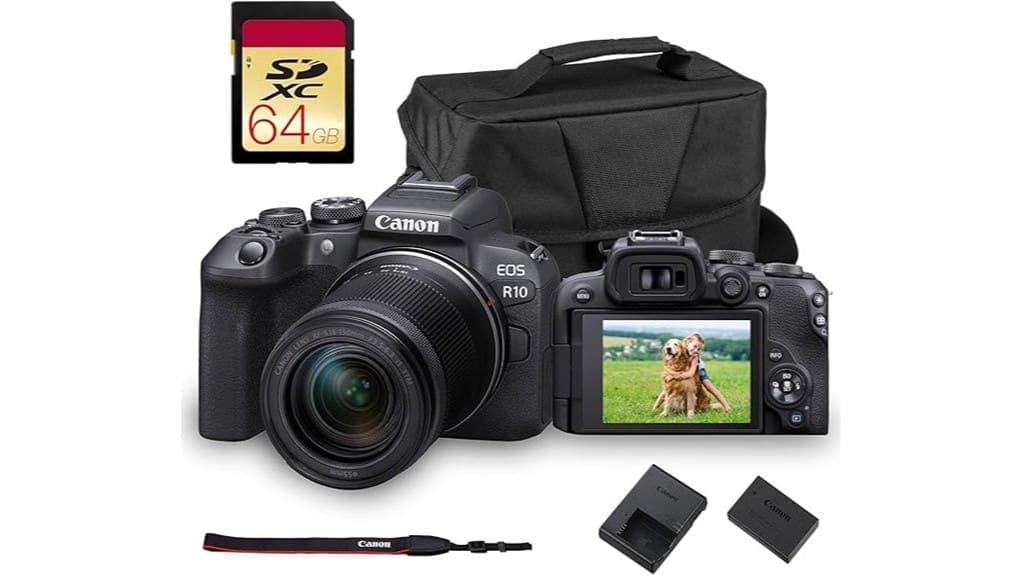

You’ll get a fast, lightweight APS‑C mirrorless that balances image quality, speed, and portability. Its 24.2MP sensor and 6K‑to‑4K oversampling give sharper 4K60 video and cleaner stills with natural skin tones. Burst rates reach 15 fps mechanical or 23 fps electronic, while Dual Pixel CMOS AF II locks and tracks reliably for sports and wildlife. The RF‑S 18‑150mm kit lens is versatile for travel, though battery life is modest — keep a spare to cover longer shoots, and more specifics follow.
Some Key Takeaways
- Fast, compact APS-C mirrorless with mechanical 15 fps and electronic 23 fps bursts for action and sports photography.
- 24.2MP sensor with 6K-to-4K oversampling delivers sharp 4K60 video and improved still microdetail.
- Dual Pixel CMOS AF II provides reliable subject locking, low-latency tracking, and strong burst autofocus performance.
- RF-S 18‑150mm kit lens offers versatile travel-ready reach with competent stabilization and sharpness.
- Good value package (body, 18‑150mm, 64GB card, bag) for users wanting speed, autofocus, and lightweight portability.
Real-World Summary: Who Should Buy the Canon EOS R10 and Why
If you want a fast, versatile mirrorless that balances image quality, speed, and portability, the Canon EOS R10 is a strong choice. You’ll get rapid burst rates and reliable Dual Pixel AF II for action, plus the RF-S 18-150mm covers most travel and everyday needs. Its compact body aids handheld shooting, and beginner ergonomics make controls approachable without dumbing down options. Battery life is modest for extended shoots, so plan spares for events or wildlife days. Overall, you’ll appreciate its blend of performance and portability if you prioritize speed, autofocus, and a lightweight system. It’s also well matched to users who want essential accessories for mirrorless systems, like compact bags and spare batteries.
Imaging and Video Quality: 24.2MP Sensor, 4K60, and Oversampled 6K Benefits
Because Canon pairs a 24.2MP APS-C sensor with oversampled 6K-to-4K processing, you get sharper 4K60 footage and cleaner stills than typical native 4K implementations. You’ll notice improved microdetail and fewer interpolation artifacts, aiding post-crop flexibility. Color science delivers natural skin tones and consistent hues straight from camera, reducing grading time. Dynamic range is respectable for the class, preserving midtones and highlight rolloff better than many competitors, though shadows clip sooner at high ISOs. Low light performance is solid with manageable noise up to moderate ISO. Rolling shutter is present in electronic reads but remains controlled for most handheld work. Consider adding a field monitor to your setup for more accurate framing and exposure reading field monitors.
Speed and Autofocus in Action: 15 Fps / 23 Fps Shooting and Dual Pixel CMOS AF II
Push the R10 into a fast-action scenario and its speed and AF system stay composed: the camera can shoot mechanical bursts up to 15 fps and electronic bursts up to 23 fps while Canon’s Dual Pixel CMOS AF II maintains precise subject locking and tracking throughout sequences. You’ll exploit high speed tracking for sports or wildlife, relying on burst precision autofocus to pick the critical frame. The electronic shutter enables silent, blur-minimized capture at 23 fps, while subject prediction algorithms anticipate movement between frames. Latency is low, buffer handling solid, and AF recovery during long runs remains consistently accurate and usable in real shoots. This makes the R10 a strong choice for enthusiast photographers seeking versatile, camera-focused accessories and gear.
Kit Lens, Handling, and Travel Usability: RF‑S 18‑150mm, Size, Battery, and Connectivity
Speed and reliable AF help you capture the decisive moment, but handling and optics determine how often you’ll be ready to shoot while on the move. The RF‑S 18‑150mm delivers lens versatility: wide-to-tele reach with competent sharpness and stabilisation, so you carry fewer optics. The body’s compact travel ergonomics balance grip and weight, letting you shoot longer without fatigue. Battery life is modest for extended trips, so plan spares or power banks for multi-day use. Wireless connectivity (Wi‑Fi, Bluetooth) is dependable for instant transfers and remote control, improving workflow without adding bulk to your kit. For extended outings, consider using external portable power banks to keep shooting without interruption.
Value and Verdict: Package Contents, Price Positioning, and Final Buying Recommendation
While the R10 kit bundles a lot for its price—body, RF‑S 18‑150mm, 64GB card and shoulder bag—it’s the combination of versatile optics, fast AF, and 4K60p video that defines its value proposition. You get a travel-ready package authorized by Canon USA that covers most shooting scenarios without immediate lens purchases. Accessory compatibility is strong across RF and RF‑S ecosystems, and connectivity simplifies workflows. Price positioning undercuts many full‑frame rivals while delivering high-speed performance and oversampled 4K detail. If you want a capable, compact APS‑C system with solid resale value, the R10 is a sensible, future‑proof buy. The kit also makes it easy to get started with essential DSLR gear for enthusiasts who shop for camera systems and accessories.
Some Questions Answered
Does the R10 Have In-Body Image Stabilization (IBIS)?
No IBIS — the R10 relies on stabilized lenses rather than sensor shift or mechanical stabilization in the body. You’ll get stabilization only if you pair it with RF-S or RF lenses that have optical stabilization. That means you should choose a lens with good IS for handheld low-light, telephoto, or video work. The camera’s fast autofocus and oversampled 4K help, but in-body stabilization isn’t available, so plan lens choices accordingly.
Can It Use Full-Frame RF Lenses Without Crop?
No — you’ll get a crop when using full frame RF lenses on the R10. The R10 uses an APS-C sensor, so full frame optics via RF mount will project a larger image circle than the sensor captures. Lens compatibility is excellent via native RF mount; you can use full frame lenses directly or with adapter use for other mounts, but expect a 1.6x crop factor, altered field of view and focal length equivalence.
What Is the Battery Life in Actual Shooting Hours?
You’ll typically get about 1.5–2.5 hours of continuous shooting video or roughly 300–400 stills per battery, so battery longevity in real world runtime is moderate. In practice you’ll see shorter runtimes at 4K60 or with frequent flash, Wi‑Fi/Bluetooth, and high-speed bursts; shooting stills conservatively extends runtime. Carry spare batteries for long sessions—two extras will cover most day trips and heavy action shooting.
Is There Headphone Output for Audio Monitoring?
No — you don’t get a headphone output for real‑time audio monitoring. You can use an external microphone via the 3.5mm mic jack, and you’ll need audio adapters or a field recorder with headphones if you want proper monitoring. This limits on‑camera verification during shoots; plan to monitor levels externally or use pre/post checks. For professional workflows, rely on dedicated audio adapters or recorders to guarantee accurate sound capture.
Does It Support UHS-II Cards for Faster Write Speeds?
No — the camera isn’t UHS II compatible; it accepts UHS-I cards only. You’ll see UHS II compatibility referenced elsewhere, but the R10’s card slot doesn’t exploit the higher UHS II bus, so you won’t get the faster sustained write performance those cards can deliver. For peak write performance and reliable buffer clearing during 4K60p and high-speed bursts, use a high-quality UHS-I V60/V90-rated card matched to your workflow.