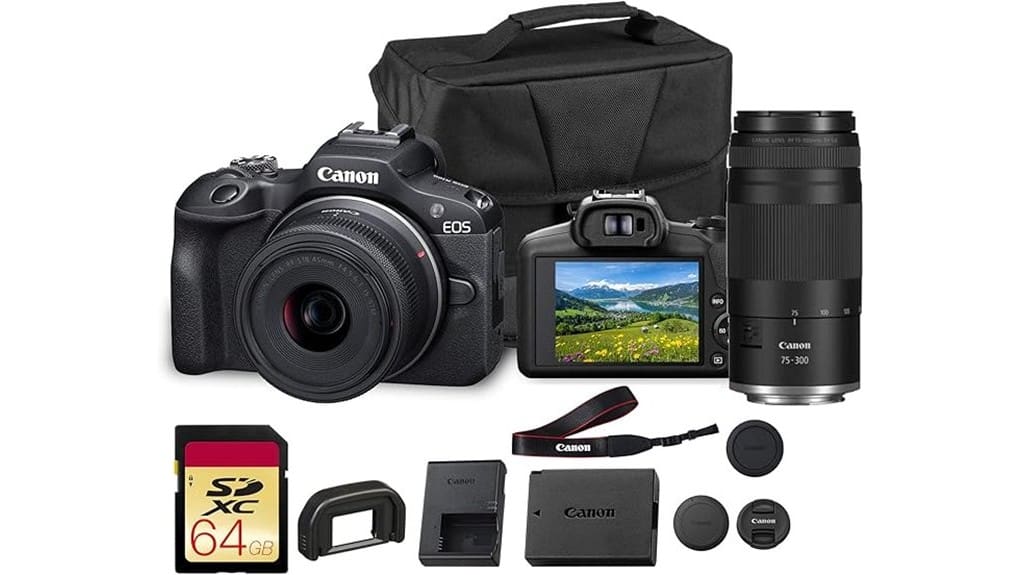
The Canon EOS R100 Double Lens Kit gives you a compact 24MP mirrorless system with versatile 18–45mm and 75–300mm lenses, ideal for beginners, travelers, and casual wildlife shooters. Autofocus is reliable with Dual Pixel AF and eye detection, though slow lens apertures limit shallow depth of field and low‑light speed compared with pricier bodies. You’ll get usable 4K video but modest bitrates and a low‑res fixed LCD. Keep batteries and a fast SD card handy, and continue for detailed pros, cons, and alternatives.
Some Key Takeaways
- Compact, lightweight mirrorless kit with RF‑S 18‑45mm and 75‑300mm lenses ideal for beginners and travel.
- 24MP DIGIC 8 sensor delivers clean mid‑ISO images, usable up to ISO 1600–3200 before strong noise reduction.
- Dual Pixel CMOS AF with 121 points and reliable eye detection handles portraits and casual tracking well.
- 4K MP4 video is serviceable but limited by rolling shutter, low bitrate, and a low‑resolution fixed LCD.
- Good starter value for versatility; bring spare LP‑E17 batteries, a fast SD card, and protective case for travel.
Canon EOS R100 Kit at a Glance: What’s Included and Who It’s For
What comes in the Canon EOS R100 Double Lens Kit and who should pick it? You get the EOS R100 body, RF-S 18-45mm f/4.5-6.3 IS STM, RF 75-300mm f/4-5.6, LP-E17 battery, LC-E17 charger, strap, caps, camera cover, 64 GB card and basic cables. It’s compact, lightweight, and aimed at beginners, travelers, vloggers and casual wildlife shooters. You’ll follow beginner tutorials quickly thanks to intuitive controls and automatic modes. Compare this kit to single-lens bundles: versatility vs. weight. For accessory recommendations, add extra batteries, a fast SD card, and a padded travel case. It’s a great match for mirrorless camera enthusiasts looking for a compact system with interchangeable lenses and essential gear.
Image Quality and Autofocus Performance: Photos and Low‑Light Results
Having covered kit contents and who it suits, let’s examine how the R100 actually performs on image quality and autofocus, especially under low light. You’ll get 24MP detail with the DIGIC 8 delivering clean mid‑ISO files; high ISO handling is competent to ISO 1600–3200 with noise reduction kicking in beyond. Dual Pixel CMOS AF provides quick, reliable autofocus tracking across 121 points; eye detection works well for portraits. Lens limits (narrow apertures) constrain shallow depth of field and low‑light speed compared with faster kit competitors. Overall, the system balances beginner usability with respectable stills and AF performance. Consider pairing the camera with color calibration gear to ensure accurate hues and consistent results across devices.
Video, Screen, and Connectivity Tested: 4K, LCD, HDMI, and Wi‑Fi Workflows
Test 4K clips reveal the R100 can record usable 2160p footage for casual creators, but you’ll notice limits compared with higher-end bodies: footage is captured to MP4 with the DIGIC 8 handling basic compression well, yet rolling shutter and bitrate constraints reduce dynamic range and fine detail in complex scenes. You’ll rely on the fixed 3.0-inch LCD for framing and review; its low resolution constrains focus-critical checks. HDMI output supports external monitoring but not high bitrate recording. 4K workflows are consequently modest — internal capture, external monitor for framing. Wireless tethering works for image transfer and remote control, practical for quick social uploads. For many users, adding an external monitor can significantly improve framing and focus accuracy when shooting video with the R100, especially for external camera monitors.
Handling, Battery Life, and Travel Readiness: Ergonomics, Weight, and Real‑World Use
Although compact and lightweight, the R100 balances portability with usable ergonomics, so you’ll find the grip comfortable for extended handheld shooting but limited for heavy lens setups. You handle controls easily; button layout is intuitive compared with entry DSLRs. Battery (LP-E17, 45 g) delivers modest endurance—expect a day of casual shooting or shorter continuous video; carry a spare for travel. Weight and small footprint make packing simple, and included strap aids in transit. Lack of water sealing reduces travel durability versus weather‑sealed bodies, so you’ll protect the camera in adverse conditions to preserve longevity. Consider keeping a spare LP-E17 battery or a dedicated spare camera battery in your kit when traveling.
Should You Buy the Double Lens Kit? Pros, Cons, and Alternative Options
The R100’s compact ergonomics and modest battery life set the stage for whether the Double Lens Kit will meet your needs: if you want a lightweight, travel-ready package that covers wide-to-tele focal lengths out of the box, this bundle delivers immediate versatility with the 18–45mm and 75–300mm pair. You’ll get solid AF, 4K capture, and basic stabilization, ideal for beginners and travel shooters. Downsides: slow apertures, middling low-light performance, and modest burst/write speed. Consider budget alternatives like single prime kits or used RF lenses, and weigh adding an extended warranty for peace of mind. For optimal performance and reliability, pairing the kit with a high-quality SD card can help ensure smooth 4K recording and faster write times.
Some Questions Answered
Does the Kit Include Lens Hoods for Either Lens?
No — the kit doesn’t include lens hoods for either lens. You get the RF‑S 18–45mm and RF 75–300mm with protective caps, but no dedicated hoods in the box. Comparatively, many kits omit hoods to reduce cost and bulk; you’ll rely on the included caps for basic protection. For flare control and extra protection, you should plan to buy compatible lens hoods (and verify mount size) as an accessory.
Is the Camera Compatible With Older EF Lenses via Adapter?
Yes — you can use older EF lenses with an EF‑to‑RF adapter; adaptor compatibility is strong. You’ll retain electronic control, but autofocus performance can vary: modern EF‑STM/USM lenses generally focus reliably, while older or third‑party glass may be slower or hunt, especially in low light or continuous AF. Expect reduced burst AF tracking versus native RF lenses; test specific lens+adapter combos to assess real‑world results.
What Is the Exact Continuous Burst Frame Rate in RAW?
You get a 14 fps burst in raw, but buffer limitations mean that rate won’t be sustained long. With the DIGIC 8 and 24 MP APS‑C sensor you can hit 14 fps for short bursts, then frame rate drops as the buffer fills and write speed (included 64 GB card, typical card limits) throttles capture. Compared to higher‑end bodies, expect fewer continuous raw frames before buffering forces slower capture or pauses for write‑out.
Are Firmware Updates Available and How Are They Installed?
Yes — firmware availability exists for the camera. You’ll get firmware updates from Canon’s support site; update methods include downloading firmware to an SD card and performing the in-camera update, or updating via Canon’s EOS Utility/desktop tethering when supported. Compare methods: SD card is standalone and simple, EOS Utility offers guided install and diagnostics. Always check release notes, confirm battery charge, and follow Canon’s instructions to avoid interruption.
Does the Package Include Any Protective Cases or Pouch?
No — the package doesn’t include a dedicated camera pouch or lens wraps. You get the Canon R-F-5 camera cover and lens dust caps, which offer minimal protection compared with a padded camera pouch and individual lens wraps. If you travel or store gear frequently, you’ll want to add a padded camera pouch and soft lens wraps to protect the RF‑S 18‑45mm and 75‑300mm lenses from impact and abrasion.