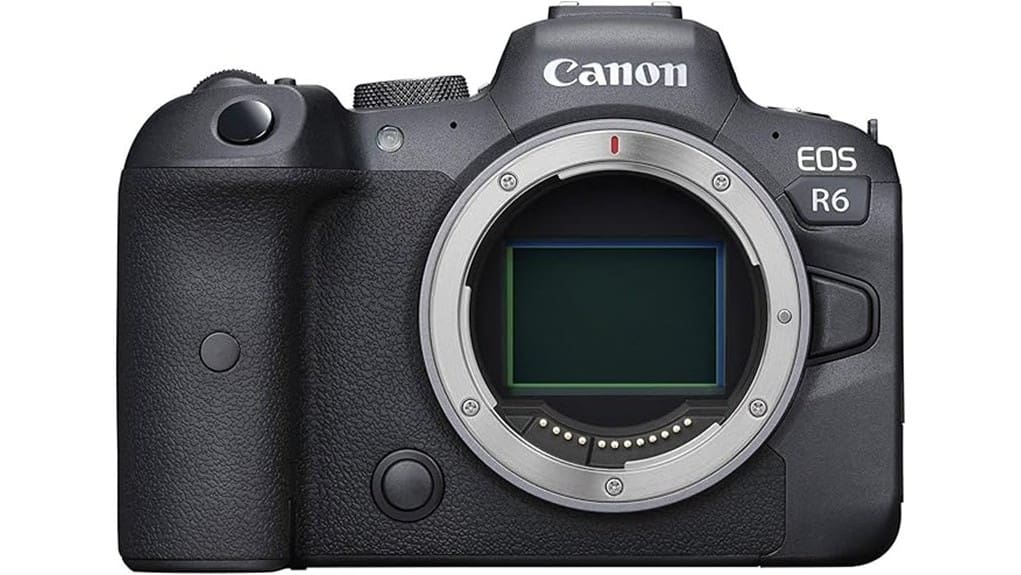
You’ll find the EOS R6 is a compact, action-ready full-frame mirrorless that favors low-light IQ, speed, and reliable Dual Pixel AF over megapixel count. It gives you a 20MP sensor, 5-axis IBIS, 4K60 10-bit capture and up to 20 fps electronic bursts, plus broad AF coverage and strong tracking for wildlife and sports. Handling is ergonomic and travel-friendly, with dual cards and weather sealing. Keep going and you’ll get deeper on pros, limits and alternatives.
Some Key Takeaways
- Excellent low-light image quality and 20 MP sensor with DIGIC X deliver clean files and wide dynamic range at base ISO.
- Dual Pixel CMOS AF II covers ~100% frame with 1,053 AF zones and reliable subject tracking for stills and video.
- 4K60 10-bit 4:2:2 capture with Canon Log enables professional-grade color grading and flexible workflows.
- 5-axis IBIS plus fast RF lenses provides up to eight stops of stabilization for handheld shooting.
- Compact, weather-sealed body with 12 fps mechanical/20 fps electronic burst rates and dual card slots for reliability.
What the EOS R6 Delivers Up Front: Key Specs and Real-World Snapshot
Kick off with the essentials: the EOS R6 pairs a 20 MP full-frame CMOS sensor and DIGIC X processor to deliver image quality and speed that rival higher-tier bodies like the EOS-1D X Mark III, but in a much smaller, more versatile package. You’ll get native ISO 100–102,400, 10-bit capture options, and 4K60 video—technical specs that justify professional use. The 5-axis IBIS and dual card slots increase reliability, while weather sealing protects shoots outdoors. Evaluate handling: the articulating screen’s touchscreen responsiveness is excellent, and the compact body trades some resolution for superior low-light performance and agility. The site also offers essential accessories for mirrorless photographers, like mirrorless camera gear to enhance shooting experiences.
Autofocus, Speed, and Tracking: How Well It Performs for Action and Wildlife?
Pushes tracking performance to a professional level: the R6’s Dual Pixel CMOS AF II covers roughly 100% of the frame with 1,053 AF zones and a phase-detection hybrid system that nails fast-moving subjects with minimal hunting. You’ll appreciate predictable Continuous AF tuning that adapts to erratic motion—useful for birds and charging mammals. With up to 20 fps electronic and 12 fps mechanical, buffer depth and write speeds limit burst duration compared to flagship bodies, but real-world hit rates remain high. Low light tracking is strong thanks to sensor/processor pairing and IBIS, outperforming many APS-C rivals in challenging conditions. Gear Guide for Enthusiast Photographers and Camera Fans offers related accessories and lenses for maximizing the R6’s capabilities, including recommendations for camera accessories to support action and wildlife shooting.
Image and Video Quality: 20MP Stills, 4K60, and Low-Light Performance
The R6’s tracking and burst capabilities set expectations for image fidelity and motion handling, and the sensor/processor pairing largely delivers: its 20‑megapixel full‑frame CMOS and DIGIC X produce clean, detailed stills with wide dynamic range at base ISO, while 4K60 video captures smooth, high‑resolution motion with 10‑bit 4:2:2 Canon Log for grading. You’ll notice excellent low‑light performance: noise control through high native ISO, retaining shadow detail better than many 24MP competitors. Color science yields pleasing skin tones straight from camera, and flexible bitrate options plus dual‑card recording support professional codecs and post workflows. For maintaining that image quality over time, using a dedicated cleaning kit with sensor cleaning tools helps prevent dust and smudges that can affect both stills and video.
Handling, Stabilization, and Battery Life: Usability for Shooters on the Move
Balance the R6 in one hand and you’ll immediately notice how its compact, body-only RF design blends professional ergonomics with travel-friendly weight, making it easier to shoot for extended periods than many bulkier full-frame options. You’ll appreciate the ergonomic grip and concise button layout that keep controls under your fingers during long walks or fast action. The 5-axis IBIS pairs with fast RF optics for up to eight stops of stabilization, outperforming many rivals. Battery life is adequate for a day’s shooting; pairing a Pocketable kit of spare batteries and Ride ready straps makes multi-hour, mobile workflows reliable. If you’re often shooting on the go, consider a backpack built specifically for camera gear with dedicated compartments for the camera, lenses, and accessories to keep everything organized and protected, including roomy pockets for camera backpacks.
Value Decision: Who Should Buy the EOS R6 and Which Alternatives to Consider
Who should actually buy the EOS R6, and when does it make more sense to pick something else? If you prioritize low-light IQ, reliable Dual Pixel AF, IBIS with up to 8 stops, and 4K60 video, the R6 is a technically strong, versatile choice for professionals and serious enthusiasts. You should consider it when sensor performance and subject tracking outweigh resolution needs. If you need higher megapixels, lower cost, or extensive third‑party lenses, evaluate budget alternatives like used Canon APS-C or full‑frame mirrorless bodies and Sony/ Nikon options. Also weigh future compatibility with RF glass and CFexpress workflows before committing. For photographers who regularly transfer large numbers of high-resolution photos and video, investing in a fast memory card reader can significantly speed up your workflow.
Some Questions Answered
Does the R6 Support In-Camera Focus Stacking?
No — the R6 doesn’t offer true in-camera focus stacking; it provides focus bracketing instead. You can set focus bracketing parameters (number of shots, step size) and the camera captures sequential frames, but it won’t merge them into a single stacked image internally. You’ll need external software to perform focus stacking. Compared to some competitors with built-in stacking, the R6 favors capture flexibility and reliance on post-processing for final depth-of-field blending.
Can It Record RAW Video or RAW Timelapse Internally?
No, it can’t record raw video internally, and it can’t do raw timelapse internally either. You’ll get internal 4K60 and Full HD120 in 10-bit 4:2:2 Canon Log or HDR-PQ, plus high-quality MJPEG/MP4 options, but true RAW output requires external recorder via video out. For timelapse, the camera makes high-quality JPEG/RAW still sequences you can assemble and export as RAW timelapse in post, but not native raw timelapse capture.
Is There Any Built-In GPS or Geotagging?
No, there’s no built in GPS; you won’t get onboard satellite tagging. You can, however, achieve geotagging via ethernet or by pairing the camera with a GPS-enabled smartphone over Wi‑Fi/Bluetooth to embed location metadata. Technically, that’s less convenient and slightly less reliable than integrated GPS, but functionally comparable for most workflows. If precise, standalone tracking is critical, consider cameras with native GPS or dedicated GPS loggers for superior consistency.
What Weather-Sealing Level Does the Body Have?
The body offers professional-grade weather sealing with robust dust resistance and splash/moisture protection, though Canon doesn’t publish an IP rating. You’ll get sealed joints, gaskets around ports and buttons, and a reinforced mount—comparable to other pro-level mirrorless bodies but slightly less documented than some ruggedized models. In practice it’s highly reliable for outdoor work, yet you shouldn’t treat it as fully waterproof or for prolonged immersion.
Are There Limitations With Third-Party RF Lens Autofocus?
Yes — you’ll see limitations with third party RF lenses’ autofocus compatibility. Third party manufacturers sometimes lag on firmware updates, so autofocus speed, eye/animal detection and continuous tracking can be degraded compared with Canon glass. That’s due to differences in implemented communication protocol and proprietary AF tuning. Compare models and firmware histories; newer third party lenses often improve, but expect variability in reliability, latency, and feature parity until vendors fully match Canon’s protocols.